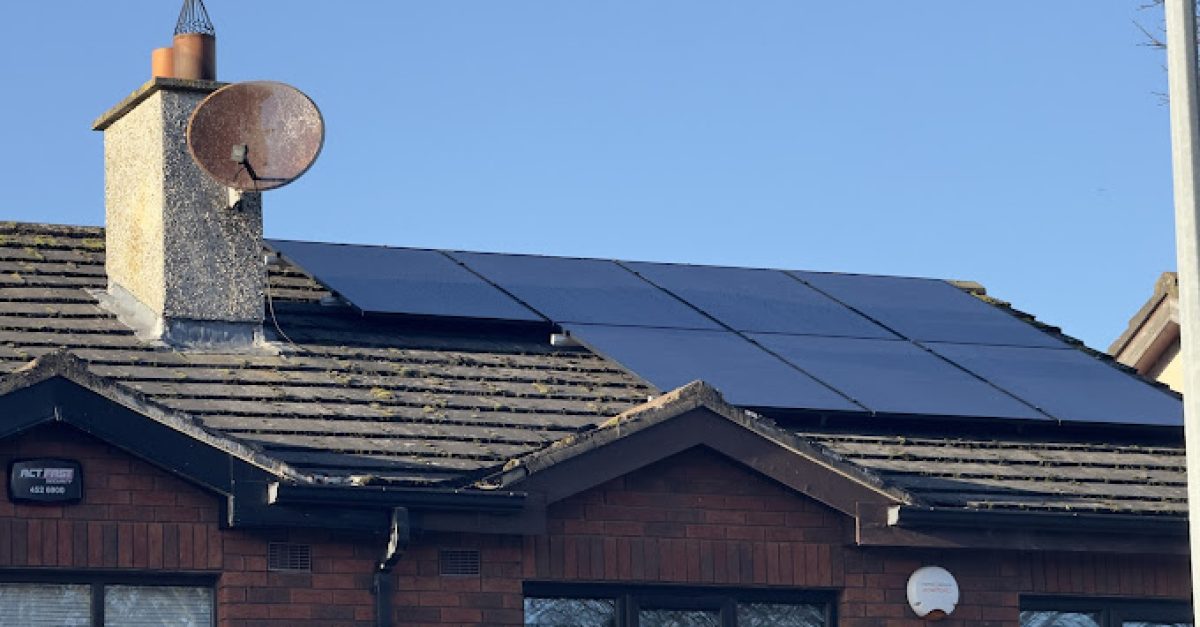
An eight-panel solar installation can be a practical starting point for an Irish home looking to generate renewable electricity without filling the entire roof. With common panel ratings around 400 watts, eight panels form a system of roughly 3.2 kWp. A recent Irish market example estimates that an eight-panel, 3.2 kWp system could generate around 2,800 kWh of electricity per year. Actual output depends on location, roof direction, slope, shade, panel specification and system losses.
In 2026, one published Irish example puts the cost of an eight-panel system at about €6,450 before the SEAI grant, or approximately €4,810 after an assumed €1,640 grant. A battery adds to the upfront price. Indicative battery prices vary significantly by capacity and installation, with one Irish supplier guide estimating around €1,700–€3,000 for a 5 kWh battery. The SEAI currently lists a separate €600 grant for a qualifying battery, subject to its rules.
These are guide figures, not a fixed national price. An actual quotation may be higher or lower depending on equipment, roof access, inverter choice, electrical work, battery size and tariff. The figures below explain what an eight-panel solar PV system with battery may offer and how to judge whether the investment suits your household.
How much does an 8-panel solar system with a battery cost in Ireland?
An 8 panel system is usually described by its total peak capacity, not panel count alone. For example, eight 400 W panels equal 3.2 kWp. If panels are rated at 450 W each, eight panels equal 3.6 kWp. This affects the system’s potential generation and, up to the grant cap, the SEAI solar PV grant amount.
A 2026 Irish cost example lists an eight-panel, 3.2 kWp system at €6,450 including panels and installation. It estimates a grant of €1,640, producing an illustrative net price of €4,810 before any battery. This particular example is a market guide, not a guarantee for every property.
Battery prices depend on usable capacity, battery chemistry, inverter configuration and whether the system is installed together with the panels or retrofitted later. An Irish energy supplier reports that a 5 kWh battery may cost around €1,700–€3,000 on average, while its broader range for batteries is €1,500–€7,000. The SEAI page lists a €600 battery grant in addition to the standard PV grant, where eligibility requirements are met.
Using these published examples, an eight-panel system plus a 5 kWh battery could have an indicative installed price around €8,150–€9,450 before grants, if the PV cost is €6,450 and the battery costs €1,700–€3,000. After an assumed €1,640 PV grant and €600 battery grant, the illustrative net cost would be roughly €5,910–€7,210. Treat this as a ballpark calculation only: the PV example’s grant calculation and a separate battery quote may not align with every installer’s package, and individual eligibility must be confirmed with SEAI before work begins.
What SEAI grant is available in 2026?
For standard eligible residential installations, SEAI lists a solar PV grant of €700 per kWp for the first 2 kWp, followed by €200 for each additional kWp up to 4 kWp. The maximum standard PV grant is €1,800. SEAI also lists a €600 grant for an eligible battery. The grant calculation is based on system capacity rather than simply the number of panels.
For example, a 3.2 kWp system would have a calculated PV grant of €1,640 under the listed rate: €1,400 for the first 2 kWp plus €240 for the next 1.2 kWp. A 3.6 kWp system would calculate to €1,720. The grant applies only within the scheme rules. The current SEAI information says eligible homes must have been built and occupied before 2025 and must meet other criteria. Grant approval must be in place before installation works start. Check the current SEAI page directly because rules can change.
Some homeowners may qualify for enhanced grant support. Those programmes have their own eligibility conditions and limits, so don’t assume that a higher grant applies to every household.
Expected output from eight solar panels
SEAI’s homeowner guide gives a benchmark of about 2,600 kWh per year for a well-located 3 kW home solar PV system in Ireland. A 3.2 kWp array would therefore have an approximate annual output in the region of 2,700–2,800 kWh, depending on conditions. A separate 2026 Irish market example uses 2,800 kWh per year for an eight-panel, 3.2 kWp system.
This is an annual estimate, not a promise that the system will generate the same amount every month. Solar PV produces electricity during daylight and tends to generate most around the middle of the day. SEAI notes that roughly 75% of annual PV electricity in Ireland is produced between May and September. Winter output is lower because days are shorter and sunlight is weaker.
A south-facing roof with little shade usually provides strong annual production. East- or west-facing panels can still work well, and their production may align better with morning or evening electricity use. Shading from trees, chimneys or nearby buildings can reduce output. The European Commission’s PVGIS tool estimates site-specific PV production using location, system power, roof angle, orientation, technology and system losses.
What does a solar battery add?
Solar panels often generate more power than a home is using at a particular moment. Without a battery, surplus electricity can be exported to the grid. With a battery, some of that excess electricity can be stored and used later, such as in the evening when the panels are no longer producing much power.
A battery can increase self-consumption, which means using more of the solar electricity produced at home rather than importing electricity later. It may be especially useful for households that are out during the day, use more electricity in the evening, or have appliances such as an electric vehicle charger or heat pump. A battery’s financial value depends on its cost, usable capacity, round-trip efficiency, electricity tariff and the payment received for exported power.
A battery is not automatically the most economical choice. If the household uses a lot of electricity during daylight hours, it may already use much of the solar generation directly. If the export payment is attractive, exporting excess power may also be financially reasonable. Compare the value of storing electricity for later against the payment available for sending it to the grid.
Battery storage should not be confused with guaranteed backup power. A standard grid-connected solar system normally shuts down during a power cut for safety. Backup operation requires suitable inverter equipment and a system configured to operate independently from the grid; confirm this explicitly when requesting a quote.
Main benefits of an 8-panel system with battery
Lower electricity imports
The panels can supply some of a home’s electricity during daylight, reducing the amount that must be bought from the supplier at those times. A battery can shift some of that solar energy into the evening or night. Savings depend on the home’s consumption pattern and electricity prices.
Better use of energy produced at home
Storing surplus can help households use more of their own solar generation. This can be useful when the home’s peak electricity use happens after sunset. Smart controls can further help by running flexible appliances, hot-water heating or EV charging when solar production is available.
Export payments for surplus generation
If the battery is full or the system is producing more electricity than the home can use, surplus power may be exported to the grid. Ireland’s Commission for Regulation of Utilities explains that suppliers pay customers for metered electricity exported under the Clean Export Guarantee arrangements. The rate depends on the supplier and tariff, so check the current offer and the payment terms when doing a financial comparison.
Reduced household emissions
Solar PV generates electricity without burning fuel at the home. Using that electricity can reduce reliance on grid electricity and associated emissions, depending on the generation mix and timing. A battery can help shift more of the solar energy to later household use, although it also adds cost and equipment to the system.
More control over energy use
A monitoring app or smart meter can show when the home is generating, importing, storing and exporting electricity. This makes it easier to shift some flexible demand into brighter hours and understand whether the battery is being used effectively.

How to decide if a battery is worth the cost
Start with your household’s electricity data. Review smart-meter or bill information to see when you use electricity and how much you export. If most of your use occurs after sunset, storage may help increase self-consumption. If the home is active during the day, direct use may reduce the need for a large battery.
Ask the installer for quotes both with and without a battery. Compare the expected annual import reduction, export payment, battery capacity, usable energy, warranty, expected degradation and inverter compatibility. Be wary of a payback estimate that assumes every stored unit replaces a high-price unit without accounting for conversion losses or battery cycling limits.
It is also useful to ask whether the battery can charge from the grid on a time-of-use tariff. Some systems allow it, which may help shift consumption away from expensive periods. The financial case depends on tariff rules and system controls, and it should be calculated rather than assumed.
What affects the final installation price?
The final quote for eight panels and a battery can change according to panel wattage, inverter type, battery capacity and brand, roof condition, scaffolding, cable routes, consumer-unit upgrades and the complexity of the electrical installation. A hybrid inverter may be appropriate for a new solar-and-battery installation. A retrofit battery may need an AC-coupled configuration or a change of inverter.
The installer should also assess roof orientation and shading, check the electrical connection and confirm how the system will be registered for grid export. SEAI advises homeowners to obtain multiple quotes from registered installers and ask how much electricity the system is expected to produce each year, what the total cost includes, and what maintenance and warranties apply.
Is an 8-panel solar battery system right for your home?
An 8 panel system can be a useful option where roof space, budget or household demand does not call for a larger array. It may suit a home that wants to reduce daytime electricity imports and store some surplus for later. But panel count alone does not determine whether it is the right size. The installer should compare system capacity with annual use, daytime occupancy, roof production and future needs such as an EV or heat pump.
Before signing, request a clear quotation showing the gross price, grant assumptions, net cost, estimated annual production, expected self-consumption, export payment assumptions and battery specifications. Confirm the grant offer before work begins. Use SEAI’s solar calculator or PVGIS for an independent estimate based on the home’s location and roof orientation.
Frequently Asked Questions
1. How much does an 8-panel solar system with a battery cost in Ireland in 2026?
A published Irish example prices an 8 panel, 3.2 kWp system at about €6,450 before grants and €4,810 after an assumed €1,640 grant. A 5 kWh battery is estimated at around €1,700–€3,000, with a separate €600 SEAI battery grant potentially available to eligible households. As an indicative calculation, the complete system might net around €5,910–€7,210 after these example grants, but actual quotes and eligibility vary.
2. How much electricity can eight solar panels produce per year?
Eight panels rated at 400 W each make a 3.2 kWp array. An Irish market example estimates around 2,800 kWh per year, while SEAI’s guide gives about 2,600 kWh for a well-located 3 kW system. Actual output depends on location, roof direction, slope, shade and equipment.
3. Is a battery necessary with eight solar panels?
No. A solar PV system can operate without a battery. A battery stores surplus daytime electricity for later use, which may help households whose electricity use peaks in the evening. Compare the extra cost with the value of self-consumption and the export payment available from your supplier.
4. What SEAI grant can I get for solar panels and a battery?
SEAI currently lists up to €1,800 for solar PV systems of up to 4 kWp, with the amount calculated according to system capacity, plus a €600 grant for an eligible battery. Eligibility requirements apply, and grant approval must be in place before work starts. Check SEAI’s current rules before budgeting.
5. Can a solar battery power my home during a power cut?
Not necessarily. A typical grid-connected system shuts down during a grid outage for safety. Backup power requires a compatible inverter and a system configured for islanded operation. Ask the installer which circuits can be powered and how long the battery is expected to last during an outage.