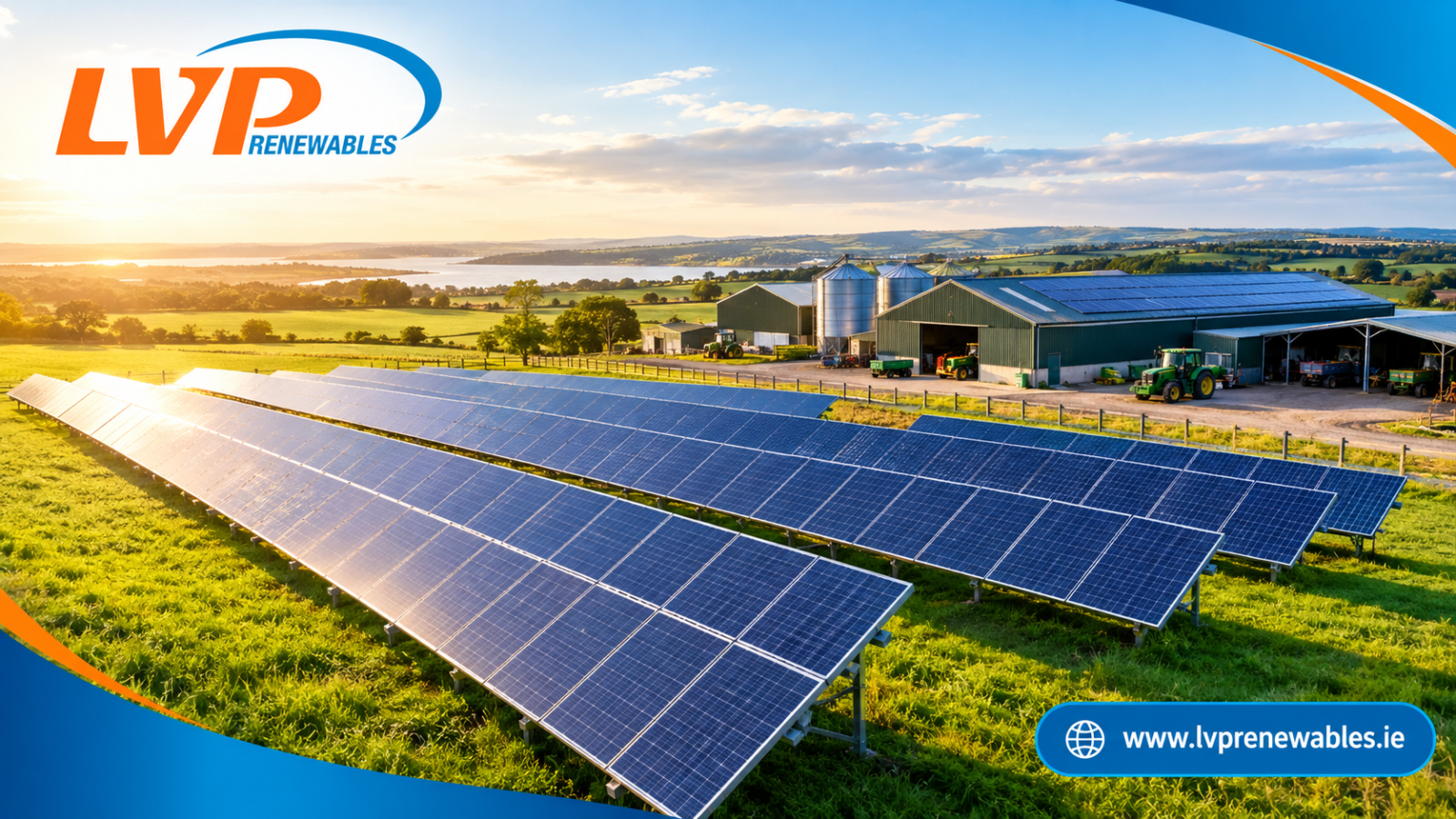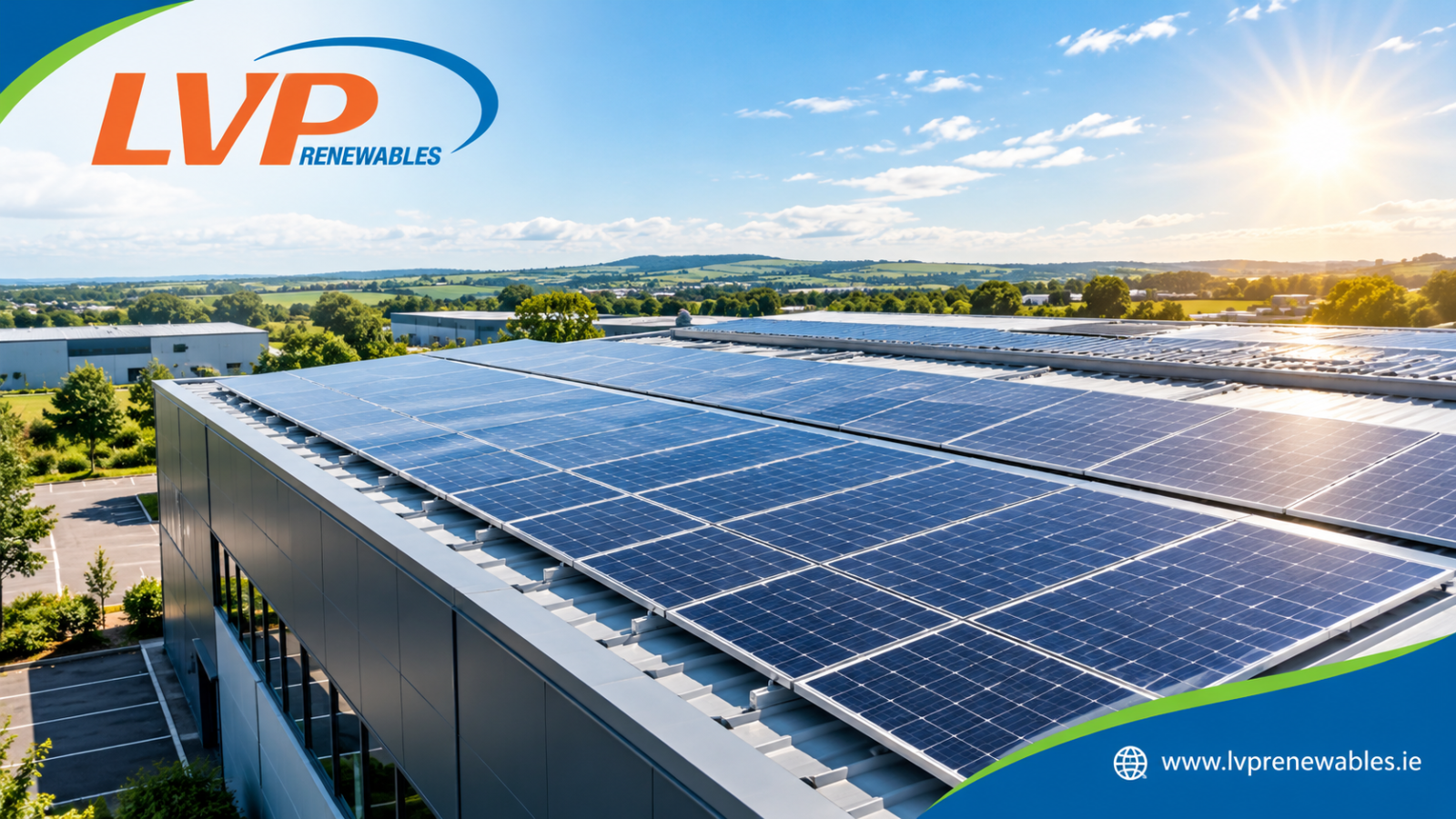
125-panel solar PV system may suit farms, warehouses, factories, retail premises and other Irish businesses with daytime electricity use. It provides 50–62.5 kilowatt-peak (kWp), depending on panel rating. The 125 solar panels cost and return depend on site design, roof condition, demand and grant eligibility.
SEAI’s broad yield benchmark suggests a well-positioned 50kWp array could generate about 43,300 kilowatt-hours (kWh) annually. This is an estimate, not a guarantee.
System Capacity: 400W, 450W and 500W Panels
Adding each panel’s rated wattage gives system capacity in kilowatt-peak (kWp); kilowatt-hours (kWh) measure generation over time.
•125 × 400W panels: 50kWp.
•125 × 450W panels: 56.25kWp.
•125 × 500W panels: 62.5kWp.
An array will not produce its rated capacity continuously. Match its size to building demand, ideally using interval meter data.
125 Solar Panels Cost in Ireland
Irish commercial cost guides vary LVP quotes €850–€2,000 per kWp, while another 2026 guide lists a standard 50kWp rooftop installation at €40,000–€55,000 before grants. Using €850–€1,700 per kWp gives a broad €42,500–€106,000 estimate for 50–62.5kWp. This is not a site quotation.
The final 125 solar panels cost depends on panel and inverter choices, mounting, labour, scaffolding, roof condition and electrical work. Roof reinforcement or grid upgrades add cost; batteries are separate. Request an itemised quote showing capacity, yield, equipment, VAT and grant assumptions. See LVP’s commercial solar PV service.
Commercial Solar Electricity Output
SEAI estimates that a well-located 3kW system in Ireland produces about 2,600kWh annually, equivalent to approximately 867kWh per kWp. Applying this benchmark to the three panel options gives:
•50kWp: about 43,300kWh a year.
•56.25kWp: about 48,750kWh a year.
•62.5kWp: about 54,200kWh a year.
These are not forecasts. About 75% of Irish solar output comes from May to September. Location, orientation, tilt, shade, cloud, panel efficiency and system losses affect production. Ask for site-specific modelling, such as European Commission PVGIS.
Roof Space and Building Suitability
SEAI’s example of 75 panels across 125m² scales to about 208m² of panel surface for 125 similar-sized modules. Actual dimensions vary.
Allow additional usable area for access, rooflights, vents and maintenance. A commercial guide’s 4.5m² per kWp implies 225–281m² for 50–62.5kWp. Survey roof strength, condition, wind loading and safe access.
Commercial Electricity Savings and Export Income
Solar used on site avoids grid purchases. Farms may run milking, refrigeration, pumps and workshops in daylight; warehouses, factories, hotels and shops have their own load profiles. Timing matters as much as annual use.
Illustration: a 50kWp system generates 43,300kWh yearly. At 65% self-use (28,167kWh) and an assumed import price of €0.30/kWh, bill savings are €8,450. Exporting the other 35% (15,167kWh) at €0.15/kWh earns €2,275. Combined example value: €10,725 a year.
Prices and the 65/35 split are assumptions. Results depend on meter data and supplier terms. CRU says export payments are based on metered units and the supplier’s rate; keep export income separate from bill savings.
Commercial Battery Storage
A battery shifts daytime surplus to evening or overnight use. Size its capacity to the operating schedule and available surplus. It adds cost and charging losses, so compare avoided later grid purchases with foregone export payments.
The SEAI Non-Domestic Microgen Grant does not cover batteries or other supplementary equipment. Farmers should check TAMS 3 terms separately, as grant eligibility differs by scheme.

SEAI Commercial Solar Grants
The SEAI Non-Domestic Microgen Grant (NDMG) supports eligible farms, businesses and other non-domestic applicants for PV up to 1,000kWp. New applications from 6 October 2026 to 6 July 2027 receive the lower of the capacity-band grant or 45% of eligible invoiced costs; existing offers are not increased.
Indicative current grant values are €25,200 for 50kWp, €27,700 for 56.25kWp and €30,200 for 62.5kWp, subject to the 45% cap and approval. Premises must have been built and occupied by 31 December 2024. Apply before starting or buying materials, use an SEAI-registered company, complete within eight months and design for on-site demand. Support is once per MPRN.
Farmers may compare TAMS 3’s Solar Capital Investment Scheme: 60% of eligible investment up to €90,000 per holding. Reference-cost and selection rules apply, and it should not be assumed to stack with NDMG on the same investment. Check current terms.
Commercial Solar Payback Period
Assume a €70,000 50kWp installation receives the €25,200 NDMG grant. Net cost is €44,800; divided by the example’s €10,725 annual value, simple payback is about 4.2 years. Grant eligibility and the invoice cap apply.
This excludes finance, maintenance, inverter replacement, degradation and price changes. Lower self-use, output or grant support lengthens payback. Treat it as a scenario, not a promised return.
Benefits for Irish Businesses and Installation Process
A suitable solar PV system can cut grid purchases, reduce exposure to price changes, use roof space and lower emissions from imported electricity. Benefits depend on generation, self-use and site suitability.
Installation begins with bills or half-hourly data and a site survey. The installer assesses the roof and shading, designs the array, checks grid requirements, then installs, commissions and sets up monitoring. Obtain grant approval first.
Comparing 100, 125 and 150 Panels
For comparison, assume 400W panels, 867kWh per kWp and €850–€1,700/kWp. 100 panels: 40kWp, 34,700kWh/year, 180m² roof, €34,000–€68,000. 125: 50kWp, 43,300kWh, 225m², €42,500–€85,000. 150: 60kWp, 52,000kWh, 270m², €51,000–€102,000. Site design changes costs.
Maintenance and Long-Term Performance
Monitor output and check inverter and meter operation. Clean panels only where soiling materially reduces output, following installer advice. Check equipment and workmanship warranties; SEAI notes that an inverter may need replacement during the system’s life.
FAQs
How much does a 125-panel solar installation cost in Ireland?
A 50–62.5kWp commercial installation has a broad indicative cost of €42,500–€106,000 before grants using current published per-kWp ranges. A site survey is needed for a firm quotation.
How much electricity can 125 solar panels generate annually?
Using SEAI’s broad yield benchmark, 50–62.5kWp may produce approximately 43,300–54,200kWh a year in suitable conditions.
How much roof space is required for 125 solar panels?
Allow roughly 225–281m² of usable roof for a 50–62.5kWp layout. The exact space depends on panel dimensions, roof obstructions and access requirements.
How long does it take for a 125-panel commercial solar system to pay back?
There is no fixed period. The worked example gives about 4.2 years after an assumed grant, but actual payback changes with installed price, generation, self-use, export rates and grant eligibility.
Conclusion
A 125-panel array can provide 50–62.5kWp, with an estimated annual output of around 43,300–54,200kWh. The 125 solar panels cost depends on site-specific electrical and roof work as well as equipment. Match the system to measured demand, confirm current grant rules and treat savings and payback as estimates.
For a tailored commercial solar assessment and installation quotation, visit LVP Renewables or contact the LVP team.