75-panel solar PV system may suit a farm, large property or business with high electricity use and adequate roof space. At 400–500 watts (W) each, the panels make a 30–37.5 kilowatt-peak (kWp) array. The 75 solar panels cost, roof strength, grid connection and daytime demand all need careful assessment.
A well-positioned 30kWp system could generate about 26,000 kilowatt-hours (kWh) a year using SEAI’s broad yield benchmark. Actual output and savings depend on the site; figures below are estimates, not a quote or guarantee.
What Capacity Do 75 Solar Panels Provide?
Solar PV panels convert daylight into direct-current (DC) electricity. An inverter converts it into alternating-current (AC) power used by equipment on site. Panel wattage is each module’s rated output; kilowatt-peak (kWp) is the total rated capacity of the array. Electricity produced over time is measured in kWh.
•75 × 400W panels: 30kWp.
•75 × 450W panels: 33.75kWp.
•75 × 500W panels: 37.5kWp.
SEAI describes a typical 30kWp installation as around 75 panels. A 30kWp array does not generate at full capacity all day; output changes with daylight, weather, shading and equipment.
How Much Electricity Could 75 Solar Panels Generate?
SEAI estimates that a well-located domestic system of about 3kW can generate roughly 2,600kWh annually. That works out at about 867kWh per kWp as a broad planning benchmark. Applying it to these larger system sizes gives:
•30kWp: about 26,000kWh a year.
•33.75kWp: about 29,300kWh a year.
•37.5kWp: about 32,500kWh a year.
These are estimates, not a guarantee. SEAI says around 75% of Irish solar generation occurs from May to September. Location, roof direction and tilt, cloud, shading, inverter sizing and electrical losses affect output. Use site-specific modelling such as the European Commission’s PVGIS for a design estimate.
75 Solar Panels Cost in Ireland
Irish commercial solar cost guides show a wide range—roughly €900–€1,700 per kWp installed, depending on system scale, roof and electrical complexity. Applying that range gives a broad PV-only estimate of around €27,000–€64,000 before grants for a 30–37.5kWp array. This is a market-based calculation, not a fixed price or an LVP Renewables quotation.
The final 75 solar panels cost varies with panel and inverter choices, roof type and condition, mounting, scaffolding, labour, electrical upgrades and grid works. Batteries, EV chargers and hot-water diverters cost extra. Ask for an itemised quote with equipment, capacity, yield and grant assumptions, and VAT treatment. See LVP’s commercial PV service.
How Much Roof Space Is Needed?
SEAI’s 30kWp example—approximately 75 panels—uses around 125m² of area. Treat this as a useful reference, not a guaranteed layout for every 400–500W module. Actual dimensions differ, and higher-wattage panels may have a different footprint.
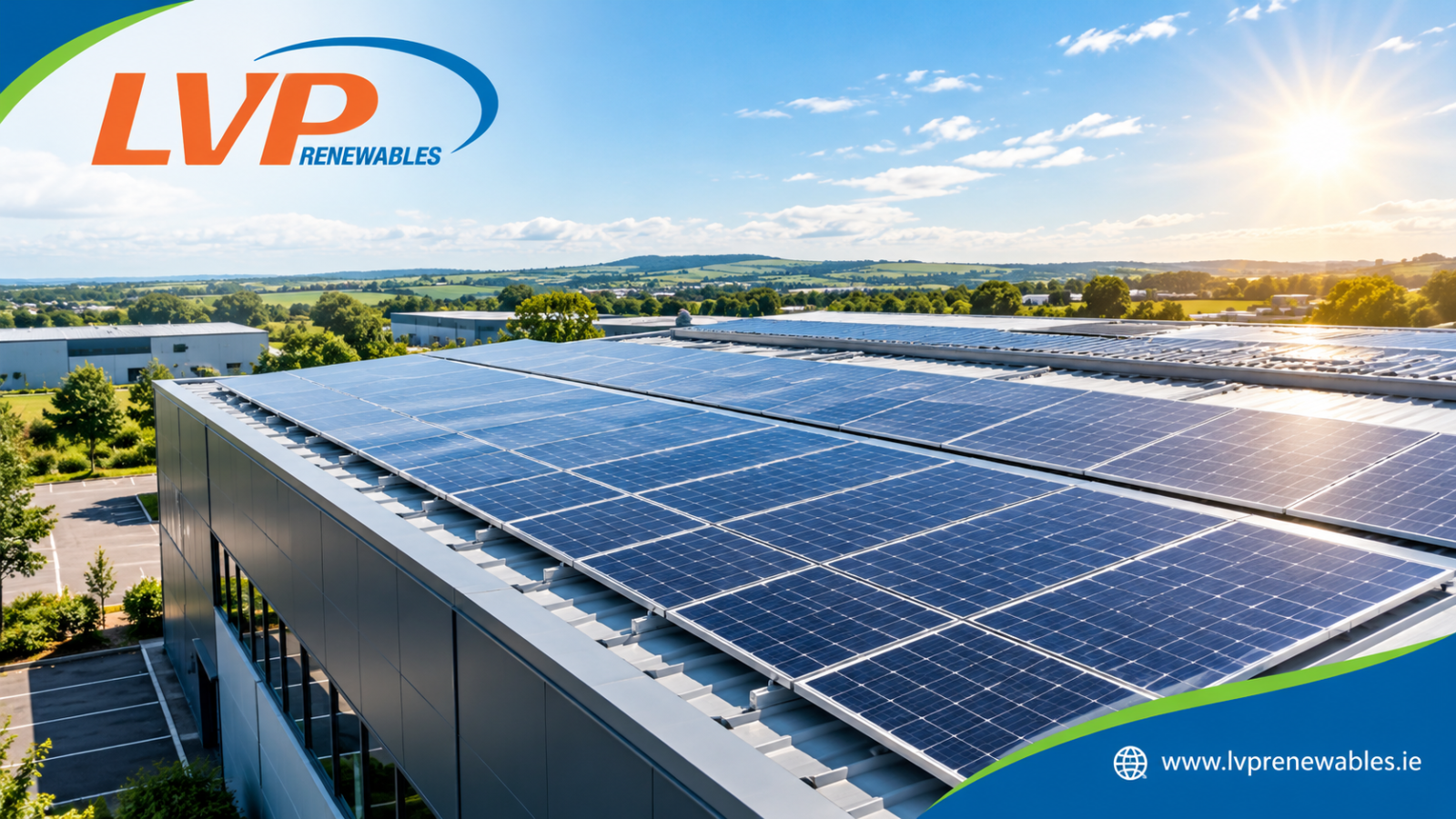
Farm sheds, barns and warehouses also need suitable roof strength and remaining service life. Rooflights, vents, ridges, gutters, shading, safe walkways and access can reduce usable space. SEAI’s business guidance recommends professional structural and wind-loading assessments for commercial arrays, and checking the roof condition before installation. A site survey should confirm the layout and suitability of the building.
How Can a Farm or Business Save on Electricity?
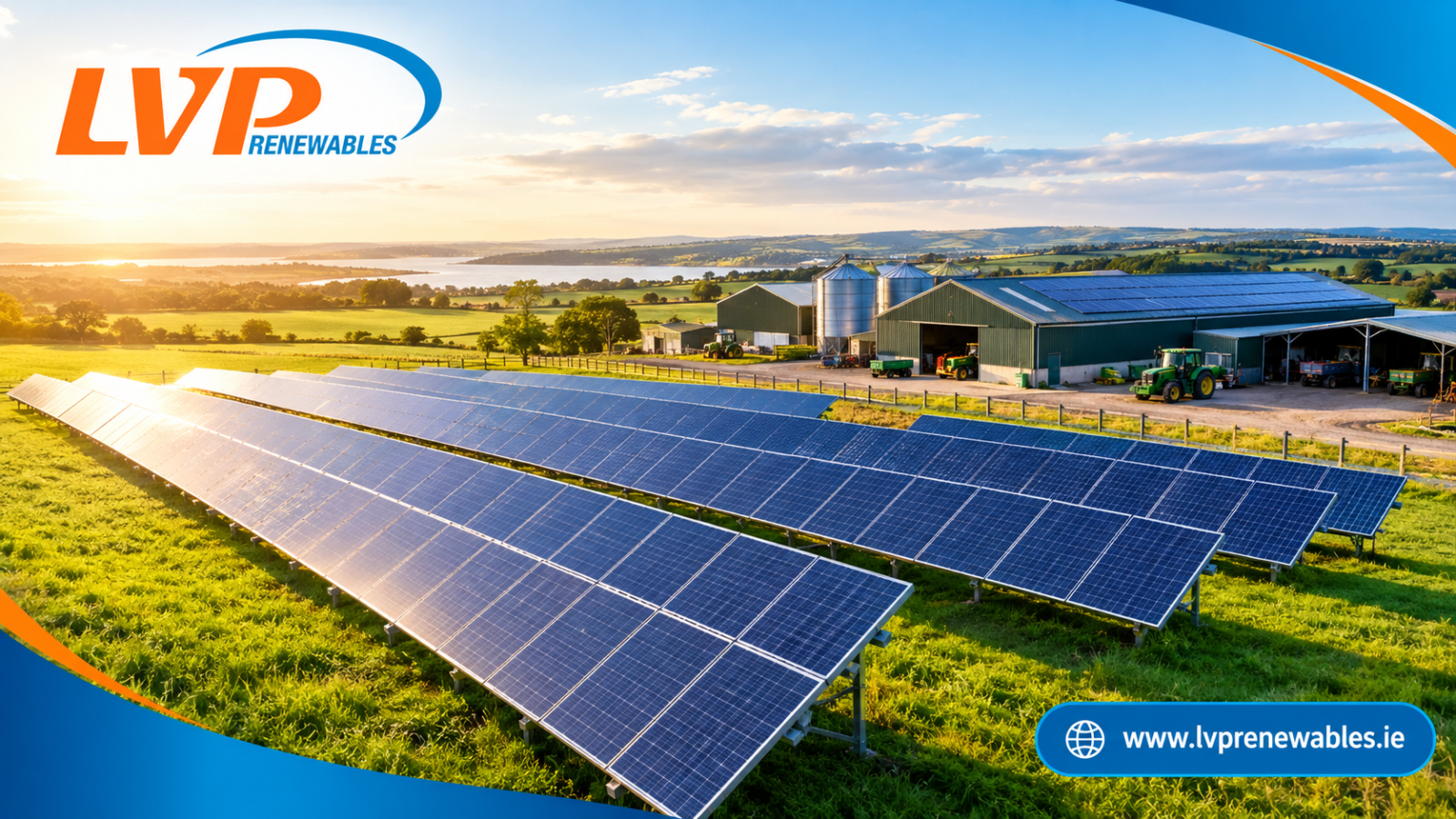
Solar power used as it is generated reduces electricity bought from the grid. Farms may have useful daytime loads such as milking equipment, milk cooling, refrigeration, ventilation, water pumps, workshops and processing. However, demand varies by farm type and season. A business that uses most power after daylight may export more generation than one operating during peak solar hours.
For example, assume a 30kWp system generates 26,000kWh annually, of which the site uses 60% directly (15,600kWh) and exports 40% (10,400kWh). At illustrative import and export rates of €0.30/kWh and €0.15/kWh:
•Avoided grid purchases: 15,600 × €0.30 = €4,680.
•Export credit: 10,400 × €0.15 = €1,560.
•Combined illustrative annual value: €6,240.
These example rates and the 60/40 split are not guaranteed tariffs. Actual savings depend on load profile, output and supplier terms. Export credits are based on metered units and the supplier’s rate; the calculation values self-used and exported electricity separately.
Battery Storage and Energy Management
A battery can store surplus solar power for use later, which may improve self-consumption where evening demand is high. Its capacity should match the site’s load pattern and the amount of surplus available. Battery systems add capital cost and have charging and discharging losses, so compare their cost with the value of export payments or later grid purchases avoided.
SEAI’s business guide recommends sizing a PV system against electricity demand now and in the future. Reviewing electricity bills—and, where available, half-hourly meter data—helps identify when farm or business loads operate and whether 75 panels are appropriate.
SEAI Grants: NDMG and TAMS 3
SEAI’s Non-Domestic Microgen Grant (NDMG) supports eligible farms, businesses and other non-domestic premises with PV systems up to 1,000kWp. For new applications from 6 October 2026 to 6 July 2027, payment is the lower of the system-band grant or 45% of eligible invoiced costs. Existing offers are not uplifted.
Published example grant values are €17,200 for 30kWp, about €18,700 for 33.75kWp and €20,200 for 37.5kWp, subject to the 45% cap and approval. Batteries are not eligible under NDMG. The premises must have been built and occupied by 31 December 2024 applicants need an SEAI-registered company, approval before buying or starting, and completion within eight months. The system must support on-site consumption, not export only.
Farmers may compare TAMS 3’s Solar Capital Investment Scheme (SCIS), which pays 60% of eligible investment up to a €90,000 ceiling per holding (a maximum €54,000 before other limits). Applications can be ranked or selected, and later tranches limit solar support to on-farm use. SCIS and NDMG cannot be assumed to stack on one investment; check current rules and choose the applicable route.

Payback, Installation and System Size
If a 30kWp system costs €42,000 and receives the €17,200 NDMG example grant, the net cost is €24,800. Dividing by the example’s €6,240 annual value gives a simple payback of about four years. It is not guaranteed: grant eligibility, roof work, financing, maintenance, tariffs and actual self-consumption change the result. TAMS also uses eligible reference costs and selection rules.
A practical project uses recent bills or interval data, checks daytime loads and assesses the roof structure and wind loading. The installer then confirms system design, grid connection and grant eligibility, installs and commissions the array, and explains monitoring. Obtain grant approval before work begins.
At 400W per module, 50 panels make 20kWp, 75 make 30kWp and 100 make 40kWp. Choose among them based on measured demand, roof area and site constraints—not simply the largest array that fits.
FAQs
How much does a 75-panel solar system cost in Ireland?
A 30–37.5kWp commercial rooftop system has a broad indicative PV-only cost of €27,000–€64,000 before grant. Roof and grid complexity, equipment and optional storage change the final quote.
How much electricity can 75 solar panels generate annually?
Using SEAI’s broad benchmark, a 30–37.5kWp system may produce about 26,000–32,500kWh a year in suitable conditions. Actual output varies by site.
How much roof space is needed for 75 solar panels?
SEAI’s 30kWp, 75-panel example uses about 125m². The exact footprint depends on panel dimensions and the roof layout.
How long does it take for a 75-panel solar system to pay for itself?
There is no fixed period. The illustrative 30kWp example gives about four years after an assumed NDMG grant, but real payback depends on the grant, installed cost, self-use and export rates.
Conclusion
Seventy-five panels create a 30–37.5kWp array, with a broad estimated output of 26,000–32,500kWh annually and around 125m² as a reference roof area for a 30kWp example. Indicative commercial installation costs are approximately €27,000–€64,000 before grants. The right financial case depends on roof suitability, daytime consumption, current grant rules and the share of electricity used on site.
For a personalised assessment of your farm, business or large property, visit LVP Renewables or contact the team for a tailored commercial solar quotation.