A 500-panel PV project may suit farms, factories, warehouses and other sites with suitable roof or land and substantial electricity demand. Rooftop systems usually supply a premises behind its meter; a ground-mounted array may serve on-site use or export to the grid. Planning, connection and funding differ by project type. Design should start with site conditions, demand and grid capacity, not a panel target.
Capacity: 500 panels are not automatically 500 kW
Panel wattage determines the array’s direct-current capacity: 500 × 400 W = 200 kWp; 500 × 450 W = 225 kWp; 500 × 500 W = 250 kWp; and 500 × 550 W = 275 kWp. The kWp figure is the panels’ rated DC capacity. Inverter output is measured in AC kW or kVA and may be lower. The grid’s approved export capacity is a separate limit. Therefore, 500 solar panels do not automatically make a 500 kW system.
The examples below use 450 W modules: 225 kWp DC. The final panel and inverter selection depends on the site and connection offer.
500 solar panels cost in Ireland
For rooftop commercial PV, LVP Renewables publishes a broad installed-price guide of about €850–€2,000 per kWp. Applied to a 225 kWp system, this gives a preliminary range of €191,000–€450,000 before VAT. The wide range reflects site and scope differences; it is a budgeting guide, not a confirmed quotation.
The 500 solar panels cost varies with module and inverter choice, mounting, cabling, switchgear, protection, labour, scaffolding, monitoring, roof condition, electrical upgrades and grid works. Quote battery storage separately.
Ground-mounted projects add engineering, foundations, ground preparation, access tracks, fencing, drainage, equipment pads, planning or environmental fees and connection cabling. Land purchase or lease, legal costs and major network reinforcement may be extra. As a feasibility scenario only, allow €225,000–€500,000 before VAT for a 225 kWp ground array, excluding land and major reinforcement. This is not a market quotation; site engineering must refine it.
Annual electricity generation in Ireland
For an illustrative Irish yield range of 850–1,000 kWh per kWp per year, a 225 kWp array could produce 191,250–225,000 kWh (about 191–225 MWh) annually. At a midpoint of 950 kWh/kWp, the calculation is 225 × 950 = 213,750 kWh, or about 214 MWh. The European Commission’s PVGIS tool models monthly and annual output from a selected location and system configuration.
Output depends on location, orientation, tilt, shading, weather, system losses and availability. Irish winter days are shorter, so production varies by season. Compare a site-specific hourly yield forecast with the business’s consumption.
Roof area and land requirements
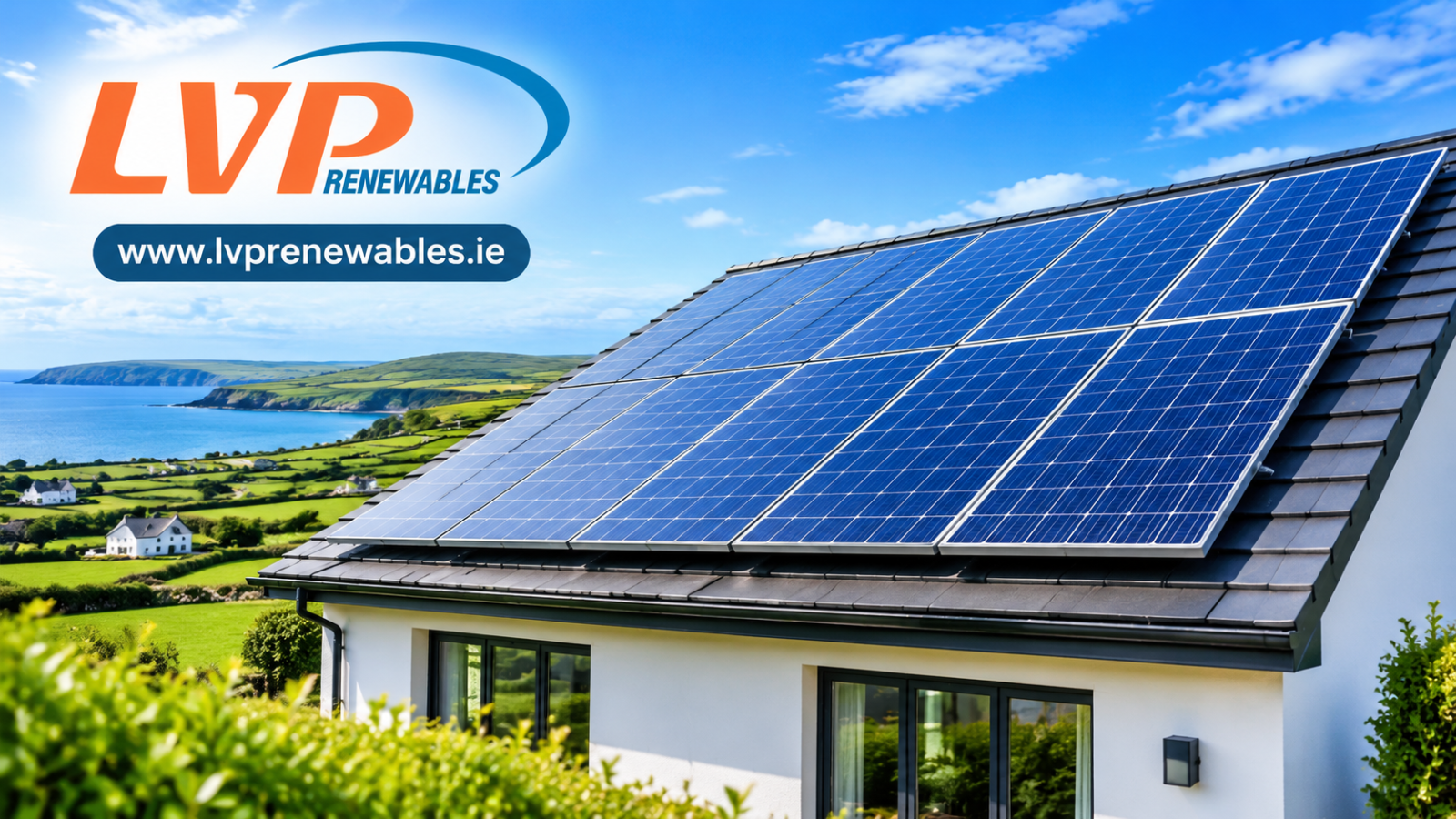
At about 2 m² per module, panels cover roughly 1,000 m². Allow around 1,300–1,600 m² of usable roof for edges, access, skylights, vents, drainage, fire clearances and maintenance. Dimensions and layout vary. Check shading, roof strength and remaining life, especially on older farm and industrial buildings.
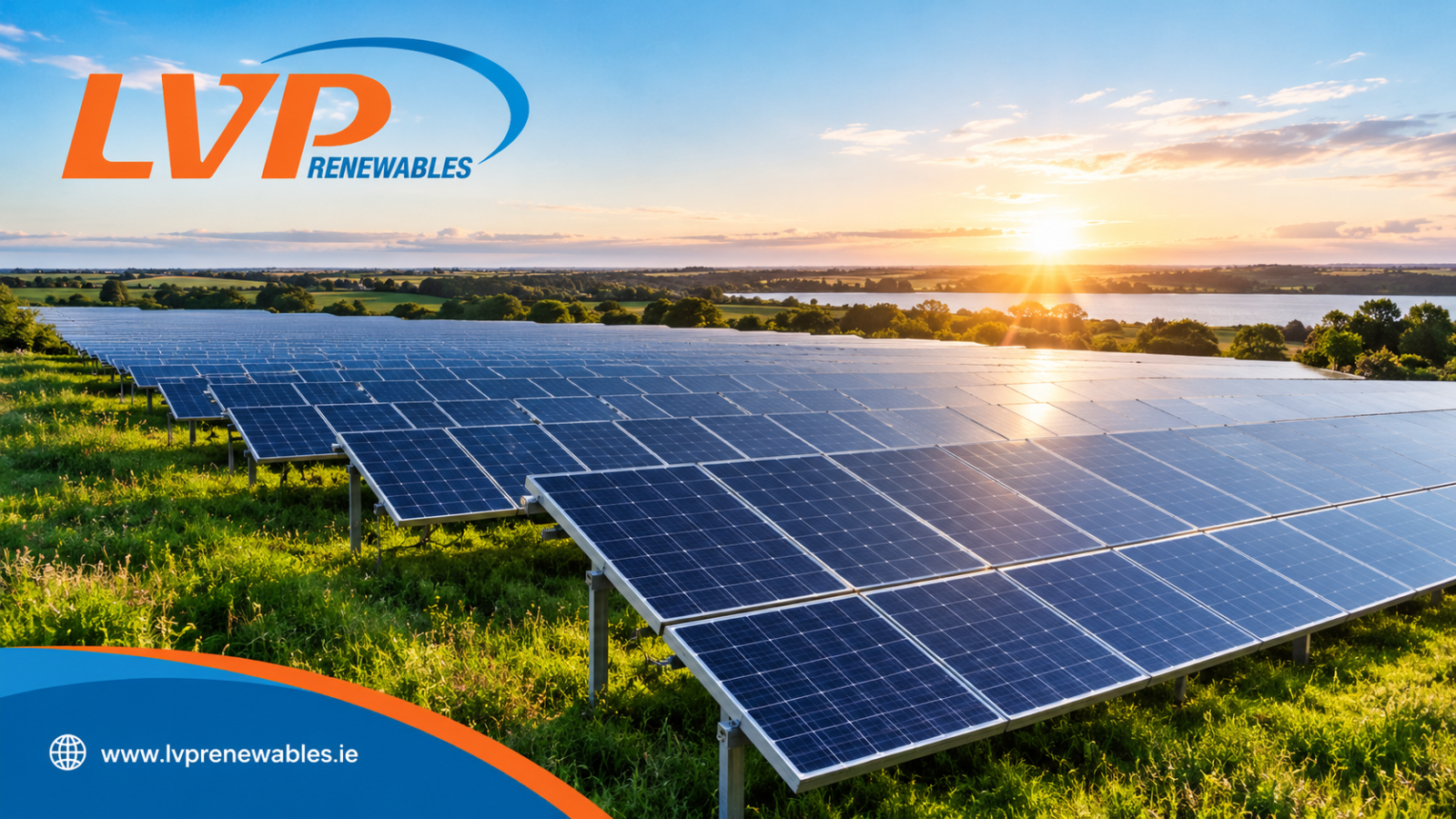
Ground arrays also need row spacing, roads, maintenance access, drainage, fencing and equipment space. Government guidance estimates about 0.1 ha for 50 kW and 1.5–2 ha for 1 MW; scaling the former to 225 kWp gives a rough 0.45 ha (1.1 acres) benchmark, not a site plan. Ground conditions may require more.
Savings, export income and battery storage
For example, assume 213,750 kWh annual generation, 65% self-consumption and an avoided import price of €0.22/kWh. On-site use is about 138,938 kWh, or €30,566 in avoided costs. The 74,813 kWh surplus would earn €7,481 at an illustrative €0.10/kWh export rate. Supplier terms vary; export income is separate from avoided purchases.
Production, refrigeration, pumps and EV charging can raise daytime self-consumption. A battery can shift surplus, but is not essential and may not improve ROI. Compare its capacity (kWh), power (kW), efficiency, life and price with the site’s demand and solar surplus; load shifting may cost less.
SEAI grants, export support and payback
The SEAI Non-Domestic Microgen Grant supports eligible self-consumption solar PV for businesses, farms and other listed non-domestic applicants, up to 1,000 kWp. As of October 2026, the enhanced application window runs from 6 October 2026 to 6 July 2027. At 225 kWp, the current stepped rates produce an indicative size-based grant of €92,700. Payment is limited to the lower of the amount shown on the application summary or 45% of eligible invoiced costs. Applicants must receive a grant offer before starting works and use an SEAI-registered company. Check current rules and eligibility before relying on support.
Export-only projects use a separate SRESS route, not the NDMG self-consumer grant; the options cannot be assumed to combine. A ground-mounted solar farm does not automatically qualify for the same support as a business roof system. Check current terms and connection requirements.
For a simple rooftop ROI illustration, assume a €300,000 eligible installation invoice, a €92,700 size-based grant, and the savings and export assumptions above. Since 45% of €300,000 is €135,000, the size-based grant is the lower figure; illustrative net cost is €207,300. Dividing by the combined annual energy value of about €38,047 gives a simple payback of about 5.4 years. Using avoided savings alone gives about 6.8 years. This is not a forecast. A full financial assessment should include maintenance, finance, tax, degradation, inverter replacement, downtime, grid charges, grant conditions and future energy prices. Ground-mounted export projects need a separate business case based on their own support and offtake terms.
Planning permission and grid connection
Rooftop exemptions have conditions; in Solar Safeguarding Zones, a 300 m² panel limit can apply. Protected structures and conservation areas also need checks. A large ground array is not automatically covered by rooftop exemptions and may require planning permission, land-use and environmental assessments. Confirm with the planning authority before committing.
ESB Networks assesses connection capacity and export limits. Inverter systems up to 200 kVA may use the small-scale route; above that, large-scale generation policy may apply. A 225 kWp DC array can have different AC ratings, so panel count is not decisive. Approved Maximum Export Capacity may be lower than inverter capacity; reinforcement or export limiting adds cost.
Comparing 250, 500 and 1,000 panels
At 450 W per panel and 950 kWh/kWp, 250 panels equal 112.5 kWp/107 MWh yearly; 500 equal 225 kWp/214 MWh; and 1,000 equal 450 kWp/428 MWh. Indicative usable roof areas are 650–800, 1,300–1,600 and 2,600–3,200 m². Costs rise with capacity but not uniformly: scale may lower €/kWp, while grid or ground works add fixed costs. Size to demand and connection capacity.
Installation and maintenance
The process covers bill analysis, site and structural survey, design, planning and grant checks, grid application, installation, testing, commissioning and monitoring. Agree who manages applications, what the price includes, warranty terms and how inspections or performance faults will be handled.
FAQs
How much does it cost to install 500 solar panels in Ireland?
At 450 W each, 500 panels make 225 kWp. Rooftop costs are broadly €191,000–€450,000 before VAT; ground projects add development costs.
How much electricity can 500 solar panels generate annually?
At 225 kWp and an assumed 850–1,000 kWh/kWp, annual generation is about 191–225 MWh. The midpoint example is 214 MWh.
How much roof space or land is needed for 500 solar panels?
Allow 1,300–1,600 m² of usable roof or roughly 0.45 ha for a ground array, subject to layout and site conditions.
What is the expected payback period for a 500-panel solar installation?
The example gives a simple 5.4 years, including assumed export income. Actual ROI depends on costs, support, tariffs, self-consumption and maintenance.
Plan your commercial solar project
A 500-panel system can deliver significant generation, but rooftop and ground-mounted projects have different costs, planning pathways, connection requirements and funding options. Contact LVP Renewables for a tailored commercial solar assessment and installation quotation.