750 solar panels may suit large farms, factories, warehouses and other high-demand Irish sites. Rooftop systems usually offset electricity used on site; ground-mounted arrays may supply a load or export power. Costs, planning, grid and funding differ by project type. Size the system using demand, site suitability and expected generation, not panel count alone.
Capacity: panel count is not system size
Panel wattage determines the direct-current array capacity: 750 × 400 W = 300 kWp; 750 × 450 W = 337.5 kWp; 750 × 500 W = 375 kWp; and 750 × 550 W = 412.5 kWp. The array rating is expressed in kilowatt-peak (kWp). Inverter output is measured in AC kilowatts (kW) or kilovolt-amperes (kVA), and approved grid export capacity is a separate limit. A 750-panel system is not automatically a 750 kW system.
The examples use 450 W modules, or 337.5 kWp DC inverter size depends on the load and connection.
How much electricity can 750 solar panels generate?
At an indicative Irish yield of 800–950 kWh/kWp annually, 337.5 kWp could generate 270,000–320,625 kWh (270–321 MWh). At 875 kWh/kWp, 337.5 × 875 = 295,313 kWh (295 MWh). This is an estimate; the European Commission’s PVGIS tool models output from site and system details.
Using the same yield range, 750 panels produce approximately:
•400 W modules (300 kWp): 240,000–285,000 kWh per year.
•450 W modules (337.5 kWp): 270,000–320,625 kWh per year.
•500 W modules (375 kWp): 300,000–356,250 kWh per year.
•550 W modules (412.5 kWp): 330,000–391,875 kWh per year.

What affects annual solar output?
Location, orientation, tilt and shading affect yield. South-facing roofs can boost annual output, while east–west layouts spread generation across working hours. Ground arrays allow orientation choices but need row spacing to limit inter-row shade. Trees, buildings, roof equipment, weather, inverter and cable losses, panel condition and downtime also matter. Production is usually higher in brighter, longer summer days than in winter; assess monthly yield and monitor performance.
750 solar panels cost in Ireland
For commercial rooftop installations, LVP Renewables publishes a broad installed-cost guide of about €850–€2,000 per kWp. Applied to 337.5 kWp, that suggests roughly €287,000–€675,000 before VAT. The spread reflects different equipment and site scopes; it is an early budget, not a fixed price or confirmed quotation.
The 750 solar panels cost varies with panel and inverter choice, mounting, cabling, labour, scaffolding, structural work, roof condition, monitoring, electrical upgrades and grid connection. Quote batteries separately.
Ground-mounted projects add engineering, foundations, groundworks, roads, fencing, drainage, equipment pads, planning and environmental fees, and connection infrastructure. Land and major reinforcement may be extra. A feasibility scenario of €1,000–€2,200/kWp gives €338,000–€743,000 before VAT for 337.5 kWp, excluding land and major reinforcement. This is a modelling allowance, not a market quotation.
Roof space and land requirements
At about 2 m² each, 750 modules cover 1,500 m². Allow roughly 1,950–2,400 m² of usable roof for edges, skylights, vents, drains, access and maintenance. The layout depends on panel size, roof shape and setbacks; assess shading, structural capacity and roof life.
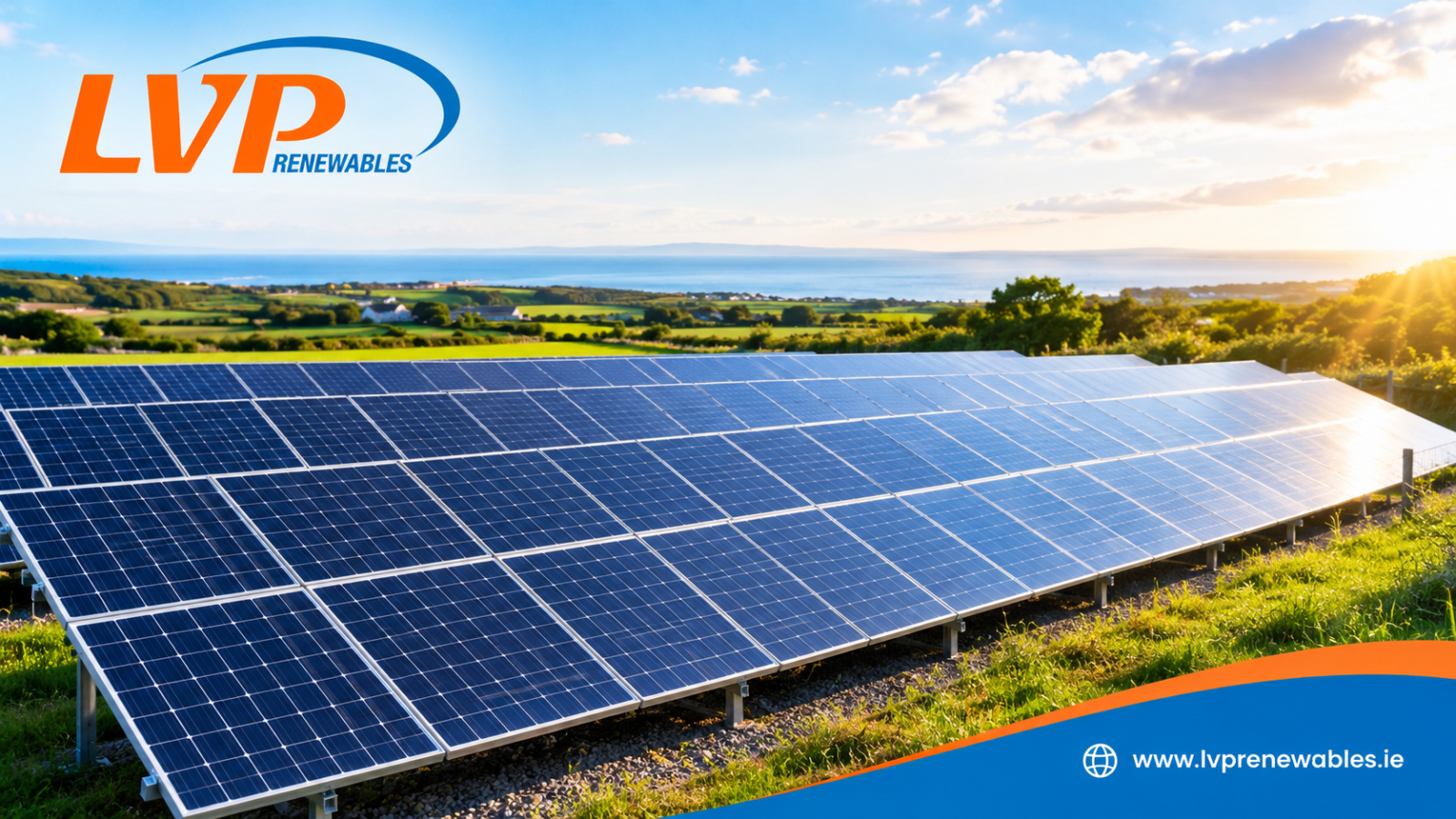
Ground arrays need row spacing, roads, drainage, foundations and equipment areas. Government benchmarks—0.1 ha for 50 kW and 1.5–2 ha for 1 MW—suggest roughly 0.5–0.7 ha (1.2–1.7 acres) for 337.5 kWp. This is only a starting estimate; site layout may need more.
Commercial electricity savings and battery storage
Solar used on site avoids grid purchases. At 295,313 kWh/year and an assumed €0.22/kWh import price, 50% self-consumption (147,656 kWh) is worth about €32,484; 75% (221,484 kWh) is worth €48,727. Surplus export is separate: at an illustrative €0.10/kWh, the 50% case earns about €14,766, versus €7,383 at 75% self-use. Supplier terms and eligibility vary. Daytime production, refrigeration, pumps or EV charging can increase direct use.
A battery may shift surplus to evening or peak periods, but adds cost and does not guarantee a better return. Compare capacity (kWh) and power (kW) with demand, surplus, efficiency, cycle life and tariffs. Shifting flexible loads to sunny hours may cost less.
SEAI grants and commercial funding
The SEAI Non-Domestic Microgen Grant supports eligible self-consumption PV. As of October 2026, enhanced applications run 6 October 2026–6 July 2027. Current stepped rates indicate €126,450 for 337.5 kWp, subject to a cap at the lower of the application amount or 45% of eligible invoiced costs. Receive the grant offer before work starts and use an SEAI-registered company. Verify eligibility and current rules.
Export-only projects use the separate SRESS route, not the NDMG self-consumer grant; do not assume both apply. A ground array must meet the self-consumption scheme criteria to qualify. Check current support and export terms.
Example payback and return on investment
For a rooftop self-consumer, assume eligible costs of €450,000, a €126,450 grant and the generation estimate above. The 45% invoice cap is €202,500, so the scheduled grant is lower and illustrative net cost is €323,550. At 65% self-use and €0.22/kWh avoided import, savings are €42,230; the remaining 103,359 kWh at an assumed €0.10 export rate adds €10,336. Total energy value is about €52,566/year, or 6.2 years’ simple payback. Finance, maintenance, degradation, tax, downtime and future prices are excluded. This is not a guarantee; export-led projects need a separate model and may not qualify for NDMG.
Planning and grid connection
Rooftop exemptions have conditions; Solar Safeguarding Zones may impose a 300 m² panel-area limit. Protected structures and conservation areas need checks. Large ground arrays are not automatically exempt and may require permission and land-use or environmental assessments. Consult the planning authority.
ESB Networks assesses capacity and export limits. Inverter systems up to 200 kVA may use the small-scale route; larger systems may enter the large-scale process. Since 337.5 kWp DC can use different AC ratings, panel count alone does not determine the application. Export approval may be lower than inverter capacity; reinforcement or export limiting affects cost and timing.
Comparing 500, 750 and 1,000 panels
At 450 W and 875 kWh/kWp, 500 panels produce 225 kWp/197 MWh yearly; 750, 337.5 kWp/295 MWh; and 1,000, 450 kWp/394 MWh. Usable roof allowances are 1,300–1,600, 1,950–2,400 and 2,600–3,200 m². Costs rise with capacity but vary with scale, groundworks and grid needs. Match size to demand and connection capacity.
Installation, monitoring and maintenance
Projects move through bill analysis, site and structural surveys, design, planning and grant checks, grid application, installation, testing, commissioning and monitoring. Confirm scope, warranties and maintenance. Performance checks can flag faults early.
FAQs
How much electricity can 750 solar panels generate annually in Ireland?
With 450 W panels and an assumed 800–950 kWh/kWp yield, the 337.5 kWp system could generate 270,000–320,625 kWh a year. Actual output requires a site-specific assessment.
How much does a 750-panel solar installation cost in Ireland?
A rooftop estimate is about €287,000–€675,000 before VAT using a broad installed cost of €850–€2,000 per kWp. Ground-mounted development costs need a separate site allowance.
How much roof space or land is needed for 750 solar panels?
Allow about 1,950–2,400 m² of usable roof or an initial 0.5–0.7 ha ground-area benchmark, subject to layout and site conditions.
How long does it take for a 750-panel solar system to pay for itself?
The worked example gives a simple payback of about 6.2 years, including assumed export value and grant support. Actual payback depends on project costs, demand, tariffs, eligibility and maintenance.
Get a commercial solar assessment
A 750-panel array can generate substantial electricity, but output, costs and savings depend on module rating, site layout, demand, grant eligibility and grid capacity. Contact LVP Renewables for a personalised commercial solar assessment and installation quotation.