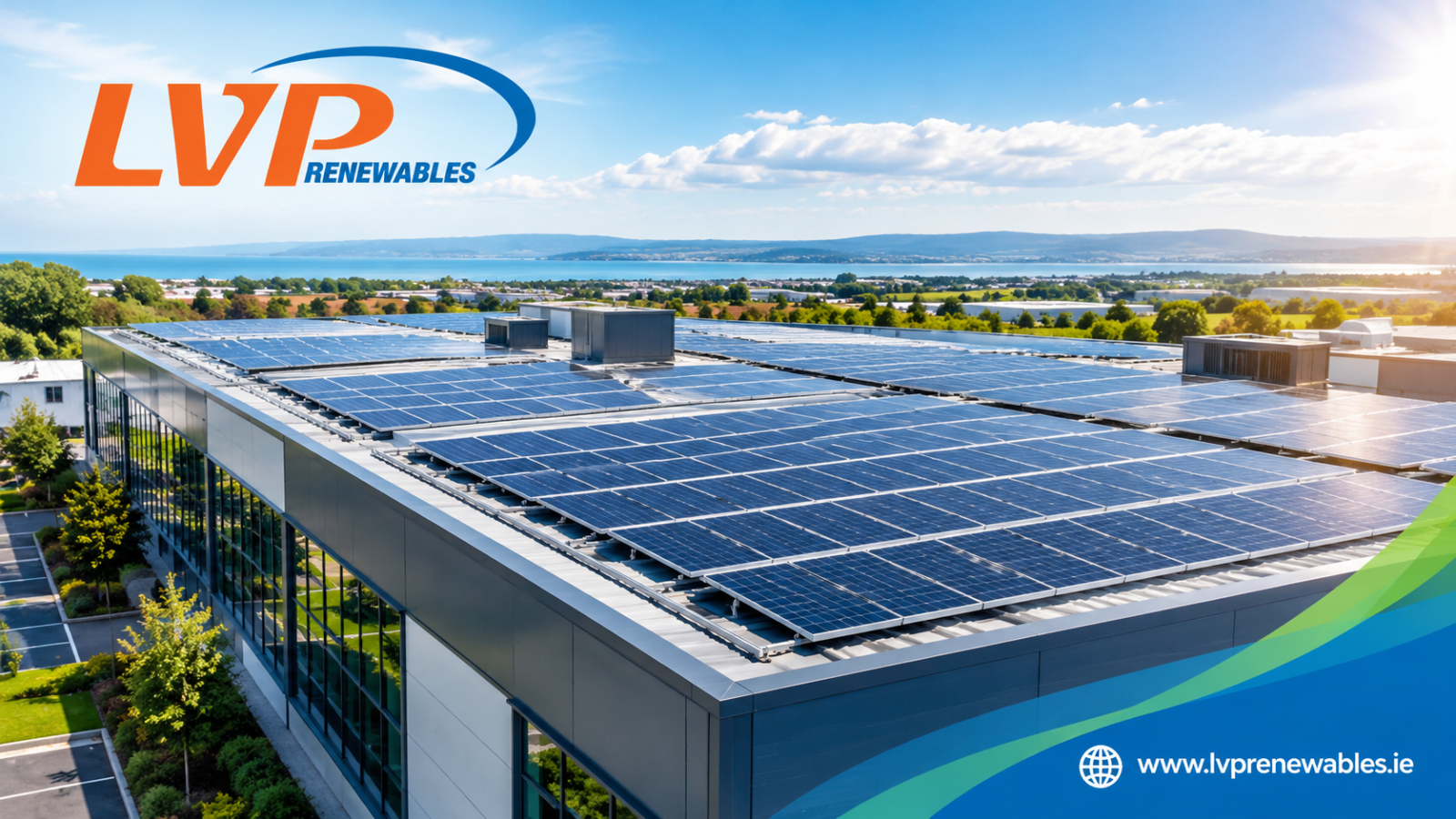
250-panel commercial solar PV installation may suit a factory, warehouse, farm, food-processing facility or other property with a large, sound roof and daytime electricity demand. Professional commercial solar system design matches generation to consumption and checks the roof, safety, electrical systems and grid connection before work begins.
The number of panels does not define system capacity. With 400 W modules, 250 panels total 100 kWp DC with 450 W modules, 112.5 kWp; and with 500 W modules, 125 kWp. The array’s DC rating in kWp differs from inverter AC output in kW or kVA. Permitted grid export capacity may be lower still, so a 250-panel system is not automatically a 250 kW system.
Commercial solar system design: from bills to roof plan
Design starts with electricity bills and, ideally, half-hourly consumption data to see whether solar output coincides with machinery, refrigeration, pumps, ventilation or charging. The survey measures roof dimensions, orientation and pitch, then maps shading, skylights, vents, drains, roof edges, access, mounting, cable routes and inverter location. Electrical switchgear and protection also need assessment.
The layout must allow safe installation, fire access and future maintenance. Older industrial and agricultural roofs need a structural assessment of condition, load capacity, wind loading and remaining life. Complete necessary roof repairs first. A robust solar PV system design in Ireland includes monitoring, commissioning and an ongoing maintenance plan.
250 solar panels cost in Ireland
For early budgeting, use an indicative installed range of €850–€1,500 per kWp before VAT, consistent with published Irish commercial pricing guidance. A 100–125 kWp array would therefore be about €85,000–€187,500; the 112.5 kWp example is €95,600–€168,800. These are planning estimates, not a confirmed LVP Renewables quotation.
The 250 solar panels cost depends on module wattage, inverter technology, mounting, labour, scaffolding or lifting access, roof condition and layout. Electrical upgrades, cable routes, monitoring, protection and grid work can add cost. Budget batteries separately. Ask for a written scope stating VAT, exclusions, optional storage and structural or network work.
Roof space and annual electricity generation
Depending on module dimensions, 250 panels may cover about 500–600 m² of panel surface. Allowing for roof edges, access, skylights, vents, drainage, fire clearances and row spacing, an initial layout may need 650–850 m² of usable roof. This is an estimate, not a fixed rule; the final area depends on roof geometry, setbacks, tilt and obstructions.
For an output illustration, assume 450 W modules (112.5 kWp) and an annual yield of 850–1,000 kWh per kWp. The array might generate 95,600–112,500 kWh annually, or 106,875 kWh at 950 kWh/kWp. Actual output varies with location, orientation, tilt, shading, weather, system losses and seasonal daylight. The European Commission’s PVGIS tool estimates production using location and system-design inputs, so request a site-specific yield assessment.
Savings, batteries and payback
At 106,875 kWh annual generation and 60% self-consumption, a business uses 64,125 kWh directly. At an assumed avoided import price of €0.22/kWh, that is about €14,100 in illustrative annual bill savings. The remaining 42,750 kWh is surplus in this example. Export income depends on the supplier, metering and applicable agreement; do not value it like avoided imports without evidence.
Commercial solar battery storage can shift surplus into later demand. Capacity is measured in kWh; charging and discharging power in kW. Compare both with the site’s load profile, peak demand, solar surplus, efficiency and battery life. Load shifting or daytime EV charging may be more economical. Confirm grant eligibility for storage before including it in an application.
For an illustrative payback, assume an installed cost of €125,000 before VAT, a €50,200 size-based grant (subject to eligibility and the invoice cap below), and the €14,100 annual avoided-cost example. The remaining initial cost is €74,800, giving a simple payback of roughly 5.3 years on avoided savings alone. Export revenue could change this, as could maintenance, finance, inverter replacement, degradation, tax, grant eligibility and energy prices. No payback or saving is guaranteed.

SEAI commercial solar grants, planning and grid connection
SEAI’s Non-Domestic Microgen Grant may support eligible businesses, farms, public bodies, schools, community centres and non-profits. As of October 2026, an enhanced application window runs from 6 October 2026 to 6 July 2027. For a 112.5 kWp system, the current stepped rates give an indicative size-based amount of €50,200. Payment is the lower of the application-summary amount or 45% of eligible invoiced works. Rules and deadlines can change. Applicants must receive the grant offer before work starts and use an eligible registered installer.
Rooftop solar may be exempt from planning permission, but not every 250-panel installation automatically qualifies. Irish rules set building-specific conditions and 43 Solar Safeguarding Zones around airports, aerodromes and helipads. Within these zones, a 300 m² rooftop panel limit may apply, which a 250-panel array could exceed. Protected structures, conservation areas, setbacks and other conditions matter too. Check the relevant planning class and local authority requirements.
The installer should establish the grid route using the inverter’s AC rating and the site connection. ESB Networks’ mini-generation band extends up to 50 kVA for three-phase connections; inverter-connected small-scale generation covers above 50 kVA up to 200 kVA. A commercial array may therefore need a different application route. ESB Networks assesses each connection: Maximum Export Capacity can differ from panel kWp and inverter rating, and is not guaranteed. Export limiting or electrical and network upgrades may be required.
Comparing 150, 200, 250 and 300 panels
On the same 450 W module and 950 kWh/kWp yield assumptions: 150 panels equal 67.5 kWp and about 64,100 kWh/year; 200 equal 90 kWp and 85,500 kWh; 250 equal 112.5 kWp and 106,900 kWh; and 300 equal 135 kWp and 128,300 kWh. At €850–€1,500 per kWp, indicative costs before VAT are respectively €57,000–€101,000, €76,500–€135,000, €95,600–€168,800 and €114,800–€202,500. Roof area rises with panel count, but usable space depends on access and obstructions. These are estimates, not quotations.
Warehouses and factories may use solar directly for daytime processes. Farms, hotels, retail and food businesses have different demand patterns. Size the system to actual consumption, not roof space alone.
Installation and maintenance
The process typically covers electricity-data review, site and structural surveys, design and yield estimate, grant and planning checks, grid application, installation, testing, commissioning and monitoring. Agree who handles applications, what warranties cover, and how faults and maintenance are managed. Performance monitoring and periodic checks can help identify problems early.
FAQs
How much does it cost to install 250 solar panels in Ireland?
For 400–500 W modules, 250 panels equal about 100–125 kWp. An indicative budget is €85,000–€187,500 before VAT and grants. A survey is needed for a quotation.
How much electricity can 250 solar panels generate annually?
With 450 W panels and an assumed yield of 850–1,000 kWh/kWp, a 112.5 kWp array could generate about 95,600–112,500 kWh. Site conditions affect the result.
How much roof space is required for 250 solar panels?
Panel surface may be around 500–600 m²; allow roughly 650–850 m² of usable roof as an initial estimate for access and obstructions.
What should businesses consider when designing a 250-panel solar PV system?
Check demand, panel and inverter ratings, roof condition, shading, access, planning rules, grid export, grant eligibility, battery economics and maintenance. Do not size on roof area alone.
Get a commercial solar assessment
A 250-panel project’s value depends on system capacity, roof space, structural suitability, grid limits, installation cost and on-site use. Contact LVP Renewables for a personalised commercial solar assessment and installation quotation.