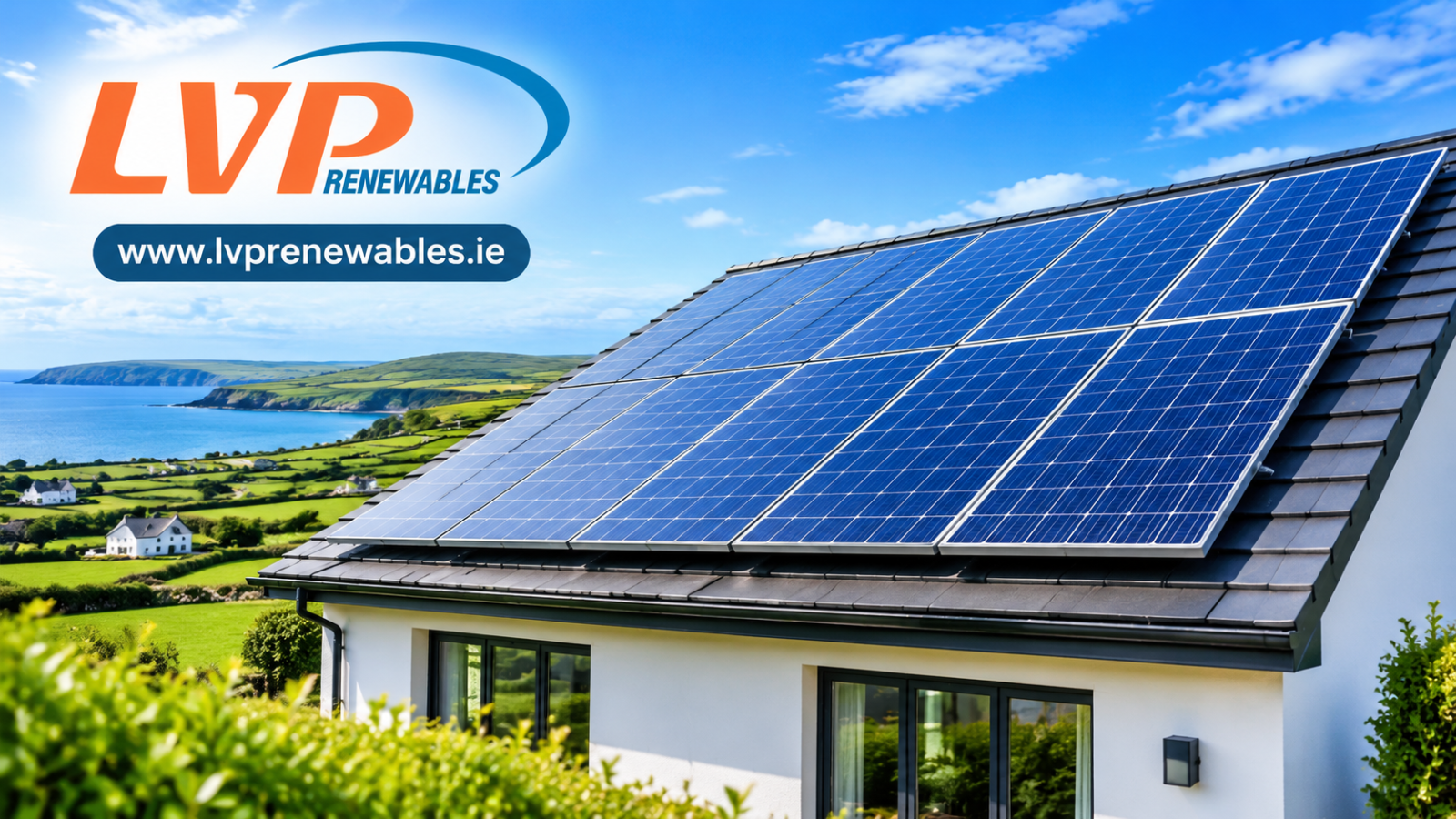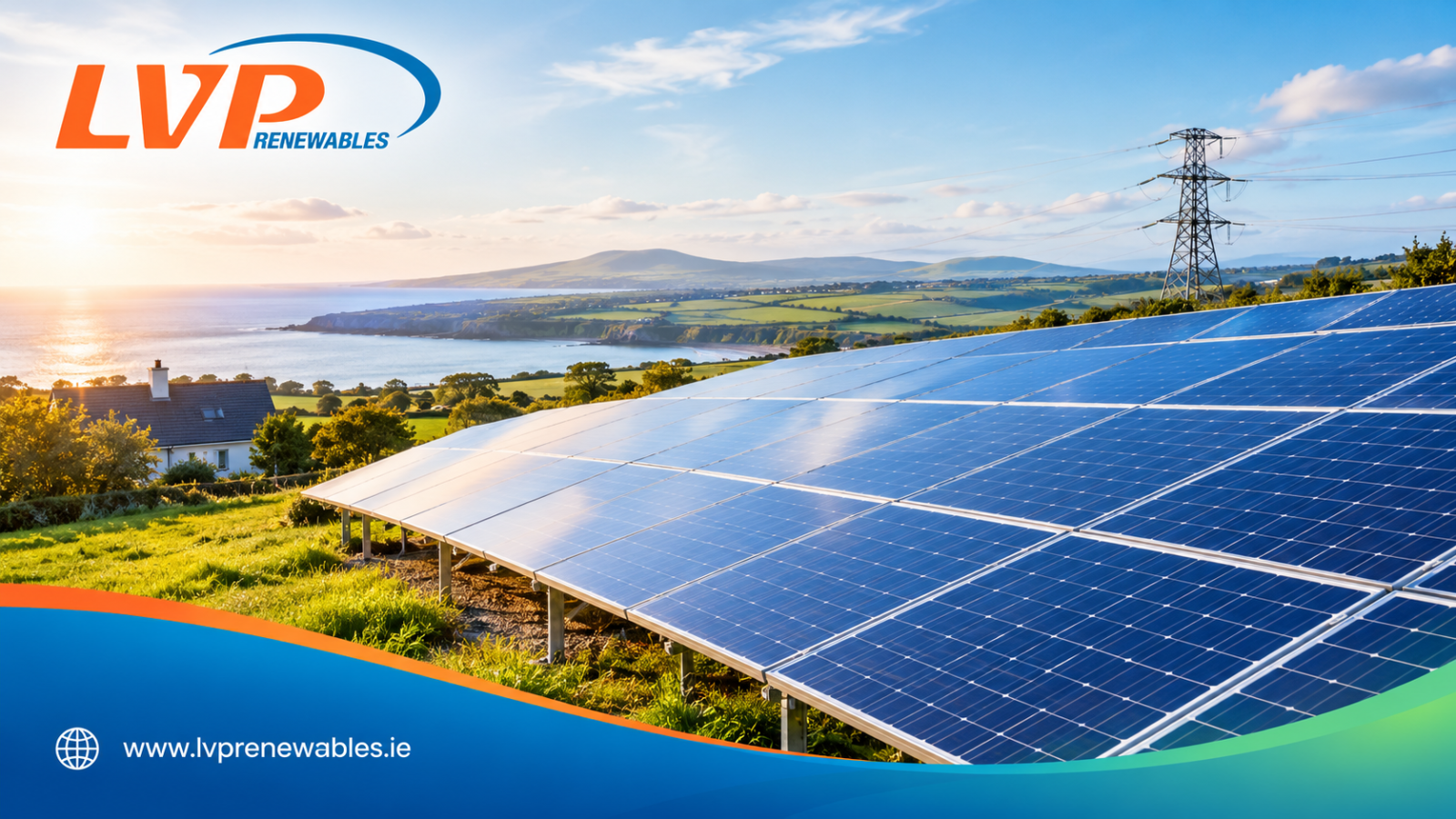
200-panel solar PV system may suit a large farm, warehouse, factory or commercial property with strong daytime demand. Size it against consumption, roof suitability, planning rules and grid capacity; panel count alone determines none of these.
With 400W modules, 200 solar panels form an 80 kilowatt-peak (kWp) DC array. SEAI’s broad Irish yield benchmark suggests annual generation of about 69,300 kilowatt-hours (kWh), subject to site conditions.
System Capacity: Panel Wattage and Inverter Output
Panel wattage is rated DC capacity. Adding module ratings gives the array’s DC capacity in kWp. An inverter converts it to AC, and its kW or kVA rating may be lower depending on design.
•200 × 400W panels: 80kWp DC.
•200 × 450W panels: 90kWp DC.
•200 × 500W panels: 100kWp DC.
A 200-panel system is not automatically a 200kW generator: the inverter’s AC rating, phase and connection conditions determine the ESB Networks application route.
200 Solar Panels Cost in Ireland
Irish cost guides vary. LVP lists €850–€2,000 per kWp; a 2026 guide gives €900–€1,500 per kWp and €40,000–€55,000 for a standard 50kWp rooftop system. Applying a broad €850–€1,700/kWp range, 80–100kWp indicates €68,000–€170,000 before grants. These are estimates, not quotations.
The final 200 solar panels cost depends on panel and inverter quality, mounting, labour, scaffolding and roof condition. Reinforcement, switchboard or grid upgrades, long cable runs and batteries add cost. Request an itemised quote for DC/AC capacity, expected yield, VAT and grant assumptions. See LVP’s commercial PV service.
Expected Annual Electricity Generation
SEAI estimates a well-located 3kW system can generate about 2,600kWh annually, or approximately 867kWh per kWp. Scaling this broad benchmark gives:
•80kWp using 400W panels: approximately 69,300kWh per year.
•90kWp using 450W panels: approximately 78,000kWh per year.
•100kWp using 500W panels: approximately 86,700kWh per year.
These are estimates, not guarantees. Location, roof direction and tilt, shade, weather, module efficiency and losses affect output. About 75% of Irish PV generation occurs from May to September. Ask for site-specific modelling, such as European Commission PVGIS.
Roof Space Requirements
As an initial allowance, use 4.5m² of usable roof per kWp: about 360m² for an 80kWp layout or 450m² at 100kWp. SEAI’s example scales to roughly 333m² of panel surface for 200 similar-sized modules. Actual dimensions vary; practical layouts need space for roof edges, walkways, skylights, vents, fire safety and maintenance.
Survey roof condition, load capacity, wind exposure and remaining life older roofs may need repair or reinforcement.
Planning Permission for Commercial Rooftop Solar
Rooftop solar on industrial, business, light-industrial and agricultural buildings is generally exempt from planning permission, including roof-covering arrays outside Solar Safeguarding Zones, if conditions are met. These cover roof-edge setbacks and panel or equipment position.
Within a Solar Safeguarding Zone around airports, aerodromes or helipads, the rooftop limit is 300m² aperture area per roof, including existing panels. Larger proposals may need permission. Exempt work in a zone must be notified to the planning authority within four weeks. Check the official map and confirm with the council.
Protected structures, Architectural Conservation Areas and hazardous glint or glare can restrict exemption. Non-domestic systems must primarily serve demand within the building’s curtilage. Aperture area differs from the full roof footprint required for safe access.
Grid Connection: MIC, MEC and ESB Networks
Confirm the site’s Maximum Import Capacity (MIC), inverter AC rating and Maximum Export Capacity (MEC), the permitted export. Existing generation, demand, export limits and local network capacity affect the design.
ESB classifies inverter-connected generation by installed AC capacity: three-phase mini-generation is up to 50kVA small-scale generation is above 50kVA to 200kVA; above 200kVA follows the large-scale route. An 80kWp DC array could fall into different routes depending on its inverter. In mini- and small-scale categories, generation capacity and MEC cannot exceed MIC.
The route may require a technical study, system diagrams, inverter data, protection and testing. Inverter-connected small-scale projects use ESB’s NC8 application; mini-generation uses NC7. A technical assessment may require network upgrades. The heatmap is indicative, not approval. Do not install or energise before accepting the required connection offer costs and timing are site-specific.

Electricity Savings, Battery Storage and Payback
On-site solar avoids grid purchases. For 69,300kWh/year from an 80kWp system, assume import at €0.30/kWh and export at €0.15/kWh. At 60% self-use, 41,580kWh saves €12,474; 27,720kWh exported earns €4,158. Total illustrative value: €16,632/year. Prices and usage are assumptions. CRU says export payment depends on metered units and supplier rate.
Battery capacity is measured in kWh and power in kW. Storage can shift midday surplus to later hours but adds cost and charging losses. Compare its rating with site surplus and evening demand.
Assume an €100,000 installation and €37,200 NDMG grant: net cost is €62,800. At €16,632 annual value, simple payback is about 3.8 years. This excludes finance, maintenance, inverter replacement, degradation, grid costs and price changes it is not guaranteed.
SEAI Commercial Solar Grants
The SEAI Non-Domestic Microgen Grant (NDMG) supports eligible non-domestic PV up to 1,000kWp for on-site use, not export-only. New applications from 6 October 2026 to 6 July 2027 receive the lower of the capacity-band amount or 45% of eligible costs. The 80kWp band value is €37,200, subject to the cap and approval.
Premises must have been built and occupied by 31 December 2024. Obtain approval before purchase or work, use an SEAI-registered company and finish within eight months. Support is once per MPRN; batteries are excluded.
Farmers may check TAMS 3’s Solar Capital Investment Scheme: 60% of eligible investment up to €90,000 per holding, subject to reference costs and selection. Do not assume it can combine with NDMG on the same investment.
Who Should Consider 200 Solar Panels?
A 200-panel array may suit farms, warehouses, factories, food processors, hotels and workshops using refrigeration, machinery, pumps or ventilation. Size from bills and interval data, not roof area alone.
Installation, Comparison and Maintenance
A typical project includes load analysis, site and structural surveys, design, planning and grant checks, grid application, installation, testing, commissioning and monitoring.
For comparison, assume 400W panels, 867kWh per kWp annually and €850–€1,700 per kWp:
•100 panels: 40kWp, 34,700kWh/year, 180m² usable roof, €34,000–€68,000 before grants.
•150 panels: 60kWp, 52,000kWh/year, 270m², €51,000–€102,000.
•200 panels: 80kWp, 69,300kWh/year, 360m², €68,000–€136,000.
Costs and layout depend on site and grid needs. Monitor generation and inverter performance, inspect periodically, and check panel, inverter and workmanship warranties. SEAI notes that an inverter may need replacement during the system’s lifetime.
FAQs
How much does it cost to install 200 solar panels in Ireland?
For an 80–100kWp design, a broad indicative price is €68,000–€170,000 before grants. The inverter design, roof and grid works affect the final quote.
How much electricity can 200 solar panels generate annually?
With 400W modules, the estimated 80kWp output is about 69,300kWh per year. Higher-wattage options may generate more, subject to site conditions.
Do 200 solar panels require planning permission in Ireland?
Not automatically. Many commercial rooftop systems are exempt outside Solar Safeguarding Zones if conditions are met. In a safeguarding zone, the 300m² aperture limit and other restrictions may apply.
What grid connection is required for 200 solar panels?
It depends on inverter AC capacity, phase, MIC, MEC and the network assessment—not panel count alone. ESB Networks determines the application route and connection offer.
Conclusion
With 400W modules, 200 solar panels make an 80kWp DC array that may generate about 69,300kWh annually. Before proceeding, confirm the roof and planning position, design the inverter and export capacity with ESB Networks, and match the system to site demand. The 200 solar panels cost, grant and payback figures above are estimates; obtain a site-specific assessment from LVP Renewables or contact its team.