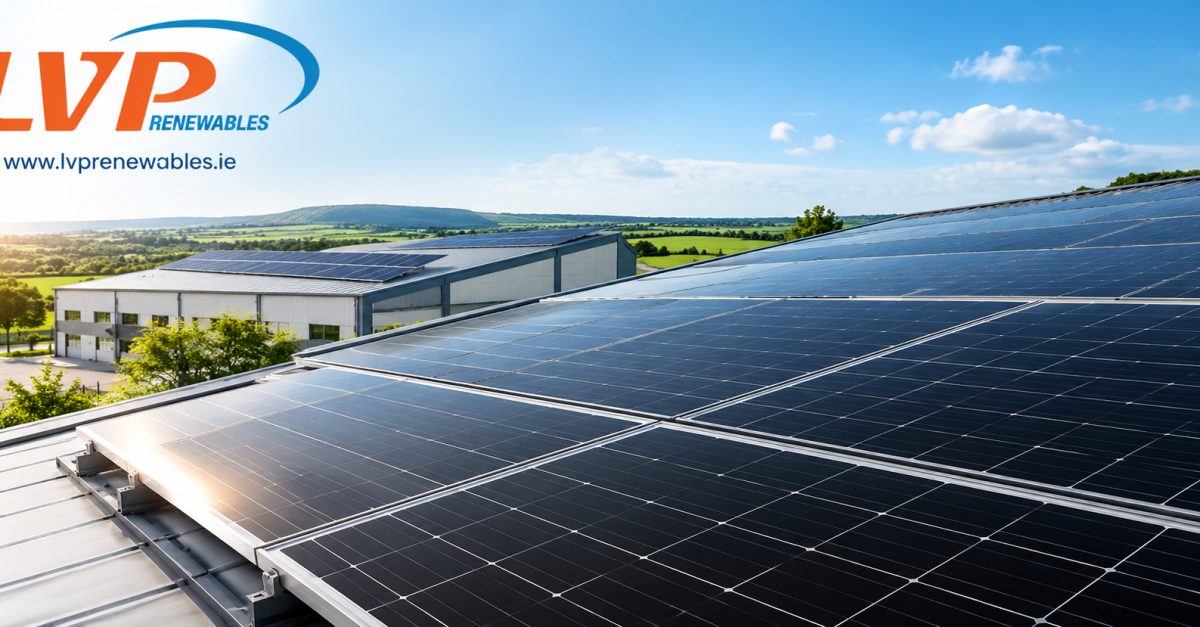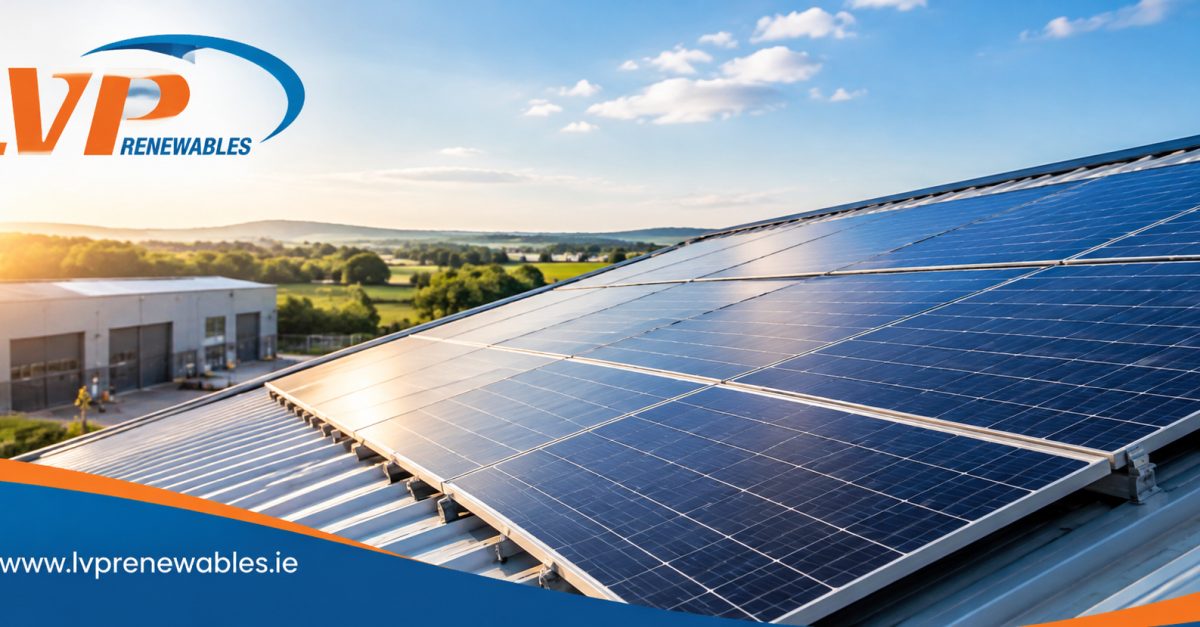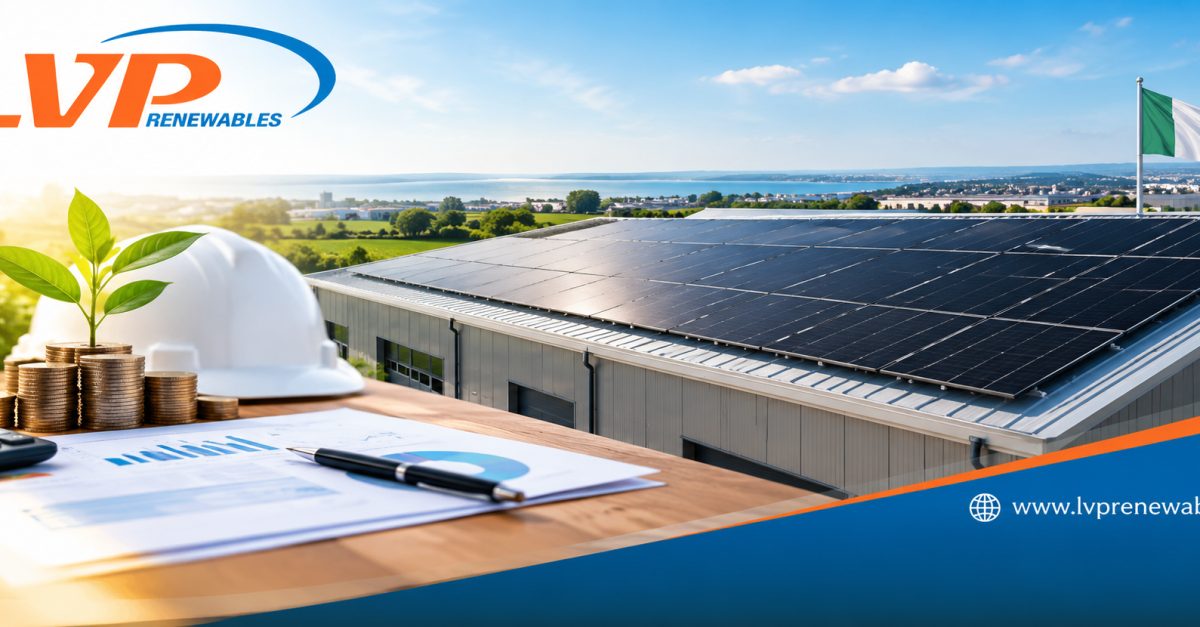
A 200kW-class solar array can make a noticeable difference to a business’s electricity costs, but the right investment depends on more than the number of panels on the roof. The 200kW solar system cost in Ireland is shaped by roof condition, grid capacity, the site’s daytime electricity demand and how much of the power can be used on site.
This guide explains what a 200kW solar PV system includes, how many panels and how much roof area it may need, what it could generate, and how the current SEAI business grant may affect the investment. All generation, price and payback figures below are estimates. They are not a site quotation or a promise of savings.
What does a 200kW solar system mean?
Solar panel capacity is commonly stated in kilowatt-peak (kWp). It describes the panels’ combined rated output under standard test conditions. In everyday discussion, a “200kW system” often means a solar array of about 200kWp DC. Its inverter converts the panels’ direct current into alternating current for the building and grid. The inverter’s AC rating may be lower than the panel array’s DC rating, so the two figures should not be treated as interchangeable.
A 200kW solar panel system is therefore not automatically a 200kW inverter. Likewise, a battery described as 200kW is not necessarily a 200kWh battery. Grant calculations and grid applications can use different capacity measures, so a proposal should clearly state the array’s kWp, inverter capacity in kW or kVA, and permitted export capacity.
In daylight, the panels generate electricity. The inverter makes it usable by the building’s electrical system. Solar power first serves the business’s live demand; surplus may be exported or, where a suitable system is installed, stored for later use. At night or during low generation, the business continues to take electricity from the grid.
How many solar panels are needed for 200kW?
The panel count depends on each module’s rated wattage. The examples below round up to reach at least approximately 200kWp. Dimensions are representative examples from specific product specifications; module sizes vary between manufacturers and models.
•400W panels: 500 modules give an array of 200.0kWp. Using example dimensions of 1.722m × 1.134m per panel, the panel-only footprint is about 976m².
•450W panels: 445 modules give an array of 200.25kWp. At approximately 1.762m × 1.134m each, the panel-only footprint is about 889m².
•500W panels: 400 modules give an array of 200.0kWp. At approximately 2.094m × 1.134m each, the panel-only footprint is about 950m².
•550W panels: 364 modules give an array of 200.2kWp. At approximately 2.278m × 1.134m each, the panel-only footprint is about 940m².
The calculation is array capacity in watts divided by panel rating. For example, 200,000W ÷ 450W is 444.4 panels, so 445 modules would be needed. That configuration is 200.25kWp, not exactly 200kWp. A designer may instead specify a slightly smaller array or a different mix of modules. The final panel count also depends on the selected equipment and roof layout.
If a proposal uses the phrase “200kW solar panels”, ask whether it means a 200kWp DC array or a 200kW AC inverter. This distinction affects the panel count and the grant calculation.
Roof space for a 200kW solar panel installation
The panel-only footprint in the examples is about 890–980m². That is not the same as the clear roof area required. Designers must also plan around roof edges, skylights, vents, plant equipment, drains and structural constraints. Flat-roof layouts may need row spacing to reduce self-shading, particularly where modules are tilted. Safe access routes and clearance for inspection and maintenance must also be kept.
As an early planning allowance, a 200kWp array may need roughly 1,100–1,400m² of usable roof area. This is an indicative layout estimate based on the module footprints above plus space for access and spacing. It is not a planning standard or a substitute for a measured roof survey. The result can change with roof shape, orientation, mounting method, fire-safety requirements and the installer’s design.
Before specifying a system, arrange a structural review. The roof must be able to carry the modules and mounting equipment and withstand wind loads. The survey should also check roof age, waterproofing, warranty restrictions and whether repairs should be completed before installation.
Estimated 200kW solar system output in Ireland
For a first-pass estimate, a well-sited 200kWp solar array might produce around 160,000–180,000kWh a year (160–180MWh), using an illustrative yield of 800–900kWh per kWp annually. SEAI’s business guide gives examples of 870kWh/kWp for one system and 900kWh/kWp for a well-designed, south-facing installation inclined close to 35 degrees. Those examples are useful benchmarks, not a guarantee for every Irish roof.
A proper forecast should be modelled for the site. The European Commission’s PVGIS tool estimates long-term PV production for a selected location and system configuration. Output changes with local weather, panel direction, tilt, temperature, system losses and shading from trees, adjoining buildings or rooftop equipment. South-facing panels often provide strong annual production, while east–west layouts can spread generation across more of the working day. A shallow roof tilt may reduce output compared with an ideal angle, but can allow a practical, dense layout.
For a 200kW solar PV system in Ireland, use a site-specific forecast rather than relying on a national average. When sizing commercial solar panels in Ireland, compare that forecast with the business’s interval electricity demand.
The useful figure for a business is not just annual generation. Compare the system’s hourly output with the site’s half-hourly or 15-minute electricity demand. Factories, cold stores and warehouses that consume power through daylight hours may use a high share directly. A site with a large weekend shutdown or mostly evening demand may export more unless it can shift loads or add storage. SEAI recommends assessing demand and self-consumption when sizing a business system.
200kW solar system cost in Ireland: what shapes the quote?
The 200kW solar system cost in Ireland depends on equipment and site conditions. The main commercial solar installation costs are the PV modules, one or more inverters, roof mounting, DC and AC cabling, switchgear and protection, metering and monitoring, design, installation, testing and commissioning. Roof access, lifting equipment, structural work, distribution-board upgrades and the need for additional grid works can also affect the price. SEAI lists access, roof mounting and electrical work among factors that influence commercial project costs.
LVP Renewables’ commercial page publishes a broad installed-cost guide of €850–€2,000 per kWp. Applying that range arithmetically to 200kWp gives an indicative €170,000–€400,000 before grant support. It is a wide planning range, not a 200kW quotation or an independent market benchmark. The published figure does not specify every project’s scope or tax treatment. Ask any installer to state clearly whether VAT, roof repairs, grid reinforcement, export controls, monitoring and other works are included. Battery storage should be priced separately.
A site-specific assessment is essential. A straightforward large roof with good access and ample grid capacity may price differently from a roof requiring reinforcement, complex safety measures, new switchgear or network upgrades. The final price should be based on a survey, load data, a grid assessment and a written equipment and scope specification.
Commercial solar grants in Ireland: current SEAI support
The principal SEAI support for eligible non-domestic solar PV is the Non-Domestic Microgen Grant (NDMG). It supports qualifying businesses, farms, public bodies, schools, community centres and non-profit organisations installing solar PV for self-consumption. Systems up to 1,000kWp are within the scheme’s stated size limit.
As of 14 October 2026, SEAI says enhanced support is available for new applications made from 6 October 2026 to 6 July 2027. The grant is calculated from system size using bands, then capped at the lower of the amount shown in the application summary and 45% of the eligible invoiced cost. SEAI’s current application guide gives a grant value of €85,200 for a 200kWp system. This is a maximum calculation under the scheme table, not a guaranteed award: the invoice-cost cap or another eligibility condition may reduce the payment.
For example, if eligible installation costs were €170,000, 45% would be €76,500, so the grant would be no more than that amount. At a €240,000 eligible invoice, 45% is €108,000, but the size-based 200kWp grant limit of €85,200 would be lower. The grant can only be claimed after the work is complete and the required documents have been submitted.
Important conditions include:
•The premises must have been built and occupied on or before 31 December 2024, and support is limited to once per MPRN.
•The project must serve a site with electricity demand for self-consumption. The grant is not for a project that generates electricity solely for export.
•The applicant must use a company and installer registered for the relevant SEAI non-domestic scheme. Electrical work must be completed by a Safe Electric-registered electrician.
•The applicant must receive the SEAI grant offer before buying materials or starting work. The offer is valid for eight months.
•Other State funding can affect the calculation because the 45% aid-intensity cap applies cumulatively. Batteries and other supplementary elements are not eligible costs under the standard PV grant.
The practical route is to select a registered installer, agree the project scope, apply to SEAI and wait for the grant offer. The installer then progresses the ESB Networks connection application, completes the approved installation and submits the required completion records. Do not assume that applying is the same as approval, or that a previous grant offer will receive the October 2026 uplift.
Grant or export tariff: choose the right project route
A business installing solar mainly to reduce its own electricity purchases can apply for the self-consumer NDMG, subject to the rules above. A separate SRESS export tariff route is designed for projects that export all generated electricity. The Department’s published SME solar tariff for projects over 50kW and up to 1MW is currently €130/MWh, with 15-year support terms; the Department says the tariff review is under way and current published rates remain in effect until changed. An export-only project cannot also use the self-consumer grant, and it is not eligible for the Clean Export Guarantee.
For a self-consumer project, surplus electricity may have value, but the export price and connection terms depend on the project’s classification, metering and supplier arrangements. Do not use a household export rate as a guaranteed assumption for a 200kWp commercial system. Confirm the available arrangement in writing before including export income in a business case.
Example savings and simple payback
The calculation below shows how assumptions affect the result. It is not a forecast for a particular business.
For this example, assume a 200kWp DC array costs €240,000 before grant and generates 170,000kWh a year. The business uses 75% of generation on site. The calculation values that electricity at an assumed avoided import price of €0.20/kWh and exports the remaining electricity at an assumed €0.10/kWh. On those assumptions, annual energy value is about €29,750. If the project receives the size-based SEAI grant of up to €85,200, subject to the scheme rules and eligible invoice, the example investment after grant is €154,800. That gives a simple payback of about 5.2 years.
In this example, the business uses 127,500kWh on site, worth €25,500 at the assumed import price. The remaining 42,500kWh is exported at the illustrative €0.10/kWh, worth €4,250. Together they give €29,750 in annual energy value. The €154,800 net investment divided by that amount gives a simple payback of roughly 5.2 years.
This simplified calculation excludes finance costs, maintenance, inverter replacement, tax, VAT, degradation, downtime, standing charges and any changes in electricity or export prices. It assumes the site can use 75% of solar production at the stated marginal electricity price. Real savings depend on the load profile and contract. SEAI notes that self-consumed solar normally saves more than exported power and advises basing savings on electricity actually displaced, not total solar generation.
A grant or tax treatment can improve the project economics, but do not add tax savings to the calculation without advice specific to the business. The final proposal should model several self-consumption and energy-price cases rather than presenting one payback number as certain.

Is a 200kW battery storage system worthwhile?
Battery storage can capture some daytime solar surplus and discharge it when the building needs power later. It may help reduce peak imports or provide backup, but backup during a grid outage requires the right inverter, isolation and electrical design; a standard grid-connected solar array does not automatically keep the building running in a blackout. A battery may also add control, fire-safety, space, commissioning and replacement considerations. SEAI notes that storage may increase self-consumption and support other services, while its economic case depends on the application.
A battery needs two ratings. Its power is measured in kW: how quickly it can charge or discharge. Its energy capacity is measured in kWh: how much electricity it can store. A 200kW battery with 200kWh of usable capacity could, in ideal arithmetic, deliver full power for one hour. A 200kW battery with 400kWh could deliver full power for two hours. Actual duration is affected by usable capacity, conversion losses, state-of-charge limits and operating strategy.
That is why “200kW battery” alone is not a complete specification. Compare power in kW with capacity in kWh, and ask what duration the system is designed to provide. There is no single responsible price for a “200kW battery” without knowing its energy capacity, duration, chemistry, controls, installation conditions and grid function. Request a separate, itemised battery proposal. Battery equipment is not eligible under the standard SEAI NDMG PV grant.
For some businesses, shifting production, charging electric vehicles during daylight or scheduling refrigeration and hot-water loads may be a less costly first step than installing a battery. Storage is more compelling where the site has regular surplus generation and valuable evening demand, peak charges or a defined resilience requirement.
Key components and project requirements
A commercial 200kW solar PV system in Ireland typically includes modules, roof mounting, one or more inverters, DC and AC cabling, isolators, switchgear, protection equipment, monitoring and export or import metering. Depending on the connection assessment, it may also need additional grid-interface protection, an export-limiting system or distribution-board and transformer work. The final equipment list should follow the electrical design and ESB Networks requirements.
Planning permission is not automatically required for every rooftop installation. Irish exemptions cover several non-domestic building types, but conditions apply. In a Solar Safeguarding Zone, rooftop solar is limited to 300m² per roof unless planning permission is obtained for a larger proposal. Outside those zones, there is no equivalent rooftop area limit, but exemptions remain subject to conditions such as roof-edge clearances and restrictions affecting protected structures or Architectural Conservation Areas. Check the site against the official map and confirm the position with the local planning authority, particularly because a 200kWp array will normally cover far more than 300m² of panel surface.
The grid route depends on the actual AC generator rating and connection. ESB Networks publishes a small-scale generation route for inverter-connected installations above about 50kVA and up to 200kVA, subject to the site’s Maximum Import Capacity. Government guidance points projects above 200kW towards the Enduring Connection Policy process. A 200kWp DC array is not necessarily a 200kW AC generator, so the installer should confirm the right application route with ESB Networks before finalising the design. ESB Networks currently reports an average of 8–10 weeks for a small-scale connection offer after the application fee is paid; complex cases can take longer. Do not energise the system before the connection offer conditions and required testing are complete.
Allow time for the roof survey, structural checks, grant approval, grid assessment, detailed design and installation. There is no reliable single installation duration for every 200kW project. The connection assessment and any network works can be important schedule drivers, so start those checks early. Once operational, monitor production against the forecast, keep access routes clear and arrange inspections and servicing in line with the equipment and installer’s maintenance plan.
Which businesses suit a 200kW solar PV system?
A 200kWp array can suit factories, warehouses, farms, hotels, food businesses and other industrial or commercial sites with a large roof and significant daytime demand. Manufacturing lines, refrigeration, ventilation, pumps, lighting and office loads can all use solar electricity while it is being generated. Businesses with lower daytime demand can still assess a system, but should model exports and load-shifting options carefully before choosing the array size.
LVP Renewables states that it designs commercial rooftop and ground-mounted PV systems from 2kW to 400kW and works with membrane, bitumen and metal roofs. Its commercial page also lists schools, creches, farms, offices and food outlets among its experience areas. A suitable design still depends on the individual roof, electrical installation, energy profile and grid approval.
How LVP Renewables can help
LVP Renewables can review a business’s electricity use and site details to assess a suitable commercial solar size. Its website says an initial quotation can be based on the previous year’s ESB bills, the site Eircode and a short conversation. A tailored assessment should then confirm the expected generation, self-consumption, grid route, roof requirements, grant eligibility and full project scope.
When considering the 200kW solar system cost in Ireland, ask for a proposal that separates the 200kWp panel array from the inverter rating and any battery capacity. Request the assumptions behind the annual output and savings, the grant amount shown in the application summary, any grid costs, and the exclusions from the price. This makes it easier to compare quotations on a like-for-like basis.
For a tailored commercial solar assessment and quotation, contact LVP Renewables through its website, or visit its commercial PV page.
FAQs
How much does a 200kW solar system cost in Ireland?
LVP Renewables publishes a broad guide of €850–€2,000 per kWp installed. For a 200kWp array, that equates to about €170,000–€400,000 before grants. It is an indicative range, not a site quote; roof work, grid requirements, VAT treatment and project scope can change the price.
How many solar panels are needed for a 200kW system?
Approximately 500 panels at 400W, 445 at 450W, 400 at 500W or 364 at 550W. The latter two larger-panel examples produce slightly more than 200kWp when rounded up. The final design should state the exact DC array rating.
What commercial solar grants are available in Ireland?
Eligible self-consumption projects may qualify for SEAI’s Non-Domestic Microgen Grant. For an exact 200kWp system, SEAI’s current table gives a size-based grant value of €85,200, capped at 45% of eligible invoiced costs. New applications receive the enhanced rates only during the published 6 October 2026–6 July 2027 window, and applicants must meet the scheme conditions and obtain approval before starting work.
Is battery storage worthwhile for a 200kW commercial solar system?
It can be worthwhile where there is regular surplus solar power and a useful later demand, or a clear peak-management or backup need. Compare the battery’s kW power with its kWh capacity and model the extra cost against the value of shifting or storing electricity. The standard SEAI NDMG PV grant does not cover battery equipment.