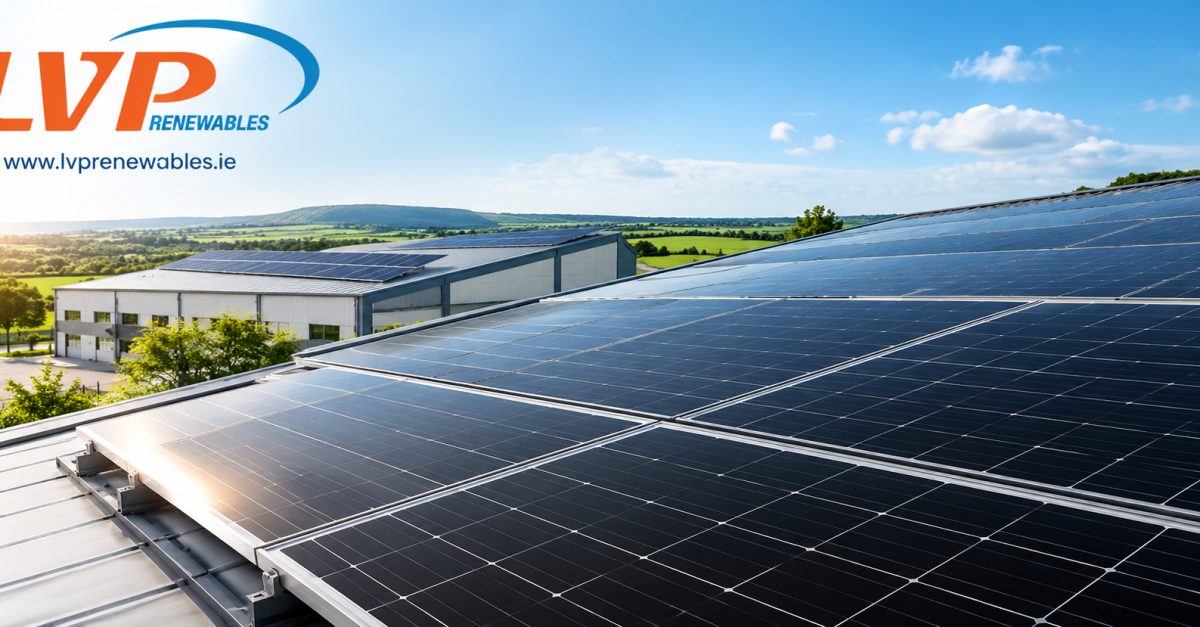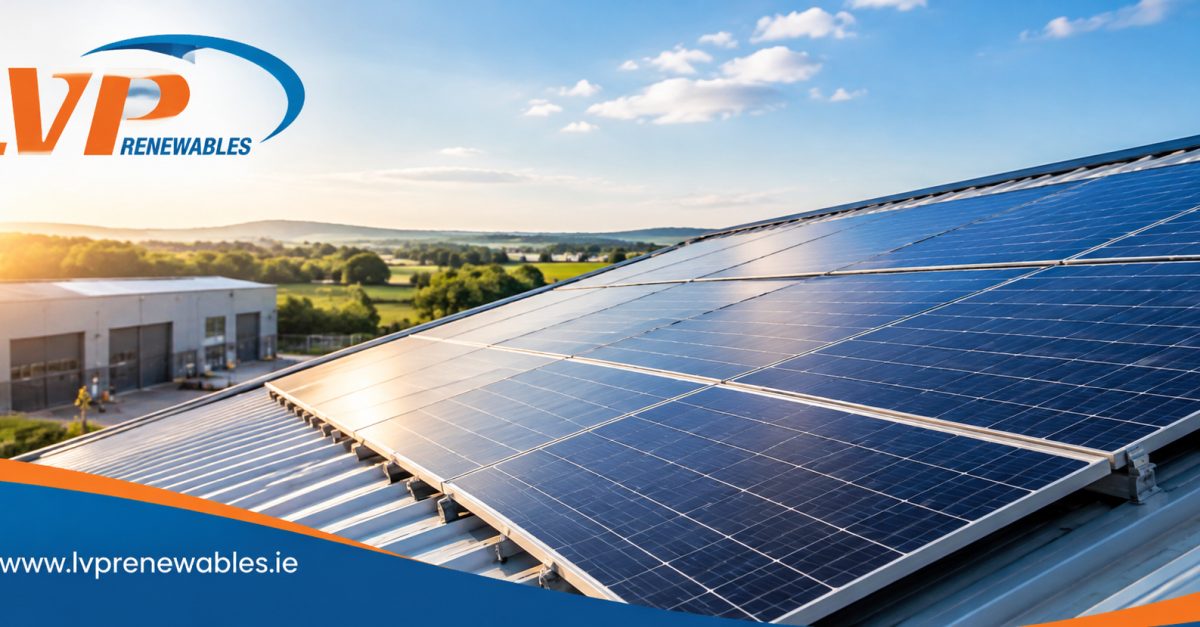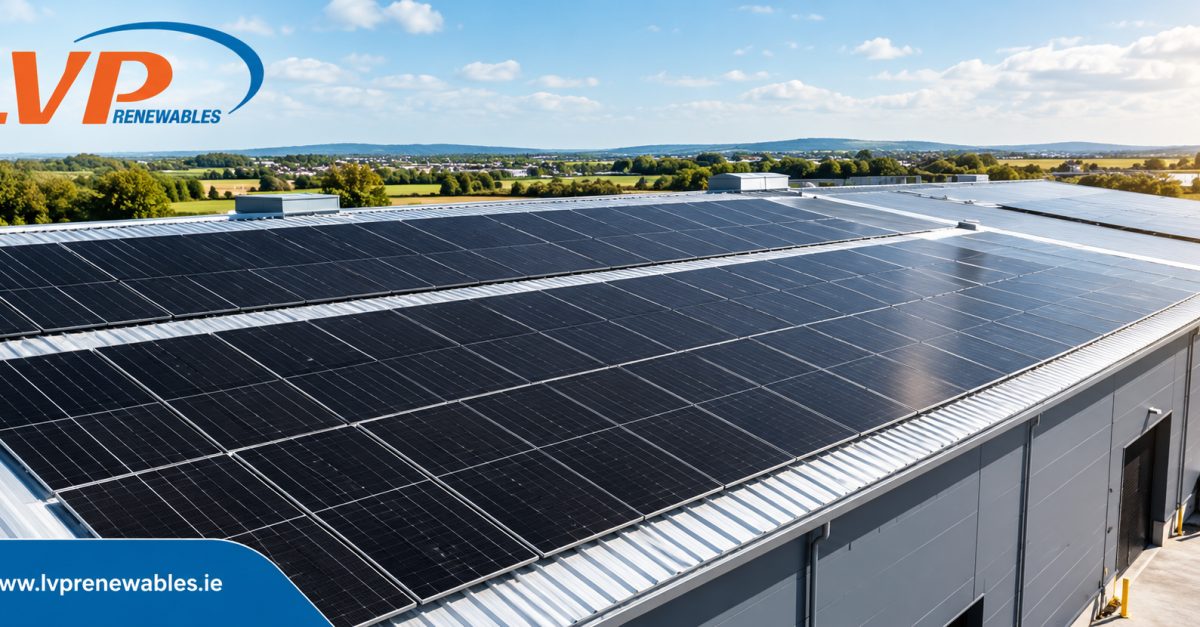
A 150kW commercial solar PV system can make a substantial contribution to a business’s electricity needs, particularly when the site uses power during daylight hours. But the system size alone does not tell you how many modules will fit, how much roof must be available or how much electricity the array will produce. Those answers depend on panel wattage, roof layout, site location, shading, electrical demand and the route to connect the installation to the grid.
This guide explains how to estimate the panel count and commercial solar roof space for a 150kW solar PV system in Ireland. It also outlines likely generation, key equipment, grant and export considerations, and the checks to complete before committing to a project. The figures below are planning estimates, not a site-specific design or guaranteed performance forecast.
What does a 150kW commercial solar PV system mean?
Solar array size is commonly expressed in kilowatts peak, or kWp. This is the combined rated output of the PV modules under standard test conditions. In everyday discussion, a 150kWp array is often called a 150kW solar system. Its inverter’s AC rating may be different, so a designer will confirm both the module capacity and the equipment and export limits at the property.
For a business, the aim is not always to fill every available section of roof. A well-sized design considers when electricity is used, how much can be consumed on site and whether the network can accept surplus generation. Matching solar production to a site’s daytime load can be more valuable than maximising the number of panels.
150kW solar panel count by module wattage
The estimate is straightforward: divide 150,000 watts by the rating of one panel, then round up to reach at least 150kWp. Using today’s common commercial module ratings gives the following approximate counts:
•400W panels: 375 panels (150kWp)
•450W panels: 334 panels (about 150.3kWp)
•500W panels: 300 panels (150kWp)
•550W panels: 273 panels (about 150.15kWp)
These examples show why a 150kW solar panel count is not a fixed number. Higher-wattage modules can reduce the number of units, but they may be physically larger and heavier. The chosen model, roof geometry, wind loading, mounting design and inverter configuration all affect the final layout. The electrical design may also use a particular DC-to-AC ratio, so ask whether a quoted system size refers to module kWp or inverter kW.
150kW commercial solar PV system: how much roof space is needed?
For early planning, a 150kWp rooftop array may need roughly 750–1,000 square metres of clear, usable roof. This is a broad allowance rather than a universal minimum. The panel faces themselves could cover around 600–750 square metres in a typical layout, while the additional area allows for row spacing, roof-edge clearances, access routes, rooflights, vents, plant equipment and safe maintenance access. A constrained, shaded or irregular roof can need more space or produce a smaller system.
Panel dimensions vary by manufacturer and wattage. As an illustration, if 300 panels are each about 2.2 square metres, their combined module area is around 660m² before access and spacing are considered. That does not mean 660m² of roof is enough: a designer must place modules around obstacles and preserve safe routes for inspection, emergency access and future roof work.
The roof also has to be structurally suitable. An engineer or competent designer should consider the condition and load capacity of the roof, panel and mounting-system weight, wind uplift and local exposure. Older roofs may need repairs or reinforcement before installation. Allow space to reach inverters, isolators and other equipment for servicing, and make sure the PV layout does not block drainage or planned roof maintenance.
Estimated 150kW solar system output in Ireland
A useful early estimate for a well-designed Irish rooftop system is approximately 120,000–150,000kWh per year for 150kWp, or roughly 800–1,000kWh per kWp. This is an indicative range, not a promise. European Commission PVGIS calculations for representative Irish locations return about 138–148MWh annually for a 150kWp array facing south at a 30-degree tilt, with 14% system losses assumed. A shallow east–west Dublin example returns about 119MWh. Actual results depend on the property’s coordinates, roof pitch and direction, equipment, shading and operating conditions.
Ireland’s changeable weather affects output from year to year, but solar panels generate electricity from daylight, not just bright sunshine. Orientation and tilt affect how much sunlight reaches the modules and when generation peaks. A south-facing roof can provide strong annual production, while east–west arrays may spread generation across more of the working day. That broader profile can suit a business whose morning and afternoon demand is high, even if the annual total differs from a south-facing design. A detailed yield forecast is an essential step when specifying a 150kW commercial solar PV system, because a national estimate cannot account for a particular roof’s shade and layout.
Nearby buildings, trees, roof structures and self-shading between rows can reduce output. A detailed proposal should include a site-specific yield estimate and state its assumptions, including shading and system losses. PVGIS is a useful independent starting point; it does not replace a roof survey or a detailed electrical design.
Main components in a 150kW solar PV system
A typical commercial installation includes PV modules and a roof mounting system, string or central inverters that convert the modules’ DC electricity to AC, and DC and AC cabling. It also needs electrical protection and isolation equipment, generation and export metering, monitoring, and the switchgear needed to connect safely into the building’s electrical installation.
The design may require export-limiting controls, upgraded switchgear or a transformer, depending on the site and grid assessment. Batteries are optional rather than an automatic part of a standard PV system. Storage can shift some solar electricity into later hours, but its cost, usable capacity, operating strategy and eligibility under any support scheme should be assessed separately.

Installation cost, savings and payback
There is no reliable one-size-fits-all price for a 150kW solar PV installation. The quotation will depend on the equipment and design, roof type and condition, access requirements, cable routes, electrical upgrades, connection works, export controls and any structural reinforcement. A battery, specialist lifting equipment, construction phasing or complex site conditions can also change the investment. Compare proposals on the same basis, including what is covered by the price, the estimated annual generation, warranties, monitoring and aftercare.
The main financial benefit is electricity generated and used on site, which can reduce the volume bought from a supplier. Surplus electricity may earn an export payment, but the applicable rate and contract terms depend on the supplier and scheme. A simple way to frame the annual benefit is:
On-site solar electricity used × the relevant avoided import cost + exported electricity × the applicable export rate − operating and maintenance costs.
For example, if a system produces 140,000kWh in a modelled year and the business uses 70% of it as it is generated, about 98,000kWh would be consumed on site. This is only an energy illustration; it does not imply a particular bill saving. The actual value depends on the business’s tariff, time-of-use rates, consumption profile, export terms and system performance.
Simple payback is the net project cost after any confirmed grant divided by the annual net financial benefit. A proper investment appraisal should also consider financing, maintenance, inverter replacement over the system’s life, electricity price changes and the value of emissions reductions. Savings and payback cannot be guaranteed from system size alone.
Commercial solar grants and export support in Ireland
The SEAI Non-Domestic Microgen Grant supports qualifying solar PV projects for businesses, farms, public bodies, schools, community centres and non-profit organisations. The current SEAI rules cover systems up to 1,000kWp. The premises must meet the scheme’s eligibility conditions, including being built and occupied on or before 31 December 2024, and the project must be designed for on-site self-consumption rather than export-only generation. Applicants must use the appropriately registered SEAI company and installer, apply for and receive a grant offer before buying materials or starting work, and complete the project within the offer’s validity period.
For new applications made from 6 October 2026 to 6 July 2027, SEAI says the enhanced grant is subject to an effective 45% limit. Under the published rate bands, the scheduled grant value for a 150kWp installation works out at €65,200; the amount paid is the lower of the value shown in the application offer and 45% of the eligible invoiced cost. Other scheme conditions apply, and other state funding may affect the cap. Existing grant offers are not automatically increased. Because scheme terms can change, businesses should check the latest SEAI guidance and confirm eligibility and the amount in writing before relying on grant support.
A self-consuming business may also receive payment for surplus electricity exported to the grid under its electricity supplier’s terms and the applicable Clean Export Guarantee arrangements. This is separate from the SEAI installation grant: the export value depends on the supplier’s current offer and metered export. The government also operates the SRESS export-tariff route for certain export-led projects above 50kW, but that is not the same as a typical self-consumption project. The Department’s guidance distinguishes the export-only route from self-consumer support, so businesses should confirm which route applies before planning revenue around exports.
Which businesses suit a 150kW solar system?
A 150kW solar panel system may suit warehouses, factories, food processors, farms, schools, offices, retail sites, leisure facilities and other properties with a large roof and significant daytime electricity use. Refrigeration, production lines, pumps, ventilation and office loads can use solar power while it is being generated. Sites with steady daytime demand are often better placed to consume a high share of their output.
The best fit is established by comparing interval electricity data with an hourly generation model, not by looking at annual consumption alone. A business with a high annual bill but very low daytime demand may export a larger share. A smaller system, staged installation, storage or load-shifting measures may then make more sense.
Planning, grid connection, installation and maintenance
Rooftop solar can qualify for planning exemptions in Ireland, but the rules depend on the building, its location and the relevant conditions. Solar Safeguarding Zones around airports and aerodromes limit rooftop installations on non-house buildings to 300m² per rooftop unless planning permission is obtained. Other restrictions can apply, including those for protected structures and Architectural Conservation Areas. A 150kWp array could exceed the safeguarding-zone limit, so check the site with the local planning authority before proceeding.
Grid approval is a separate project step. For renewable self-consumer projects between 50kW and 1MW, government guidance directs projects below 200kW to the ESB Networks small-scale generation route. ESB Networks assesses the proposed connection, import capacity, export limit and any required network works. The applicable route depends on the system’s electrical rating and design; 150kWp of panels does not by itself guarantee a particular export capacity or a straightforward connection. The installer should confirm the correct application route and secure approval before the system is connected or energised.
A practical project sequence is to review electricity bills and interval data, survey and assess the roof, develop the electrical and structural design, check planning and grant conditions, apply for grid connection, then schedule installation and commissioning. After handover, monitor production and investigate unexpected drops. Keep panels, gutters, access ways and electrical equipment in a safe condition. Inspection and cleaning needs depend on the site; follow the installer’s maintenance recommendations and arrange prompt checks after severe weather or roof works.
How LVP Renewables can help
LVP Renewables’ commercial PV service describes systems for a range of business properties and roof types, with design attention to roof capacity, wind loading, maintenance and safety. The company asks prospective customers for a recent electricity bill and Eircode to begin preparing a quotation. A tailored assessment can help establish whether a 150kW solar PV system in Ireland is a good fit for your roof, electricity profile, grid connection and project objectives.
For an assessment based on your premises and electricity use, contact LVP Renewables to discuss your commercial solar requirements and request a tailored quotation.
FAQs
How many panels are needed for a 150kW solar system?
It depends on panel rating. As an estimate, allow 375 panels at 400W, 334 at 450W, 300 at 500W or 273 at 550W to reach at least 150kWp. The final count depends on the selected module and system design.
How much roof space does a 150kW commercial solar PV system need?
A useful early allowance is about 750–1,000m² of clear, usable roof. The panel footprint is smaller than the full area needed once access routes, setbacks, rooflights, shading and maintenance space are included. A survey determines the practical capacity.
How much electricity does a 150kW solar system generate in Ireland?
For an initial estimate, allow around 120,000–150,000kWh a year for 150kWp. Location, orientation, tilt, shading, equipment and weather affect the actual 150kW solar system output. A site-specific yield model is needed for a project forecast.
How much does a 150kW commercial solar installation cost?
There is no dependable universal price. Roof condition, mounting method, equipment, access, electrical upgrades and grid-connection works can all affect the quotation. Request a site-specific proposal that itemises scope and confirms grant assumptions rather than treating an online estimate as a guaranteed price.