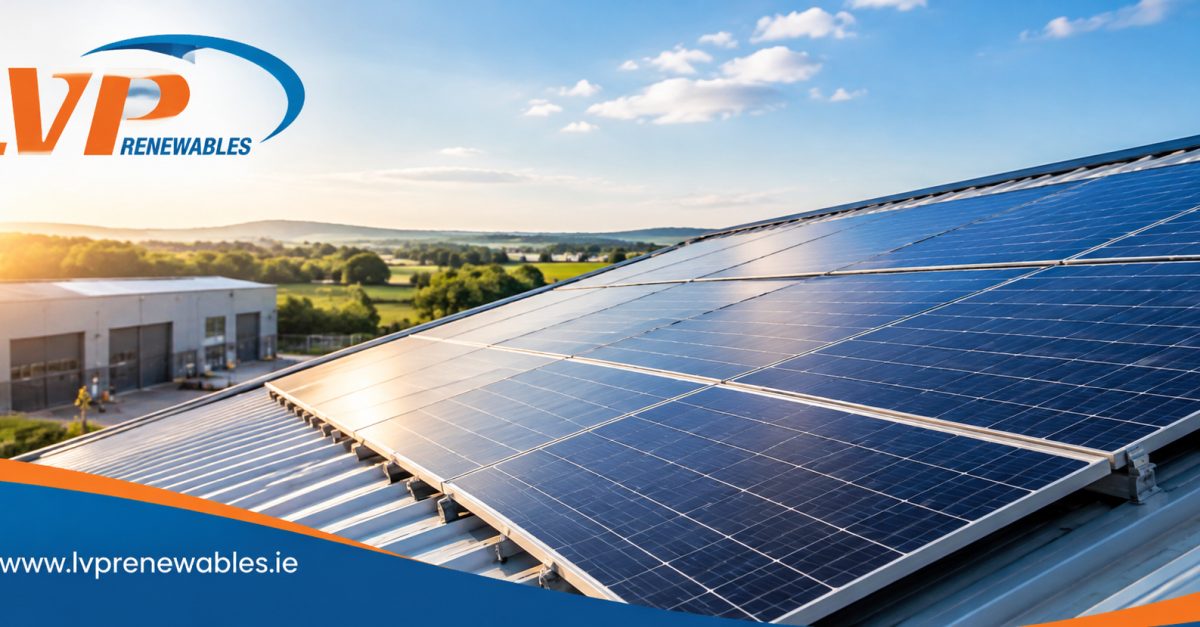
For a business with a suitable roof and meaningful daytime electricity use, solar panels can reduce the amount of power bought from the grid. A 40kW solar system is a sizeable commercial installation, potentially suited to a warehouse, farm, workshop, office, school or retail premises. Whether it is the right size depends on the building’s electricity profile, usable roof area and grid connection—not simply on the size of the business.
This guide gives Irish businesses a starting point for costs, panel numbers, generation, savings and support. All figures are indicative, not a quotation or a guarantee. For an overview of the technology and installation options, see LVP Renewables’ guide to photovoltaic (PV) panels.
What is a 40kW solar system, and which businesses can benefit?
Solar arrays are commonly described by their kilowatt-peak (kWp) rating: the panels’ nominal output under standard test conditions. A kilowatt (kW) describes power at a moment in time. A kilowatt-hour (kWh) measures energy generated or used over time. Commercial quotes may refer to a 40kWp panel array and separately specify inverter capacity in kW; ask the installer to identify both.
A 40kWp array may suit a site with a good-sized, structurally sound roof and regular daytime loads. Refrigeration, pumps, machinery, ventilation, IT equipment and EV charging can all use solar electricity while it is being generated. Farms, warehouses, food businesses, workshops and offices are examples, but a usage review is needed before sizing. A smaller array may be more economical if much of the output would be exported rather than used on site. SEAI’s business guide likewise recommends matching system size to electricity demand and checking roof condition, shading, orientation and connection requirements.
40kW solar system cost in Ireland: indicative price range
As a broad budgeting reference, an Irish commercial installer publishes rooftop PV prices of approximately €850–€1,500 per kWp installed, with roof access, roof type and pitch among the price factors. Applied to a 40kWp array, that suggests an indicative range of about €34,000–€60,000 before VAT. Treat this as an early planning range, not a market quotation: equipment, electrical work, access, structural requirements and project scope can move a final price outside it.
A tailored quotation should state whether the figure includes VAT, monitoring, grid-connection work, scaffolding or other access equipment, electrical upgrades, and any battery or EV-charging equipment. Batteries are a separate cost item and are not included in the SEAI NDMG solar PV grant calculation. The final price depends on system design, roof conditions, equipment, site access and the business’s electricity needs.
Factors affecting commercial solar installation costs
Key cost drivers include:
•Roof and access: Height, roof material, available working area and safe access arrangements affect labour and mounting costs.
•Structural condition: The installer may need to assess roof capacity, wind loading, repairs or reinforcement before panels are fitted.
•Electrical infrastructure: Cable routes, inverter location, switchgear, distribution-board capacity and grid-connection requirements can add work.
•System design and equipment: Panel and inverter specification, monitoring, optimisers, warranties and optional storage all affect the quote.
•Site constraints: Shading, roof orientation, operating hours and installation access can change the layout and expected output.
A good proposal separates the PV array from optional extras and explains assumptions. SEAI recommends checking the building’s condition and planning the structural, electrical and grid aspects as part of the project.
How many solar panels are required for a 40kW system?
The panel count depends on the wattage of the selected modules. For example, 40,000 watts ÷ 450 watts per panel = about 89 panels. With 400W modules, the same nominal capacity would take about 100 panels. These are examples; the installer’s design determines the final count and rated system size.
The physical roof area is greater than the panel surface area alone because the design must allow for roof edges, access, obstructions, spacing and safe installation. SEAI’s grant page gives an example of a 30kWp system using 75 panels over about 125m², but actual panel dimensions and layout vary. A roof survey is therefore more useful than a simple panel-count estimate.
Estimated electricity generation and potential business savings
For a high-level illustration, an Irish commercial installer cites an indicative long-term yield of around 750–900kWh per kWp per year. Applying that range to 40kWp gives approximately 30,000–36,000kWh (30–36MWh) a year. This is not a site-specific forecast. Location, orientation, tilt, shading, weather, equipment and system losses affect output. The European Commission’s PVGIS tool estimates monthly and yearly production using location and system-design inputs, so a proper proposal should include a location-specific forecast.
Savings depend on how much solar electricity the business uses as it is produced and on the price it would otherwise pay for electricity. To show the arithmetic only, suppose the array generates 30,000–36,000kWh annually, the business uses 80% of it on site, and each self-consumed unit avoids an illustrative €0.30/kWh of purchased electricity. That would mean 24,000–28,800kWh used on site and about €7,200–€8,640 in annual bill savings, before maintenance, financing, export payments, VAT/tax treatment or other charges. The assumed tariff and self-use share are examples, not claims about a typical bill or promised savings. A business with strong daytime demand may use a higher share; a site closed during daylight may use less.
SEAI grants and support for Irish businesses
The SEAI Non-Domestic Microgen Grant (NDMG) is available to eligible businesses, agricultural sites, public bodies and non-profits for qualifying solar PV systems, up to 1,000kWp. As at 14 October 2026, SEAI says new applications made from 6 October 2026 to 6 July 2027 are covered by an enhanced support period. The payable grant is the lower of the amount shown in the application and 45% of eligible invoiced installation costs. The grant uses stepped rates by system size, so it is not a flat 45% discount.
Using SEAI’s published rates, a 40kWp system has a scheduled grant value of €21,200, subject to eligibility, the invoice-based 45% cap and the terms in force when applying. The grant guide states that battery and other supplementary elements are outside the standard PV grant. Applicants must obtain an SEAI grant offer before starting work; SEAI says the offer is valid for eight months. The scheme also requires an eligible registered company and connection documentation as applicable.
Grant rules and application windows can change. Check the current SEAI Non-Domestic Microgen Grant page and confirm eligibility, rates and documentation with SEAI and your installer before committing to a project.
How much does it cost to charge a 40kW battery?
People searching “how much does it cost to charge an 40kw battery” are often referring to a battery with 40kWh of storage capacity. The units matter: kW is a rate of power; kWh is the quantity of energy a battery stores. A battery may also have a separate kW charge-power limit.
For a practical example, assume a 40kWh battery is charged from empty to full using grid electricity and has 90% charging efficiency. It would need about 44.4kWh from the grid (40 ÷ 0.90), before considering any other system losses. At purely illustrative unit rates, the energy cost would be:
•€0.20/kWh: about €8.89
•€0.30/kWh: about €13.33
•€0.40/kWh: about €17.78
These examples exclude standing charges, taxes or other bill components and do not represent current market tariffs. The actual answer to “how much does it cost to charge an 40kw battery” depends on usable battery capacity, state of charge, charging efficiency, the tariff at the time of charging and whether the electricity comes from the grid or surplus solar. For example, a half-full battery would require less energy than a full recharge. Solar charging may reduce grid purchases, but its value also depends on whether that electricity could otherwise have been exported.
A 40kWp solar array does not automatically charge a 40kWh battery at 40kW. Real output changes with sunlight, and the inverter, battery management system and other site loads limit the charge rate. For a site-specific estimate of “how much does it cost to charge an 40kw battery”, compare the battery’s usable kWh, round-trip efficiency and charge-power rating with the business’s interval electricity data and tariff.

Solar battery storage versus grid electricity
A battery can store some surplus daytime solar for use later, such as during evening operations or a later shift. It can improve the timing of solar use, but it adds capital cost and conversion losses. The financial case depends on the difference between the price of imported electricity and the value of exporting unused solar, as well as the battery’s cycle life, size and use pattern.
Without storage, the business can still use solar directly while the panels are producing and draw from the grid when demand exceeds solar output. A battery should be assessed against the business’s load data rather than added automatically. For some sites, shifting flexible processes or EV charging into sunny hours may be a simpler way to consume more on-site generation.
Installation process, roof suitability, maintenance and warranties
A typical project starts with a review of electricity bills or half-hourly data, site survey and roof assessment. The installer then proposes a system layout, generation forecast, equipment, costs and grid-connection process. If applying for the NDMG, secure the SEAI offer before work begins. The installer should coordinate the necessary ESB Networks connection steps before installation and commissioning.
Before signing, confirm that the roof is in suitable condition for the system’s expected service life and ask who is responsible for structural checks, electrical certification, monitoring setup and handover documents. Ask for written product and workmanship warranty terms, including what is covered, who handles claims and whether monitoring or maintenance visits are included. Solar PV has no moving parts, but periodic checks, inverter attention and prompt investigation of faults help protect performance. SEAI’s business guide covers commissioning and ongoing operation and maintenance.
Choosing a reliable commercial solar installer in Ireland
Compare more than the headline price. Ask each tendering installer for:
•Evidence of relevant commercial projects and references for similar sites.
•A clear system design, panel count, inverter rating and site-specific yield estimate.
•A breakdown of included works, exclusions, VAT and optional battery costs.
•Confirmation of current SEAI NDMG registration and who will handle grant and grid paperwork.
•Warranty documents, monitoring arrangements, maintenance options and aftercare contacts.
For a 40kW solar system, the best design is the one that fits the building, grid connection and consumption profile—not necessarily the one with the most panels. You can also review LVP Renewables’ solar PV information and learn more about the company at the LVP Renewables homepage.
Conclusion: plan a 40kW solar system around your business
A 40kW solar system can be a worthwhile option for an Irish business with suitable roof space and consistent daytime electricity demand, but the right economics depend on the details. A rough 40kWp budget based on published Irish commercial pricing is €34,000–€60,000 before VAT; potential generation, savings and SEAI support must be checked against the site and current scheme rules. Battery charging costs need a separate calculation based on kWh capacity, efficiency and the tariff used.
For a tailored assessment, contact LVP Renewables to discuss your roof, electricity usage and project goals, and request a commercial solar quote based on your actual site.
FAQs
How much does a 40kW solar system cost in Ireland?
For early budgeting, a 40kWp commercial array may fall around €34,000–€60,000 before VAT, using a published Irish installer range of €850–€1,500 per kWp. This is indicative only; a site survey and written quotation are needed.
How many solar panels are needed for a 40kW solar system?
About 89 panels at 450W each, or around 100 panels at 400W each. The final number depends on module rating and system design.
How much does it cost to charge a 40kWh battery?
At 90% charging efficiency, a full 40kWh recharge uses about 44.4kWh from the source. At an illustrative €0.30/kWh grid rate, that is about €13.33, excluding standing charges and other bill items. Solar charging and actual tariffs change the result.
Is a 40kW solar system suitable for a small or medium-sized business?
It can be, if the business has enough suitable roof area and electricity use—especially during daylight—to use a substantial share of the output. A smaller system may suit a lower-demand site. Ask an installer to compare the proposed output with your actual consumption data.