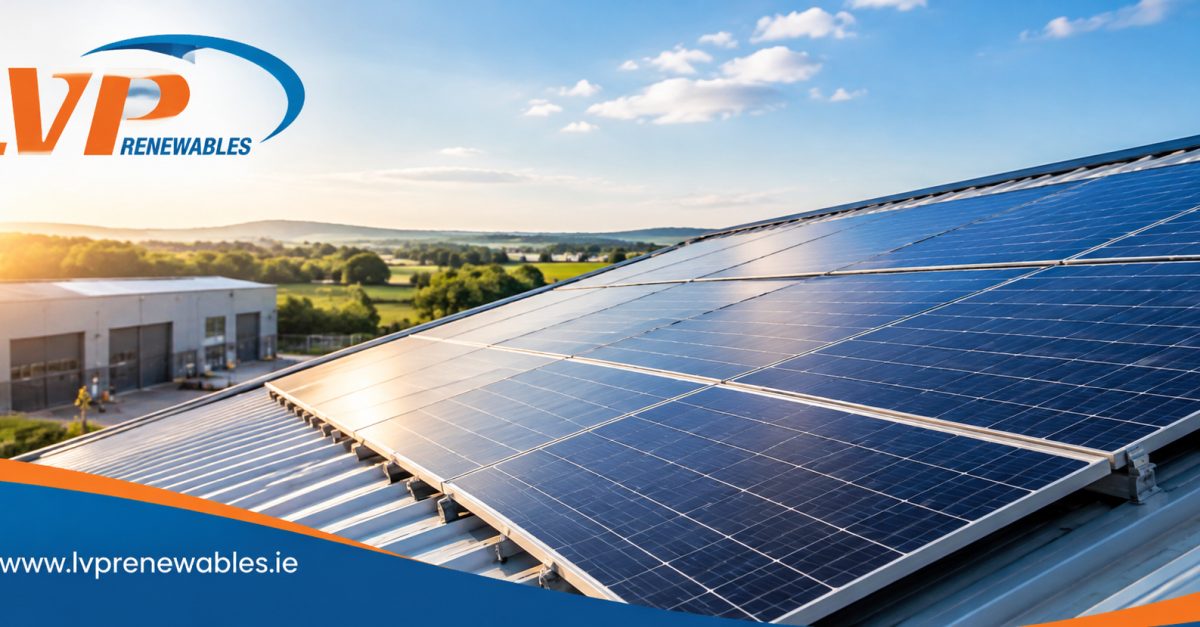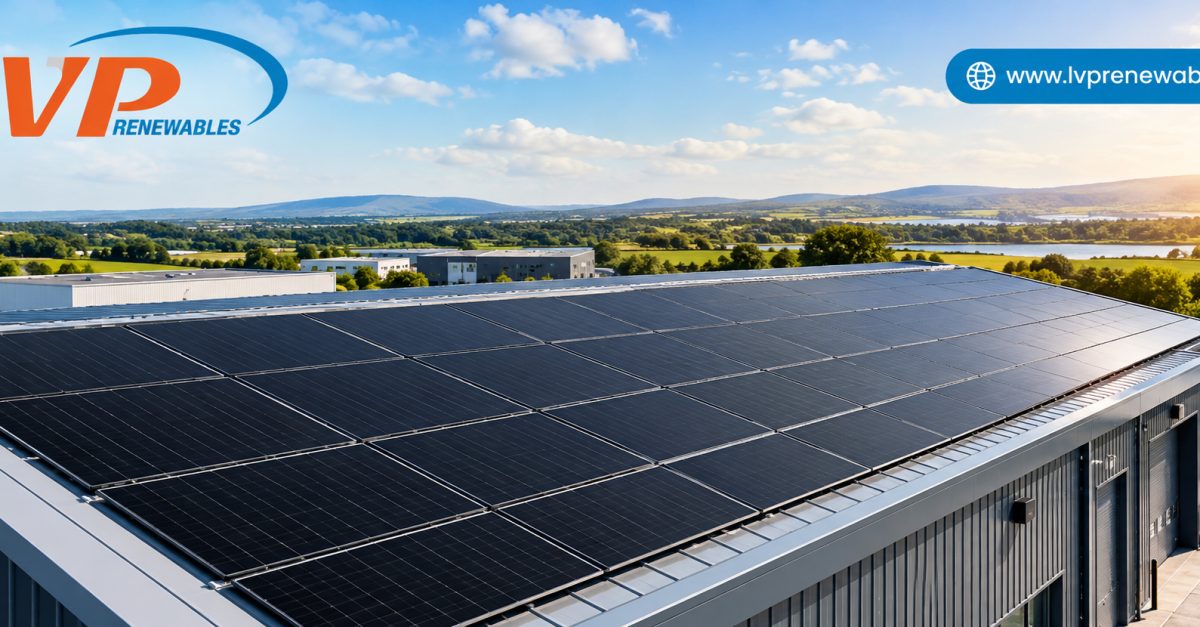
A 100kW solar system can make a substantial contribution to a business’s daytime electricity use, but the right design depends on more than roof size. Electricity demand, grid connection requirements, system price and grant eligibility all affect the value of an installation.
For businesses researching 100kW solar system cost in Ireland, a useful early budget is approximately €90,000–€150,000 before VAT and before grants. This is an indicative range, not a quotation. A recent Irish commercial pricing guide places 100kWp projects in this bracket, while supplier-published rates show that complex sites can fall outside it.
This guide explains how to estimate capacity, panel numbers, roof area, grant support and likely savings—and what to check before commissioning a commercial solar PV system.
What is a 100kW solar system?
A commercial solar PV system converts daylight into electricity using photovoltaic panels and inverters. A system described as “100kW” is usually referring to about 100 kilowatts peak (100kWp) of panel capacity under standard test conditions. The inverter’s AC rating may differ from the panel capacity, so compare quotations on a like-for-like basis.
The electricity is used by the building first. Any generation not consumed on site at that moment may be exported, subject to the site’s connection arrangements and supplier terms. A solar system does not guarantee power during a grid outage; that requires compatible equipment and a specifically designed backup arrangement.
A 100kW solar system is a sizeable project. It is often suited to warehouses, factories, farms, offices, schools, food businesses and other premises with significant daytime electricity use. SEAI recommends reviewing electricity demand, roof condition, shading, orientation, grid requirements and likely self-consumption before choosing an array size.
How many panels and how much roof space?
The panel count depends on the module wattage selected. As a simple example, a 100kWp array would need about 220 panels rated at 450W each. Panels in the 400–500W range would mean roughly 200–250 modules. Final numbers depend on the product, layout and the system’s DC-to-AC design.
Allow roughly 420–500 square metres for the panel area as an initial planning guide, then additional usable roof area for access routes, setbacks, roof obstructions and spacing. SEAI’s example of a 30kWp array uses 75 panels across 125m², which gives a useful broad area reference, but every roof layout is different.
Before design, check that the roof is structurally sound and likely to remain serviceable for the expected life of the PV system. Roof strengthening, repairs, access equipment or a ballasted mounting system can change both the usable area and project price.
100kW solar system cost in Ireland
For budgeting, an indicative 100kWp installation may cost €90,000–€150,000 before VAT and grants. The estimate covers a broad range of typical commercial projects; it is not a standard rate. Published Irish installer pricing varies according to system size and site conditions, so a difficult roof or expensive grid works may take a project above this range.
The 100kW solar system cost can move materially based on:
•Roof type and condition: Metal, membrane and flat roofs need different mounting approaches. Repairs or reinforcement add to the project.
•Access and safety: Roof height, fragile coverings, restricted access and working-hour constraints affect labour and equipment requirements.
•Electrical scope: Inverter location, distribution-board upgrades, cabling, protection equipment and export limits can change the design.
•Grid connection: A 100kW project should be assessed against its specific ESB Networks connection route and local network capacity. Do not assume the small-system notification process applies.
•Equipment and monitoring: Panel, inverter, mounting, monitoring and warranty specifications affect the price.
•Battery storage: Batteries are optional and add capital cost. Their value depends on when the business uses electricity and the value of stored power compared with exporting it.
•Planning and structural work: Ground-mounted arrays, protected or constrained buildings, and substantial roof alterations may need additional assessments or permissions.
Ask suppliers to show the system capacity in kWp, inverter rating, annual generation estimate, exclusions, VAT treatment, connection assumptions and any grant assumptions separately. That makes competing proposals easier to compare.
SEAI commercial solar grants and other supports
The main SEAI grant for non-domestic PV is the Non-Domestic Microgen Grant (NDMG). The scheme supports eligible businesses, farms, public bodies, schools, community centres and non-profit organisations. It covers systems up to 1,000kWp.
As at October 2026, SEAI states that new applications made from 6 October 2026 to 6 July 2027 can receive an enhanced grant, with the final payment limited to the lower of the amount on the application summary and 45% of the eligible invoiced cost. Existing offers are not increased, and work must not start before the grant offer is received. The published window and terms are time-sensitive, so confirm them on SEAI’s live scheme page before committing.
For a 100kWp system, the current schedule works out to a maximum indicative grant of €45,200: the first 6kWp attracts €4,800; the next 14kWp is at €600/kWp; and the remaining 80kWp is at €400/kWp. However, the amount actually paid may be lower if 45% of the eligible invoice is less than €45,200 or if the SEAI offer sets a lower amount. It is not a guaranteed cash rebate.
For a project priced at €90,000, 45% is €40,500, so that would be the maximum under the percentage cap, subject to the offer and eligible costs. At a €150,000 project price, the schedule’s €45,200 limit would be lower than 45% of the price. On those assumptions, the indicative cost after the grant would be about €49,500–€104,800 before VAT. The actual grant and net cost depend on SEAI approval, the project invoice and scheme rules.
How to apply for the NDMG
SEAI requires applicants to select a registered Non-Domestic Microgen solar company, agree the work and apply for a grant offer. Wait for the letter of offer before starting work. The installer must also make the required ESB Networks connection application before installation. SEAI says grant offers are valid for eight months, and final payment depends on the required completion documents being submitted.
To check current grant availability, use the official SEAI Non-Domestic Microgen Grant page and its application portal. Confirm the registered status of the installer, the amount shown on the application summary and the conditions attached to the offer. Availability can change, and being eligible to apply does not guarantee approval.
Farm-specific support and tax relief
Farmers may also wish to assess the TAMS 3 Solar Capital Investment Scheme. The Department of Agriculture states that eligible projects can receive 60% grant aid up to a €90,000 investment ceiling per holding, subject to scheme conditions and selection. Current terms limit grant-aided PV panel capacity to 62kWp and size it against eligible farm electricity demand. A 100kWp project therefore cannot assume that the full array qualifies under TAMS. The terms also require any separately supported additional system to be isolated and discrete. Check the live Department rules and discuss grant choices before designing the project.
The Accelerated Capital Allowance (ACA) is a tax measure, not a grant. Eligible companies, sole traders and farmers may be able to deduct the cost of qualifying new equipment from taxable profits in the year of purchase, subject to the equipment register and tax rules. It does not reduce the invoice like a grant, and its value depends on the business’s tax position. Ask a tax adviser to confirm whether the PV equipment and project costs qualify.
Do not assume that different grant schemes can be combined for the same equipment. In particular, the TAMS terms specify conditions for projects seeking separate support for additional PV capacity. Verify the rules for the actual site and installation before applying.
Savings, self-consumption and payback
Solar savings come mainly from electricity the business uses while the panels are generating. A factory running production lines through the day may use a large share of its output directly. A warehouse can power lighting, refrigeration, conveyors or charging equipment. An office may use solar generation for computers, ventilation and cooling, though its demand can dip at weekends or during holidays. Farms with daytime refrigeration, milking or processing loads may also benefit.
SEAI notes that using generated electricity on site is generally more valuable than selling it to the grid. A system that regularly produces more than the business needs may have lower bill savings per installed kWp, even if some surplus can be exported. Suppliers may pay for eligible metered exports under the applicable arrangements, but payment rates, metering and connection requirements depend on the installation and supplier. At 100kW, confirm the correct export and grid-connection route for the site rather than relying on guidance for small microgeneration systems.
Here is an illustrative calculation, not a production forecast. Suppose a 100kWp array generates 85,000kWh in a year, the business uses 70% of that output on site, and each self-consumed kWh avoids 22 cent of variable electricity cost. Direct bill savings would be about €13,090 per year before maintenance and any export income. If the project cost €120,000 before VAT and it received the full €45,200 NDMG amount, the net project cost would be €74,800 before VAT. Dividing that by the example’s direct savings gives a simple payback of about 5.7 years, excluding export payments, financing, tax effects, maintenance and changes in electricity prices.
Actual results can be higher or lower. Use the site’s half-hourly electricity data, tariff and planned operating hours to model self-consumption. Then compare the proposal’s generation estimate with a location-specific PVGIS assessment. The European Commission’s PVGIS tool estimates monthly and annual output using site location, solar radiation, temperature, wind, panel technology, orientation and mounting assumptions.
Should a business install a battery?
A battery can store some midday surplus for use later, but it adds cost and has its own efficiency, lifespan and replacement considerations. It may be useful where a site has substantial evening or overnight demand or where the export value is much lower than the cost of imported electricity. It may be unnecessary where daytime use already absorbs most solar output.
Compare a panels-only design with a battery option using actual demand data. A battery should improve the project’s economics or meet a clear operational requirement; it should not be added simply because it is available.
Domestic hot water is a separate application
A 100kWp PV system generates electricity; it is not a 100kW water heater. The search phrase “domestic hot water heaters 100kw” refers to a separate heating application. A 100kW thermal heater is rated by heat output, whereas solar PV capacity describes electrical output.
If your business is researching domestic hot water heaters 100kw because it has a major hot-water demand, assess the heating plant and the PV array as related but separate parts of the energy design. For hotels, dairies, food producers or leisure centres, compare hot-water demand, storage temperatures and operating times with the solar generation profile. Businesses comparing domestic hot water heaters 100kw with PV should not treat the two ratings as interchangeable.
Maintenance and practical benefits
Commercial solar systems generally need limited routine upkeep, but they are not maintenance-free. Include inverter and monitoring checks, visual inspection of panels and mounting, prompt investigation of performance alerts, and safe cleaning only where soiling is materially affecting output. Follow the equipment manufacturers’ maintenance guidance and arrange access safely. The inverter may need replacement sooner than the panels, so review warranty periods and the installer’s support arrangements.
A well-designed array can help a business:
•reduce the volume of electricity bought from the grid;
•make daytime energy costs more predictable;
•cut operational emissions associated with purchased electricity;
•use roof or site space to generate power on-site; and
•support sustainability reporting with measured generation data.
The most reliable starting point is an energy-use review. SEAI advises businesses to consider efficiency improvements and existing demand before fixing the size of a PV system.
Is a 100kW solar system right for your premises?
A 100kW solar system can suit a commercial site with sufficient roof or ground area, a sound structure, an acceptable connection route and strong daytime electricity demand. The 100kW solar system cost is only one part of the decision: a careful design should explain generation, self-use, exports, grant eligibility, battery options and the assumptions behind its payback estimate.
LVP Renewables provides commercial PV installations in Ireland and describes systems for different roof types and site requirements. For a tailored assessment, prepare recent electricity bills, your Eircode, operating hours and details of any planned site changes. Contact LVP Renewables to request a commercial solar quotation and discuss the system and grant rules that apply to your premises.
FAQs
How much does a 100kW solar system cost in Ireland?
A useful indicative budget is €90,000–€150,000 before VAT and before grants, although roof works, equipment, access and grid requirements can move the price outside this range. Under the SEAI schedule current in October 2026, a 100kWp system may have a grant amount up to €45,200, but payment is subject to the SEAI offer and 45% eligible-cost cap. Get a site-specific quotation before relying on any estimate.
How many panels are needed for a 100kW system?
It depends on panel wattage. At 450W per panel, 100kWp requires about 220 panels. A different module rating changes the count, and the final layout must also allow for roof setbacks, access and obstructions.
What commercial grants are available for a 100kW solar system?
The SEAI Non-Domestic Microgen Grant is the main commercial PV grant and currently supports eligible systems up to 1,000kWp. New applications in the published 6 October 2026–6 July 2027 window may qualify for enhanced support, subject to the scheme rules and prior offer. Eligible farms can also examine TAMS 3, whose PV grant-aided capacity is capped at 62kWp and subject to demand and other conditions. Always check current terms before starting work.
What savings and payback can a business expect?
There is no single payback figure. Results depend on system output, how much power the business consumes at the time of generation, import and export rates, grant support, project cost and maintenance. A worked example in this guide shows how to calculate direct savings, but it is not a promise or forecast. Ask for a model based on your site’s interval demand data and current tariff.