A 20-panel solar installation is a large residential system. With panels rated at around 460 watts each, the array would have a peak capacity of approximately 9.2 kWp. An Irish installer’s 2026 guide estimates that a system of this size may cost about €15,000–€18,000 before grants. With a battery included, the guide gives an indicative combined price of approximately €17,500–€23,000 before grants. The final figure depends on panel and battery specifications, roof access, electrical work and the design of the system.
A well-positioned 9.2 kWp array may generate around 7,800–8,300 kWh of electricity per year in Ireland. That is a planning estimate, not a guarantee: annual output changes with location, roof orientation, shading, panel technology and installation losses.
This guide explains what 20 panels mean in system-size terms, what the installation may cost, how a battery affects the project, what output to expect and which factors matter when comparing quotes.
What size system is 20 solar panels?
The number of panels alone does not tell you the system’s generating capacity. Panel wattage matters. For example, 20 panels rated at 460 W each make a 9.2 kWp system. If the panels are 400 W each, the same panel count gives 8 kWp. If each panel is 470 W, the system reaches 9.4 kWp.
SEAI notes that a typical PV module is about 1.8 metres by 1 metre. Twenty panels may therefore need roughly 36 square metres of clear roof area, before allowing for layout, roof edges, access paths and mounting clearances. A survey should confirm that the roof has enough suitable space and is structurally sound.
A system around 8–9.4 kWp is larger than many standard home installations. It may suit a high-use home with a heat pump, an electric vehicle, a large household or plans to electrify more appliances. It is not automatically the best choice for every home. The system should be sized against electricity use and the amount of solar energy the household can use or export.
How much do 20 solar panels and a battery cost in Ireland?
LVP Renewables’ 2026 guide places the cost of installing 20 solar panels at approximately €15,000–€18,000 before grants. Its guide includes the PV modules, a suitable inverter, mounting hardware, cabling, labour, commissioning and compliance paperwork. The page estimates that adding battery storage can bring the combined project to approximately €17,500–€23,000 before grants, depending on battery capacity and configuration. Treat these figures as indicative market guidance rather than a fixed quote.
Battery size is one of the main reasons combined quotations differ. A larger storage battery costs more, but its usefulness depends on how much electricity the household uses after the panels stop generating. Some Irish market guides put a 10 kWh battery at around €5,500–€8,000 installed, while smaller or differently configured add-ons may cost less. Confirm what is included in each quote, especially whether the price includes a compatible inverter, backup functionality and electrical work.
The roof also affects price. A simple installation on one roof face may cost less than one that needs multiple roof orientations, extra scaffolding, long cable routes, optimisers or electrical upgrades. Roof repairs or structural work may add costs that are not part of a standard solar quotation.
Estimated cost after the standard SEAI grant
SEAI’s standard domestic grant is calculated only on the first 4 kWp of a solar PV array, even if the installed system is larger. The current rate is €700 per kWp for the first 2 kWp and €200 per kWp for the next 2 kWp, up to a maximum of €1,800. An eligible battery of 5 kWh or larger can qualify for a separate €600 grant.
Using the indicative combined price of €17,500–€23,000, subtracting the maximum standard support of €2,400 would give an illustrative net cost of approximately €15,100–€20,600. This calculation assumes the household qualifies for both grants and the battery meets the scheme criteria. The actual offer and payment depend on SEAI approval and completion rules.
Some homeowners receiving qualifying Department of Social Protection payments may be eligible for enhanced grants. SEAI currently lists enhanced support of up to €8,400 for solar PV up to 4 kWp and a further €600 for a qualifying battery, for a possible total of €9,000. These enhanced amounts are not available to every household. Check the current SEAI criteria before including them in a budget.
Grant approval must be secured before installation work starts. SEAI’s current scheme information also sets property eligibility requirements, including that the home must have been built and occupied before 2025. Confirm the latest rules, the eligible contractor and the system details on the SEAI website before signing off on grant assumptions.

Expected output from a 20-panel system
For 20 panels rated at 460 W, the total system size is 9.2 kWp. LVP Renewables estimates roughly 7,800–8,300 kWh of annual generation for this size of array in Ireland, depending on site conditions.
That annual output averages approximately 21–23 kWh per day across the year, but solar production is not evenly distributed. SEAI explains that PV systems generate during daylight hours, with most generation around midday. In Ireland, about 75% of annual solar output is produced from May to September, so winter generation is much lower than summer generation.
The direction and angle of the roof have a strong influence on the yearly result. A south-facing roof with minimal shade generally produces well. East- and west-facing arrays can still be suitable, though the timing of generation differs. Nearby trees, chimneys and buildings can cast shadows that reduce output. The European Commission’s PVGIS tool can help estimate production using a specific location, system size, roof slope, direction and loss assumptions.
Use the expected output as a starting point for an installer’s design, not as a promise of the electricity that will be available at every hour. The inverter’s capacity, system losses, panel temperature, weather and maintenance also affect production.
What does a battery do in a 20-panel system?
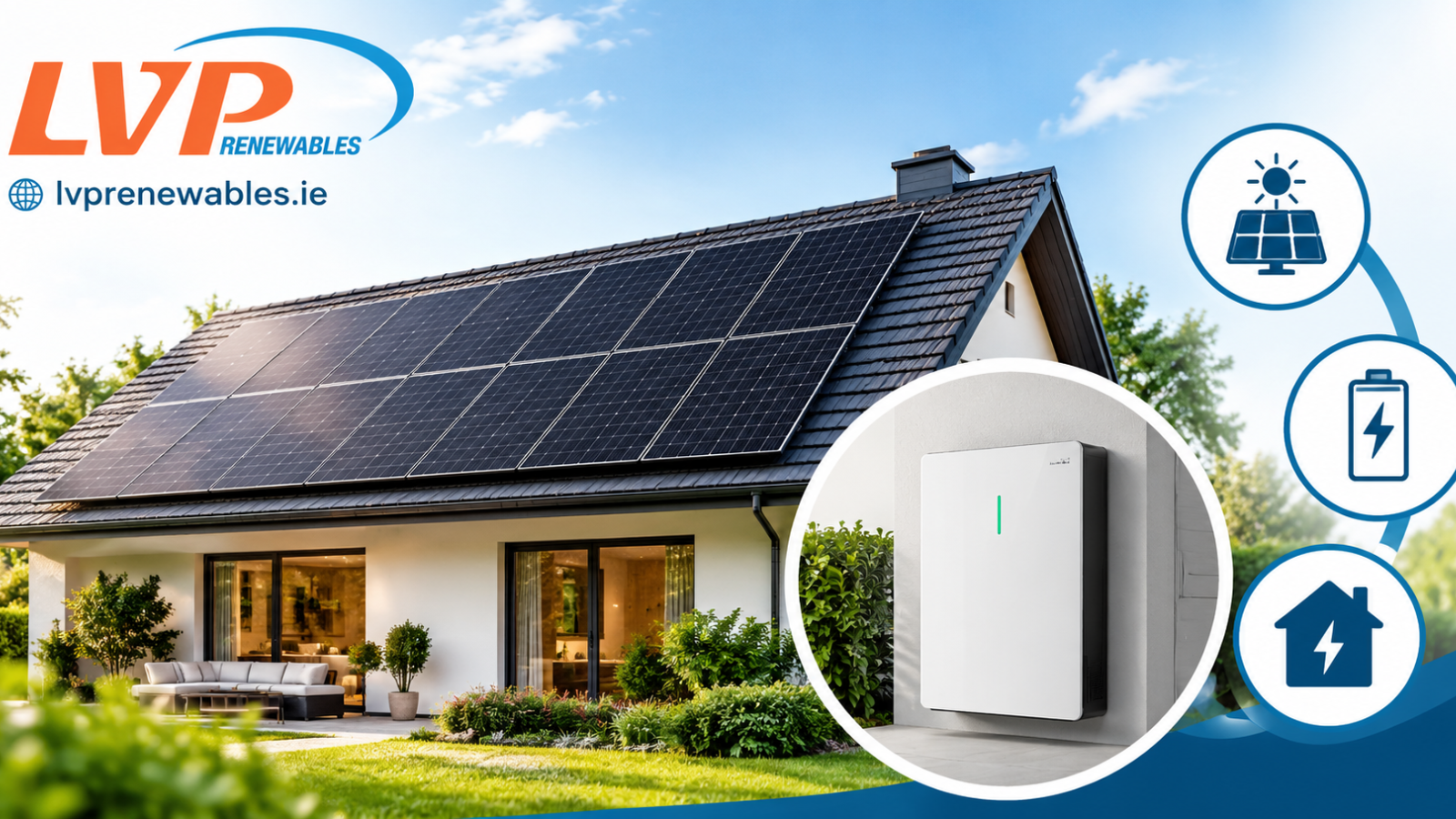
A solar battery stores some electricity generated in the daytime for later use. If the panels produce more electricity than the home needs at midday, the battery can charge. Later, household appliances can use stored solar power rather than drawing as much electricity from the grid. This can increase self-consumption and help reduce imports during evening hours.
The right battery size depends on evening usage, not simply the number of solar panels. A household with high night-time demand, an EV or a heat pump may use more storage than a home with lower consumption. A battery that is too large may remain partly unused for much of the year. In winter, the panels may not generate enough surplus to fully charge it every day.
A battery does not make a home automatically independent from the grid. Most grid-connected solar systems shut down during a power cut unless the design includes compatible backup equipment. If backup power is important, ask whether the proposed battery and inverter can operate during an outage, which circuits they can support and how long they can run them.
Benefits of installing 20 panels with a battery
More renewable electricity for a high-use home
A larger array can supply more of a home’s daytime electricity demand than a smaller system, especially when appliances, hot-water heating or EV charging can be scheduled during sunny hours. The system may be a strong fit for households that expect electricity use to rise as they move away from fossil-fuel vehicles or heating.
Greater potential for self-consumption
Without a battery, unused daytime generation is exported to the grid. A battery can hold some of this excess for later use. The financial benefit depends on the difference between the price of imported electricity and the export payment available from the chosen supplier.
Export revenue for surplus power
If the home’s battery is full or the panels generate more than the home can use, surplus electricity can be exported. Ireland’s Commission for Regulation of Utilities describes how suppliers pay customers for metered exported electricity under the Clean Export Guarantee arrangements. Export rates differ between suppliers and tariffs, so they should be checked when assessing the system’s economics.
Reduced reliance on grid electricity
Solar generation can reduce the amount of electricity purchased from the grid, while the battery can shift some solar energy to later hours. The system does not eliminate grid imports, particularly during dark winter periods or when household demand exceeds available production.
Long-term value from a rooftop asset
Solar panels are intended to generate electricity for many years. SEAI’s homeowner guidance notes that panels are expected to last over 20 years, though other components such as inverters may need attention or replacement during the system’s lifetime. Monitoring production and understanding warranty coverage help homeowners manage the investment.
Is 20 panels too many for a home?
It depends on the home’s annual electricity demand and how much of the output can be used or exported. If a household uses relatively little electricity, a 9.2 kWp array may create large summer surpluses. Export payments can provide value for excess production, but the export rate may be lower than the cost of importing electricity later.
Review a full year of electricity bills or smart-meter data before choosing the system size. Consider current use as well as likely new loads, such as an EV, heat pump or home office. SEAI advises homeowners to take annual electricity use, occupancy, roof orientation, available space, self-consumption and budget into account when sizing an array.
What to check before arranging installation
Ask each installer for a written quote that identifies the panel make and wattage, total kWp, inverter model and capacity, battery usable capacity, monitoring features and warranty terms. Confirm whether the price includes scaffolding, electrical upgrades, commissioning, grid connection paperwork, safety certification and any post-installation requirements.
Request a site-specific annual output estimate and ask what assumptions were used for shading, roof slope, orientation and system losses. Compare the battery and PV costs separately, and ask for the projected energy used on site versus exported. SEAI recommends obtaining multiple quotes from registered solar PV companies and checking total cost, expected annual generation, warranties and maintenance requirements.
Frequently Asked Questions
1. How much does a 20-panel solar system with a battery cost in Ireland?
An Irish 2026 guide estimates approximately €17,500–€23,000 before grants for 20 panels with a battery. The standard SEAI PV and battery grants may total up to €2,400 for eligible households, which would make an illustrative net figure around €15,100–€20,600. The final cost depends on system design, battery capacity, property and grant eligibility.
2. How much electricity can 20 solar panels generate?
Twenty 460 W panels make a 9.2 kWp array. An Irish guide estimates annual generation of about 7,800–8,300 kWh in suitable conditions. Roof direction, shading, location, panel rating and system losses can change the actual result.
3. What battery size is suitable for 20 solar panels?
There is no single battery size that suits every 20-panel system. A home with heavy evening use, an EV or a heat pump may need more storage than a household that uses most electricity during the day. Size the battery using smart-meter data and the installer’s assessment of the home’s load profile.
4. What is the maximum standard SEAI grant for 20 solar panels and a battery?
Under the current standard scheme, the solar grant is capped at €1,800 for PV capacity up to 4 kWp, even when the installed array is larger. An eligible battery of at least 5 kWh may qualify for a separate €600 grant. Enhanced support may be available for some eligible households.
5. Do 20 solar panels need a battery?
No. The panels can operate without a battery, and surplus electricity may be exported to the grid. A battery can store some excess daytime generation for evening use, but its value depends on battery cost, household use, electricity tariffs and export payments.