If you've been keeping an eye on solar panel Ireland news, you may have noticed suppliers adjusting the rates they pay for exported electricity. Electric Ireland reduced its feed-in tariff, prompting a wave of questions from homeowners: does this change the economics of going solar? And more specifically, how does it affect the time it takes for a system to pay for itself?
Here's a clear, honest breakdown of what the Electric Ireland solar panel tariff cut actually means for your payback period, and why it matters less than many people assume.
What the Electric Ireland Tariff Cut Actually Was
The export payment homeowners receive for surplus solar electricity is called the Clean Export Guarantee (CEG), sometimes referred to as a feed-in tariff. Every Irish electricity supplier is required to offer one, but the rate isn't regulated—each supplier sets its own.
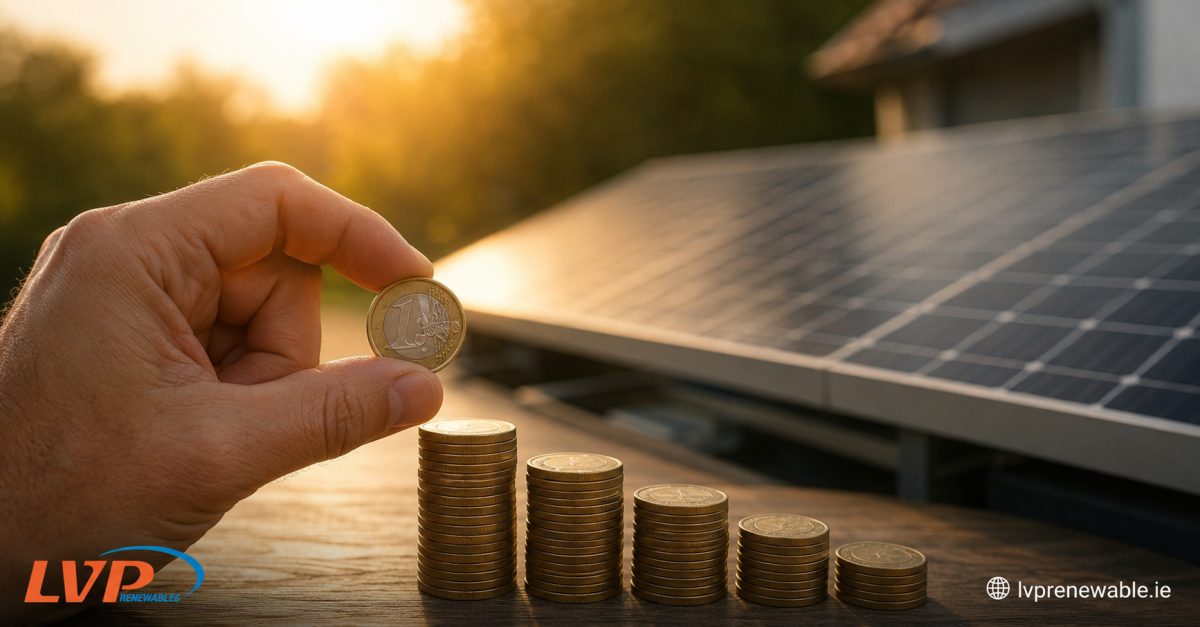
Electric Ireland reduced its CEG rate as part of a broader trend across the market, following the pattern of falling export payments seen from several suppliers in recent years. As of 2026, Electric Ireland's export rate sits at 19.5 cent per kWh, which remains one of the more competitive standard rates on the market, even after the reduction.
For context, rates across Irish suppliers currently range from roughly 15c to just under 20c per kWh on standard plans, with a small number of premium, condition-based offers sitting higher.
Why the Cut Doesn't Hit Payback as Hard as You'd Think
It's natural to assume that any tariff cut for solar panel Ireland systems will meaningfully extend how long it takes to recoup your investment. In practice, the impact is usually smaller than expected, for a few reasons:
- Export income is only part of your return. The bulk of a solar system's savings come from self-consumption—using the electricity you generate directly, rather than selling it back to the grid. Self-consumed electricity offsets your import rate (often 30–40+ cent per kWh), which is worth far more per unit than any export payment.
- Most homes export less than half their generation. A typical household without a battery uses a significant portion of solar output directly during the day, meaning the export rate only applies to the surplus.
- The rate difference is modest in cash terms. On a typical 4kWp system, moving from a higher to a slightly lower export rate usually changes annual income by tens of euros, not hundreds.
Working Out the Real Impact on Your Payback Period
To understand how a tariff cut affects your specific payback period, it helps to break the calculation into its core components:
- System cost – after any applicable solar panels grants have been deducted
- Annual self-consumption savings – electricity you generate and use directly
- Annual export income – surplus electricity sold back to the grid at your supplier's CEG rate
- Total annual return – self-consumption savings plus export income
Only the fourth figure is affected by an export rate cut, and typically only a portion of it. For most households, a modest rate reduction adds a matter of months, not years, to an otherwise 4–7 year payback period.
Ways to Reduce Your Exposure to Future Tariff Cuts
If falling export rates concern you, there are practical steps that reduce your reliance on export income altogether:
- Increase self-consumption by running appliances like washing machines, dishwashers, and immersion heaters during daylight hours when your panels are generating.
- Consider a battery storage system, which stores surplus solar power for use in the evening rather than exporting it at the CEG rate.
- Compare export rates across suppliers periodically, since switching supplier is straightforward and doesn't require any change to your solar panel installation.
- Use a power diverter to route surplus electricity to your hot water cylinder, effectively converting cheap export income into an offset against your immersion or heating costs.
Don't Overlook the Grant Side of the Equation
While tariff rates fluctuate, the upfront cost side of the equation has stayed comparatively stable. Solar panels grants from SEAI continue to reduce the initial investment required, and combined with 0% VAT on domestic installations, the net cost of a typical system remains firmly in payback-friendly territory.
For most homeowners, the size of the grant and the upfront system cost still matter far more to the overall payback period than a one or two cent movement in the export rate.
The Bigger Picture
Export tariffs will likely continue to shift over time as the market matures and wholesale electricity prices change. That's a normal part of owning a solar panel Ireland system, not a sign that solar has become a worse investment. Self-consumption remains the primary driver of savings, and grants remain the primary driver of affordability—export income is best treated as a bonus on top, rather than the main reason to go solar.
FAQs
How much did the Electric Ireland tariff cut actually reduce export income?
The exact impact depends on your system size and export volume, but for a typical household it amounts to a difference of tens of euros per year, not a dramatic shift in overall solar savings.
Does the tariff cut affect my SEAI grant?
No. The Clean Export Guarantee and SEAI solar panels grants are separate schemes. A change to your supplier's export rate has no effect on your grant eligibility or amount.
Should I switch suppliers because of the tariff cut?
It can be worth comparing rates, since switching is simple and doesn't affect your solar panels themselves. However, always compare the total annual bill—import rate included—rather than the export rate alone.
Is self-consumption more important than the export rate?
Yes. Electricity you use directly from your panels saves you the full import rate, which is significantly higher than any export payment. Maximising self-consumption has a bigger impact on payback than the export tariff does.