1MW solar farm can generate a significant volume of renewable electricity, but developing one is more than buying panels and choosing a field. Land suitability, planning permission, export capacity, support-scheme eligibility and a route to sell the electricity all affect whether a project is viable.
This guide explains what a 1MW solar farm cost in Ireland assessment should include. It also covers typical land area, panel count, indicative annual production, potential support routes and why a battery rated at 1MW needs a separate MWh specification. Cost figures are not invented where a dependable current Irish project benchmark is unavailable.
What is a 1MW solar power plant?
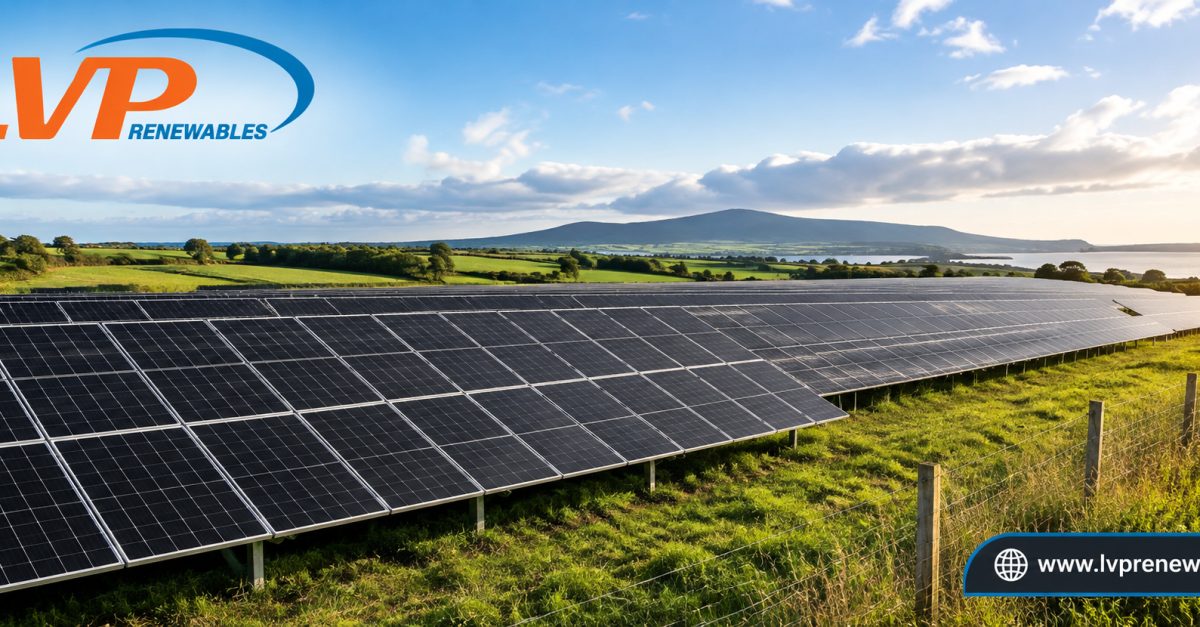
A ground-mounted solar farm uses rows of photovoltaic (PV) modules to convert daylight into direct-current electricity. Inverters convert that electricity to alternating current for export to the grid or use on site. The plant also needs mounting structures, cabling, electrical protection, monitoring, metering and a grid connection.
The solar array’s peak DC capacity is usually described in kilowatt-peak (kWp) or megawatt-peak (MWp). In this article, “1MW solar farm” refers to a nominal 1MWp panel array. It does not mean the site will produce 1MW continuously. The inverter’s AC rating and the connection’s approved maximum export capacity, or MEC, are separate values and may be lower than the DC array rating.
A solar farm is different from commercial rooftop PV, which is usually designed to offset electricity use at a business premises. It is also different from a battery energy storage system (BESS). A battery stores electricity; it does not generate solar energy. The battery’s power rating is measured in kW or MW, while its energy capacity is measured in kWh or MWh. A “1MW battery” therefore does not tell you whether it can deliver for one hour, two hours or longer.
1MW solar panel count by module wattage
The 1MW solar panel count is the target capacity in watts divided by each module’s rated wattage. The table rounds up to a whole panel where needed so the array reaches or slightly exceeds 1,000kWp.
For a 1MWp target, the panel count depends on the wattage of each module:
•400W panels: 1,000,000 ÷ 400 = 2,500 panels, giving an array of 1,000.00kWp.
•450W panels: 1,000,000 ÷ 450 = 2,222.22, so use 2,223 panels to reach or exceed the target. This gives 1,000.35kWp.
•500W panels: 1,000,000 ÷ 500 = 2,000 panels, giving an array of 1,000.00kWp.
•550W panels: 1,000,000 ÷ 550 = 1,818.18, so use 1,819 panels to reach or exceed the target. This gives 1,000.45kWp.
For example, 2,222 panels rated at 450W would total 999.90kWp, just below 1MWp. The designer may choose a slightly different array size to suit the module format, inverter design, land layout or export agreement. Teagasc describes a typical solar park of about 1MW as having approximately 4,000 panels; that reflects lower-wattage module assumptions than several options in the table and is not a universal panel count.

1MW solar farm land requirements
Teagasc’s Irish solar PV guidance estimates that a typical solar park uses around four to five acres per MW, or approximately 1.5–2 hectares. Treat that as a first-pass site-screening estimate, not a fixed rule. The parcel may need to be larger where the shape is irregular or the land has slopes, poor drainage, hedgerows, watercourses, ecological constraints or limited access.
The panels do not occupy every part of the site. Row spacing helps limit inter-row shading, while tracks are needed for construction, maintenance and emergency access. Space is also required for inverters, transformers, switchgear, substations, cable routes and security measures. The final layout depends on module dimensions, fixed-tilt or tracking design, ground conditions, setbacks and planning conditions.
A landowner should commission a topographical and constraints survey before agreeing a lease or purchase. Soil condition, flood risk, drainage, landscape impacts, biodiversity, archaeology and proximity to a suitable grid connection can materially change the usable area and development cost. A site that appears large enough on a map may have much less developable land once these factors are assessed.
Estimated annual output of a 1MW solar farm in Ireland
For early planning, a useful broad range is about 850–1,000MWh per year from a 1MWp solar farm, depending on location, layout and losses. Teagasc gives a typical solar-park estimate of approximately 850,000–950,000kWh a year per MW. Separate illustrative European Commission PVGIS 5.3 runs for Dublin, Cork and Galway, using a fixed south-facing array at 35° tilt and 14% system losses, model roughly 926–994MWh per year per MWp.
These values are estimates, not a yield guarantee. A developer should model the actual site’s coordinates, terrain, row spacing, orientation, shading, module type, inverter configuration and electrical losses. Irish weather varies through the year: longer summer days typically deliver stronger generation, while short winter days reduce production. Cloud cover affects output, but solar PV can generate in daylight without direct sunshine.
How many homes can 1MW power?
Using the 850–1,000MWh annual output range above and the CSO’s 2025 national median residential electricity consumption of 3,228kWh per year, the energy is equivalent to roughly 260–310 households’ annual consumption. This is an annual energy comparison: it does not mean the solar farm supplies those homes directly at every hour. Actual supply depends on the timing of generation, grid operation, household demand and any contracted electricity arrangements.
1MW solar farm cost in Ireland: project cost components
A reliable 1MW solar power plant cost cannot be inferred from the price of panels alone. Total installed project cost includes PV modules, inverters, mounting structures, DC and AC cabling, transformers, switchgear, protection equipment, metering and monitoring. It also includes civil works, foundations or piles, access tracks, drainage, fencing, installation labour, engineering, surveys, planning work, commissioning and grid connection.
The 1MW solar farm cost in Ireland can vary significantly with ground conditions, terrain, cable length, equipment selection, planning obligations, export capacity and the distance to a suitable connection point. Network studies or upgrades may add cost and delay. Financing, land lease or purchase, legal work, insurance and ongoing operating expenses are separate from the EPC or equipment contract and should be accounted for in the overall project budget.
LVP Renewables publishes a broad commercial PV installed-price range of €850–€2,000 per kWp, but its commercial page describes systems in the 2–400kW range. That is not a verified utility-scale ground-mounted 1MW price and should not be extrapolated into a project quotation. No single current Irish 1MW solar-farm cost range is used here because the available public price reference is not directly comparable. Investors should obtain a site-specific, itemised proposal that separates equipment, civil works, grid connection and development costs.
Equipment cost, installed cost and operating expenses
Equipment cost covers the panels, inverters, racking, cabling and electrical components. Installed project cost adds design, surveys, civil and electrical works, labour, grid works, testing and commissioning. The full development budget may also include planning, environmental assessment, legal and land costs, financing and contingency.
After commissioning, operating expenses can include site inspections, vegetation management, monitoring, inverter or component repairs, insurance, land rent, security, grid charges and asset management. The level depends on the site and contract. Long-term financial analysis should allow for panel degradation, equipment replacement and periods when the plant is unavailable.
1MW battery storage cost: power is not energy
There is no meaningful single price for a 1MW battery without knowing how much energy it must store. A 1MW / 2MWh battery can nominally deliver 1MW for two hours; a 1MW / 4MWh battery can nominally deliver for four hours, before operating limits and conversion losses. Both have the same power rating but different energy capacities and uses.
A BESS quotation should specify usable MWh, charge and discharge power, duration, battery chemistry, inverters or power-conversion system, controls, cooling, fire detection and suppression, civil works, grid connection, commissioning, warranties and replacement assumptions. A 1MW battery storage cost can therefore differ greatly between projects. No current Ireland-specific price range is stated here without a comparable, documented source and a defined MWh duration.
Storage may help shift solar output into higher-value periods, manage export constraints or provide contracted grid services where permitted. It also adds capital cost, losses, operational complexity and safety requirements. Model the battery separately from the solar farm and confirm that the revenue opportunity, grid approval and operating strategy justify the extra investment.
Grants and support schemes in Ireland
Support depends on whether the project primarily serves an on-site consumer or exports electricity to the grid. SEAI’s Non-Domestic Microgen Grant (NDMG) is aimed at renewable self-consumers using solar to power a farm, business or community building; Government guidance describes this as the SRESS self-consumer grant route. SEAI lists systems up to 1,000kWp and, as displayed on 14 October 2026, shows €300/kWp for the 201–1,000kWp band. For a 1,000kWp project, that is a €300,000 band calculation. For new applications made between 6 October 2026 and 6 July 2027, SEAI states an enhanced effective 45% rate; the payment is the lower of the grant amount on the application summary or 45% of the invoiced cost.
That calculation is not an award or a guarantee that an export-led solar farm qualifies. The Government’s SRESS guidance describes Phase 1 as a grant route for renewable self-consumers. Applicants must meet the current scheme requirements, use the appropriate registered company and receive a grant offer before starting work. Check the latest application guide and terms with SEAI before including any grant in a project-finance model. Existing applications are not increased under the enhanced rate, and the application window is time-limited.
For an export-only project, the Government’s SRESS Phase 2 guidance says applications are welcome for projects greater than 50kW and up to 1MW. If accepted, the electricity supplier pays the project for exported electricity under the scheme’s arrangements. The applicant must still secure a grid connection, planning permission where required, and a supplier route. The guidance says ground-mounted installations over 75m² require SMEs and farmers to have full planning permission before applying; Renewable Energy Communities are given nine months after a SRESS Letter of Offer to obtain planning permission.
The separate Renewable Electricity Support Scheme (RESS) allocates support through auctions, with EirGrid operating the auction process and qualification. It is not a standard grant and should not be treated as an automatic support route for a 1MW project. Check the current auction’s qualification rules and timetable if considering it. Verify all grant or tariff conditions before committing land, financing or construction expenditure.
Revenue, financing and return on investment
A solar farm may sell electricity through an accepted SRESS export tariff, a power purchase agreement (PPA), or another permitted supplier or market arrangement. The price, term, settlement basis, volume risk and curtailment provisions depend on the contract. A developer should obtain indicative terms from potential buyers or suppliers early, rather than assume a fixed export price.
A basic revenue estimate is annual metered export multiplied by the contracted price. A project cash-flow model then subtracts operating costs, land rent, insurance, grid and market charges, asset management, financing and tax. Simple payback divides the project’s net upfront investment by annual net cash flow; a fuller investment appraisal compares cash flows over the project life and calculates net present value or internal rate of return.
The model should show land purchase or lease terms, development and planning costs, grid connection offers, contingency, debt interest, construction timing, degradation, downtime, maintenance and any battery replacement. Sensitivity cases should test lower output, lower selling prices, delays, higher connection costs and different financing terms. Without a project quotation and an evidenced revenue agreement, publishing one payback period would create false precision.
Planning, grid connection and project timeline
A 1MW ground-mounted solar farm is a development project, not simply a panel installation. Planning permission and environmental screening should be investigated early with the local planning authority. The required studies depend on site characteristics and project impacts, including landscape, ecology, drainage, heritage, traffic and grid works. The planning route and any environmental assessment are site-specific; do not assume that an exemption for some rooftop systems applies to a solar farm.
For a project over 200kW, Government SRESS guidance directs the applicant to apply for grid connection through ESB Networks’ Enduring Connection Policy (ECP) process. ESB Networks says applications below 40MW are initially submitted to the distribution network for a distribution-level connection. Neither fact guarantees capacity at a particular substation. The project needs a connection assessment, approved MEC, protection and metering design, and clarity on required network works and charges.
Typical development stages include land control and feasibility, site and environmental surveys, grid pre-application work, planning and support-scheme applications, a connection offer, detailed engineering, procurement, construction, testing and commissioning. Planning appeals, grid capacity and connection works, environmental surveys and equipment lead times can extend the programme. Establish a project-specific schedule after the authorities and network operator have reviewed the proposals rather than promising a generic completion date.
Key risks and suitable project sites
A viable site needs enough contiguous developable land, manageable terrain, good access and a credible route to export. Key risks include planning refusal or conditions, environmental constraints, grid congestion, curtailment, uncertain support or offtake, cost escalation, construction delays and changes in electricity prices. A land agreement should account for planning and grid-development periods and specify what happens if the project cannot proceed.
Potential participants include landowners, farmers, renewable-energy communities, businesses and project developers. A site near a suitable grid connection, with a clear planning pathway and credible buyer or support route, can be more valuable than a larger but constrained field. Project feasibility should be established before major development expenditure.
How LVP Renewables can help
LVP Renewables’ commercial PV page describes systems from 2kW to 400kW and roof- or ground-based commercial installations. A 1MW solar farm is above that stated range, so prospective developers should confirm directly whether LVP can support the project scope or advise on the right assessment route. LVP can be contacted through its website to discuss commercial solar requirements and request a tailored assessment.
The most useful first steps are to identify the site, gather land and electricity information, assess whether the project will self-consume or export, and investigate grid and planning constraints. A well-founded 1MW solar farm cost in Ireland estimate comes only after these site-specific checks and a defined commercial route for the electricity.
FAQs
How much does a 1MW solar farm cost in Ireland?
There is no single verified current price for every Irish 1MW solar farm. Groundworks, grid connection, planning, land and export requirements vary substantially. A comparable, itemised site proposal is needed; the smaller commercial PV price range published by LVP should not be treated as a utility-scale quote.
How much land is needed for a 1MW solar farm?
Teagasc gives a typical estimate of four to five acres, or about 1.5–2 hectares, per MW of solar park capacity. Layout, access, drainage, terrain and environmental constraints can increase or change the usable site area.
How many homes can a 1MW solar farm power?
At an estimated 850–1,000MWh annual output and the CSO’s 2025 median household use of 3,228kWh, the annual energy is equivalent to about 260–310 households. It is not a guarantee of direct, continuous supply to those homes.
How much does a 1MW battery storage system cost?
A 1MW power rating alone is not enough to price a battery. A 1MW/2MWh unit stores less energy than a 1MW/4MWh unit. Obtain an itemised quotation after specifying MWh duration, usable capacity, grid connection, safety equipment, controls and warranty terms.