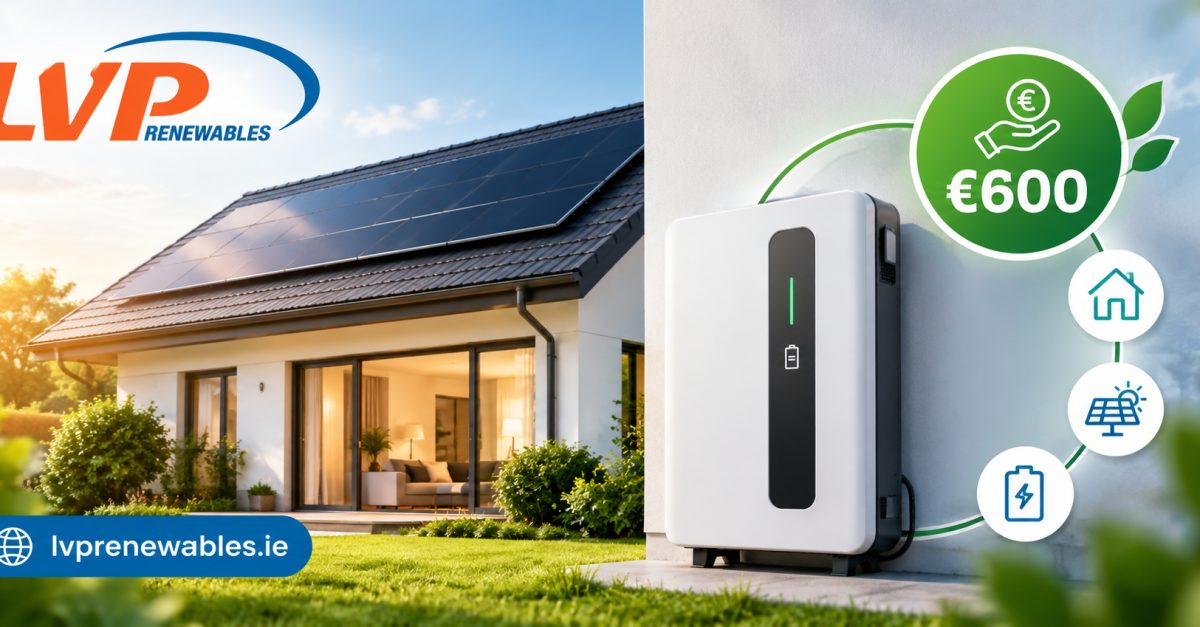
The New SEAI Battery Grant 2026, effective from 6 October, offers eligible homeowners €600 towards a qualifying home battery. A battery stores electricity for later use, including solar power generated in daylight. It does not generate electricity, and the grant will not cover the full installation price. Here is how the scheme works, who may qualify and when storage could make sense for a home.
What is the New SEAI Battery Grant 2026?
SEAI’s Battery Energy Storage System Grant is a flat €600 for an eligible home battery of at least 5kWh. It is separate from the domestic solar PV grant, which supports panels that generate electricity. The standard PV grant is up to €1,800, so eligible applicants may receive up to €2,400 across both measures. Each grant has separate rules.
Who is eligible for the €600 SEAI battery grant?
Eligible applicant types include homeowners, private landlords, owner management companies and approved housing bodies. The property must have an MPRN and have been built and occupied before 2025. The battery must be 5kWh or larger, and a property that has previously received battery funding at that MPRN cannot receive the grant again.
Use an SEAI-registered solar PV contractor, meet the technical specifications and receive the Grant Offer before work starts. Where solar PV is present, SEAI requires a post-works BER assessment before payment. Check the current scheme terms before ordering equipment.
How does solar battery storage work?
Solar photovoltaic panels generate electricity in daylight. The home uses what it needs at the time; surplus power can charge a compatible battery. Later, stored electricity can supply evening demand when panels are producing less. If household demand exceeds available solar and stored energy, the home still draws from the grid.
A solar battery stores electricity; it does not generate it. Panels alone provide daytime electricity and can export surplus power. Adding storage may shift some generation to later hours, depending on system configuration and household use.
Is a €600 home battery grant worth it?
The grant lowers the upfront price, but a battery remains a significant purchase. It may suit a home that regularly has unused daytime solar generation and higher evening use. It may be less attractive if the household uses most electricity while panels are generating, has little surplus, or needs substantial electrical work.
The benefits of solar battery storage include using more home-generated electricity later and potentially reducing grid imports at peak times. The financial case depends on tariffs, export payments, battery efficiency, system size and usage. Avoid assuming a fixed payback period.
SEAI’s 2026 announcement associates the battery measure with potential savings of up to €137 a year. It separately estimates up to €878 annually for a 4kWp solar PV system paired with a 5kWh battery. These are modelled “up to” figures, not guaranteed savings or a battery-only estimate of €878.
How much does a solar battery cost in Ireland?
Irish consumer and installer guides indicate a broad €1,500–€7,000 price for adding a home battery. Subtracting the eligible €600 grant gives an illustrative cost of €900–€6,400. A quote may include or exclude other equipment and electrical work, so these are not fixed prices.
Home battery installation: Approximately €1,500–€7,000.
SEAI battery grant: €600, subject to eligibility and approval.
Indicative cost after grant: Approximately €900–€6,400. The actual cost depends on the equipment and any additional electrical work.
Potential annual savings: SEAI cites up to €137 associated with the battery measure. This is an estimate, not a guarantee.
Solar PV and battery together: SEAI estimates savings of up to €878 per year for a 4kWp solar PV system paired with a 5kWh battery. This figure is for the combined system, not the battery alone.
Price depends on capacity, battery chemistry and manufacturer, inverter compatibility, existing PV equipment, electrical work, monitoring and warranty. Ask for a written quote for your home.

How much can you save with a solar battery?
Savings depend on household demand, when electricity is used, solar generation, tariffs and export arrangements. A time-of-use tariff can change the value of storing or using power at different hours. Seasonal generation also matters: a battery cannot store summer electricity for winter.
SEAI’s up-to €878 figure applies to a combined 4kWp PV and 5kWh battery example; it should not be presented as savings from storage alone. Use your bills and export rate to estimate your likely result.
Can you apply for the battery grant if you already have solar panels?
Potentially. SEAI allows an eligible applicant with an existing PV application to submit a separate battery application without amending it, as long as battery work has not started. The other measure may also be applied for later if its conditions are met.
Before applying, have a contractor check inverter compatibility and system suitability. The battery grant still requires its own offer before installation. Previous battery funding at the MPRN disqualifies the home; check the separate PV rules if claiming both grants.
Can you apply for both the SEAI solar PV grant and battery grant?
Yes, if eligible. The standard solar PV grant is up to €1,800 and the separate battery grant is €600, giving potential combined support of €2,400. The actual award depends on each application and the installed system. Some homeowners receiving specified social protection payments may qualify for a distinct enhanced PV-and-battery package up to €9,000; it is not the standard grant and is not universal.
How to apply for the SEAI battery grant in Ireland
1.Check SEAI’s current eligibility and technical rules.
2.Choose an SEAI-registered solar PV contractor and obtain a written quote.
3.Confirm battery capacity, inverter compatibility and any additional work.
4.Apply through SEAI and wait for the Grant Offer before installation.
5.Have the installer complete required technical and ESB Networks procedures.
6.Submit completion documents and any applicable BER.
The offer identifies the approved measure and installer and is generally valid for eight months. Get SEAI agreement before changing approved details.
Solar PV panels alone or with a battery?
Solar PV panels alone
- Upfront cost: Lower; no battery purchase.
- Surplus power: May be exported to the grid.
- Evening demand: Usually supplied by the grid.
- Best fit: Homes that use more electricity during daylight hours.
- Grant support: Solar PV grant of up to €1,800, subject to eligibility.
Solar PV with battery storage
- Upfront cost: Higher, even after the battery grant.
- Surplus power: Some can be stored for later use.
- Evening demand: Stored solar electricity may cover some use.
- Best fit: Homes with surplus daytime generation and later electricity demand.
- Grant support: Solar PV grant plus an eligible €600 battery grant.
Panels generate electricity; batteries store it. The extra investment should be weighed against expected household use and savings.
Why choose LVP Renewables for solar PV and battery storage?
LVP Renewables lists domestic solar PV and battery storage services. Request a quote that specifies battery size, compatibility, installation scope and grant assumptions, then confirm eligibility with SEAI. Explore domestic PV, battery storage or LVP Renewables to discuss a quotation.
FAQs
1. Is there a new €600 SEAI battery grant in Ireland in 2026?
Yes. Eligible home batteries of at least 5kWh can receive €600.
2. What is the minimum battery capacity?
The battery must be 5kWh or larger.
3. Who can apply?
Eligible applicant types include homeowners, private landlords, owner management companies and approved housing bodies.
4. Can I get the grant if I already have solar PV panels?
Potentially, if you qualify and apply before battery work starts.
5. Can I apply for both grants?
Yes, eligible applicants may receive up to €2,400 combined under the standard PV and battery grants.
6. Is a 5kWh battery enough for a typical home?
It depends on evening demand and available solar surplus. Ask an installer to size it to your usage.
Conclusion: Is the €600 home battery worth it?
The New SEAI Battery Grant 2026 offers €600 towards an eligible battery of at least 5kWh, but leaves a substantial upfront cost. Eligibility, solar output, evening use and tariffs determine whether storage makes sense. Compare a complete quote with realistic savings and get approval before installation. Visit LVP Renewables to discuss solar PV and battery storage.