The €9,000 SEAI solar grant is the maximum support for eligible homeowners receiving certain Department of Social Protection (DSP) payments: up to €8,400 for solar PV plus €600 for an eligible battery. It pays towards approved work; it is not an automatic cash benefit. This guide covers DSP welfare payment eligibility, grant amounts and the Warmer Homes alternative.
What is the €9,000 SEAI solar grant for welfare recipients?
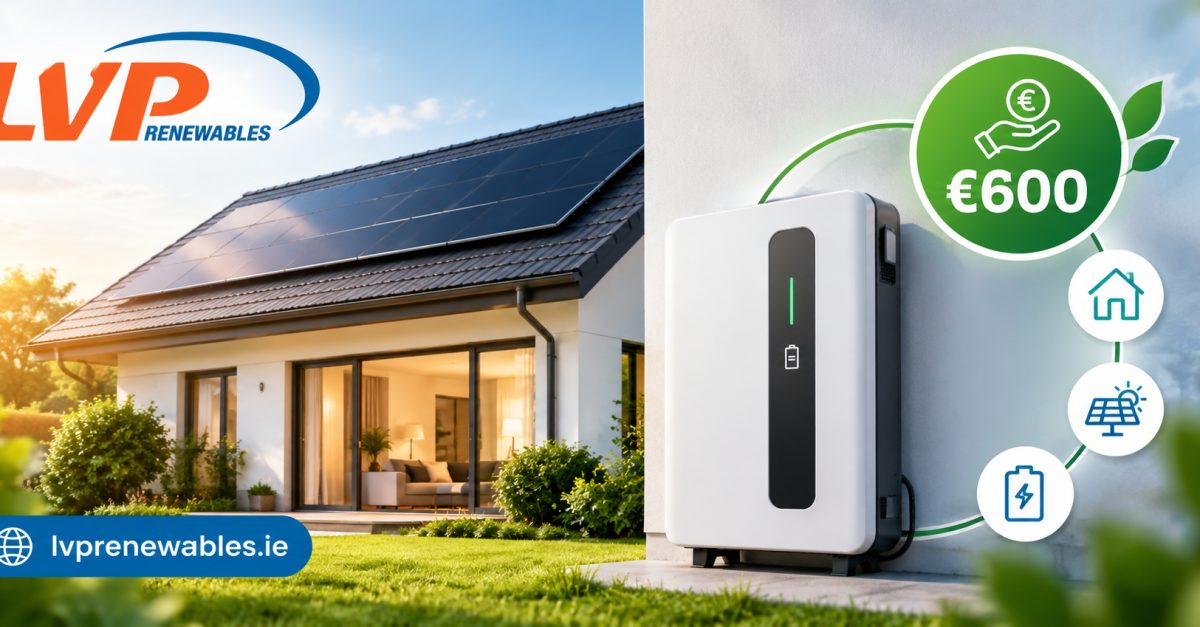
From 6 October 2026, eligible homeowners receiving specified DSP payments can apply for higher solar photovoltaic panel grants. Support is up to €8,400 for PV up to 4kWp, plus a separate SEAI battery grant of €600 for a qualifying battery of 5kWh or more. The combined maximum is subject to approval.
Unlike the standard domestic PV grant, capped at €1,800, the enhanced solar PV grant in Ireland depends on named payment categories and property conditions. Not every welfare recipient qualifies.
Which DSP welfare payments qualify?
SEAI lists these qualifying Department of Social Protection payments and conditions:
1.Fuel Allowance under the National Fuel Scheme.
2.Jobseeker’s Allowance received for more than six months, with a child under seven in the household.
3.Working Family Payment.
4.One-Parent Family Payment.
5.Domiciliary Care Allowance.
6.Carer’s Allowance, if the applicant lives with the person they care for.
7.Disability Allowance received for more than six months, with a child under seven in the household.
At least one qualifying payment is required, but payment status alone does not guarantee approval. The scheme is not a general solar PV grant for low-income households; check SEAI’s current rules for your circumstances.
Who can apply for the enhanced solar PV and battery grant?
The home needs an MPRN and must have been built and occupied before 2025. A property whose MPRN has already received PV funding cannot get another PV grant. The battery grant has separate criteria, including a 5kWh minimum and a restriction on prior battery funding.
Eligible applicant types include homeowners, private landlords, owner management companies and approved housing bodies, subject to scheme rules. Use an SEAI-registered contractor; a One Stop Shop may manage eligible multi-upgrade projects. Get the grant offer before work and complete the required post-works BER.
How much can you receive for solar PV panels and a battery?
SEAI lists €3,350 per kWp for the first 2kWp, then €850 per additional kWp up to 4kWp. The battery grant is separate.
Solar PV panels, up to 2kWp: Enhanced grant of €6,700.
Solar PV panels, up to 3kWp: Enhanced grant of €7,550.
Solar PV panels, up to 4kWp: Enhanced grant of €8,400.
Eligible solar battery, 5kWh or larger: Additional grant of €600.
Maximum combined support for solar PV and battery: Up to €9,000.
These are maximum contributions, not guaranteed awards or cash. The €600 battery grant is additional to the €8,400 PV cap.

Enhanced grants or the Warmer Homes Scheme?
Qualifying households can compare two routes with different eligibility and project management.
Enhanced individual grants
- How it works: The homeowner applies for the higher grants and selects eligible upgrades and an SEAI-registered contractor. An eligible One Stop Shop may manage multiple upgrades.
- Key points: The homeowner has more choice of measures and provider. The grant contributes towards approved costs; the homeowner pays any remaining amount.
Warmer Homes Scheme
- How it works: SEAI assesses the home, selects suitable measures and manages the fully funded work.
- Key points: The applicant does not choose every upgrade. The home must meet the scheme’s separate ownership, age, payment and survey requirements.
Warmer Homes requires the applicant to own and live in the home, built and occupied before 2006, and pass a suitability survey. SEAI says PV and battery will be offered as standard from 2026, subject to assessment. Contractor contact may take around 15 months.
How do solar photovoltaic panels and battery storage work?
Solar PV panels generate electricity in daylight. The home uses what it needs; surplus can charge a compatible solar battery for later use. If demand exceeds generation and stored power, electricity still comes from the grid.
Panels generate; batteries store. Savings depend on the home, system, usage and tariffs. SEAI cites up to €878 annual savings for a 4kWp PV system with a 5kWh battery, a modelled maximum rather than a household forecast.
Example: how the €9,000 grant could reduce costs
Hypothetical example only: suppose an eligible homeowner receives a written quote of €12,000 for an approved 4kWp PV system and qualifying 5kWh battery. If the application qualifies for the maximum enhanced grants, the calculation is:
•Installation quote: €12,000
•Enhanced grant for 4kWp solar PV: −€8,400
•Eligible battery grant: −€600
•Illustrative amount remaining: €3,000
This hypothetical is not a market average or cash payment. Actual quotes and grants depend on eligibility, equipment, roof and electrical work.
How to apply for the enhanced SEAI solar grant
1.Confirm a qualifying DSP payment and check the property rules.
2.Compare enhanced individual grants with Warmer Homes.
3.Get an itemised quote from an SEAI-registered contractor or eligible One Stop Shop.
4.Apply through SEAI and provide requested information.
5.Wait for the grant offer before work starts. It names the approved measure, installer and amount.
6.Complete the work, ESB Networks procedures and post-works BER; submit required documents.
SEAI generally requires approved PV work to finish within eight months. Check the offer before changing the installer or measure.
Is the €9,000 SEAI solar grant worth applying for?
The enhanced rate can reduce upfront cost, but grant size alone should not determine what to install. Compare written quotes, expected generation, battery suitability and remaining costs against household electricity use.
Searches such as “solar panel grants Ireland”, “SEAI grants Ireland 2026” and “renewable energy grants Ireland” can surface different schemes. The phrases “enhanced solar PV grant Ireland”, “solar PV grant for low-income households” and “SEAI solar grant for welfare recipients” refer here to the route for specified DSP payments—not a general income test. When checking “solar panels Ireland”, “solar battery storage” or “solar energy Ireland”, use current SEAI guidance.
Why choose LVP Renewables for solar PV panels?
LVP Renewables lists domestic solar PV and battery storage services. Request a quotation for the proposed system and installation, then verify grant eligibility with SEAI. Visit LVP Renewables to discuss solar PV and battery storage.
FAQs
1. Can I get up to €9,000 for solar panels and a battery?
Potentially. The maximum combines up to €8,400 for PV and €600 for a qualifying battery, subject to eligibility and approval.
2. Which DSP payments qualify?
Fuel Allowance, Working Family Payment, One-Parent Family Payment, Domiciliary Care Allowance, and Carer’s Allowance with the live-in condition qualify; Jobseeker’s and Disability Allowance have extra duration and child-age rules.
3. Does everyone receiving social welfare qualify?
No. Only the specified payments qualify, and property and grant conditions also apply.
4. How much is the enhanced PV grant for a 4kWp system?
Up to €8,400, with a further €600 for an eligible battery.
5. Is the battery grant included in the €9,000 total?
The maximum total is €8,400 PV plus an additional €600 battery grant.
6. Do I need to own the home?
The enhanced route is for eligible homeowners; the applicant and property must meet SEAI’s rules.
7. How does the enhanced route differ from Warmer Homes?
Enhanced grants let applicants choose approved measures; Warmer Homes funds suitable measures selected after assessment.
Conclusion
The €9,000 SEAI solar grant is a maximum package—not an automatic benefit for every welfare recipient. It combines up to €8,400 for eligible solar PV and an additional €600 for a qualifying battery. DSP payment, property and technical rules all matter, and Warmer Homes is a separate fully funded route with its own conditions. Confirm eligibility and compare the remaining costs before starting. Visit LVP Renewables to discuss solar PV and battery storage.