Every so often, a policy change is announced and homeowners immediately assume the worst: “Does this mean I will lose my grant?” That is the concern many people have had about Ireland’s new Building Energy Rating, or BER, scale, which came into effect on 24 May 2026.
The straightforward answer is that the new BER scale does not remove the standard SEAI Solar PV grant. The main change is the way energy performance is displayed on BER certificates. Homeowners still need to follow the correct grant process, receive approval before work starts and complete any required post-works documentation. However, the new rating format itself is not a reason to reject an eligible solar panel grant application.
If you are currently considering solar panels grants, this guide explains what changed, what stayed the same, how the updated SEAI support works in 2026 and what your post-installation BER certificate may look like.

A Quick Recap: What Changed on 24 May 2026
For almost two decades, Irish BER certificates used a 15-level scale. Ratings ran from A1 through to G and included subdivisions such as B1, B2, B3, C1, C2 and C3. These subcategories could be difficult for homeowners, buyers and tenants to compare quickly.
From 24 May 2026, Ireland moved to a simpler scale with eight categories:
•A0
•A
•B
•C
•D
•E
•F
•G
The change applies to residential and non-domestic properties, including homes, businesses, schools and public buildings. The new system is intended to align Ireland’s building energy performance information more closely with the approach used across the European Union under the Energy Performance of Buildings Directive.
A0 is a new top category. It is intended for highly energy-efficient buildings that do not use fossil fuels. The other categories remain A to G, but the former subcategories have been removed. In practical terms, the new scale has reduced the number of rating levels from 15 to eight.
The change does not mean that every existing BER certificate must be replaced immediately. SEAI states that existing BER certificates remain valid for 10 years from their date of issue. If your certificate was issued under the old scale and has not expired, it can continue to be used for relevant purposes such as selling or renting the property.
New BER certificates will use the simplified scale and may also show additional information about energy use, renewable energy contribution and whole-life carbon emissions. The updated certificate includes a QR code that can link owners to BER details and tailored energy-upgrade information.
The Question Everyone Is Asking: Does It Affect My Solar Grant?
The short answer is no, the simplified BER scale does not by itself reduce or remove the standard SEAI Solar PV grant. The individual domestic solar electricity grant is based on the scheme’s grant rules, property requirements, system details and approved contractor conditions. It is not normally dependent on achieving a particular minimum BER category simply because the rating scale has changed.
A post-works BER assessment can still be required as part of the grant payment process when solar PV is installed. This means your completed certificate may now show the new A0-to-G format, but the certificate format is different from the grant eligibility decision.
Homeowners may notice the following practical differences:
•A post-installation BER certificate issued after 24 May 2026 will use the new A0, A, B, C, D, E, F and G categories.
•Existing BER certificates remain valid for 10 years from their issue date unless another rule requires a current assessment.
•Older quotations or installer documents that mention the previous 15-point scale may need to be updated for clarity.
•The grant application still needs to be completed before installation begins.
•The grant offer, system details, contractor information and completion documents remain important.
•The exact grant payment is determined by the applicable SEAI scheme and not by the visual appearance of the new BER certificate.
One important distinction is that different SEAI schemes can have different BER requirements. For example, certain whole-home upgrade programmes or One Stop Shop projects may have a post-works BER performance requirement. The new scale may change how that requirement is written, such as referring to a B rating rather than an old B2 category, while the underlying energy-efficiency standard remains comparable. This is separate from the ordinary individual Solar PV grant process.
What Has Not Changed: Solar Panels Grants in 2026
The new BER scale did not replace the main domestic solar grant rates. Under the current standard SEAI Solar PV grant, support is calculated according to the size of the solar PV system up to 4kWp:
Residential Solar PV
The standard grant provides €700 per kWp for the first 2kWp, giving up to €1,400. It then provides €200 for every additional kWp between 2kWp and 4kWp. The maximum standard Solar PV grant is €1,800.
A system larger than 4kWp does not receive an unlimited grant simply because it contains more panels. The standard grant calculation is capped at the applicable limit. For example, a 4.6kWp system may still be assessed only up to 4kWp for the standard solar grant.
Battery Energy Storage Grant
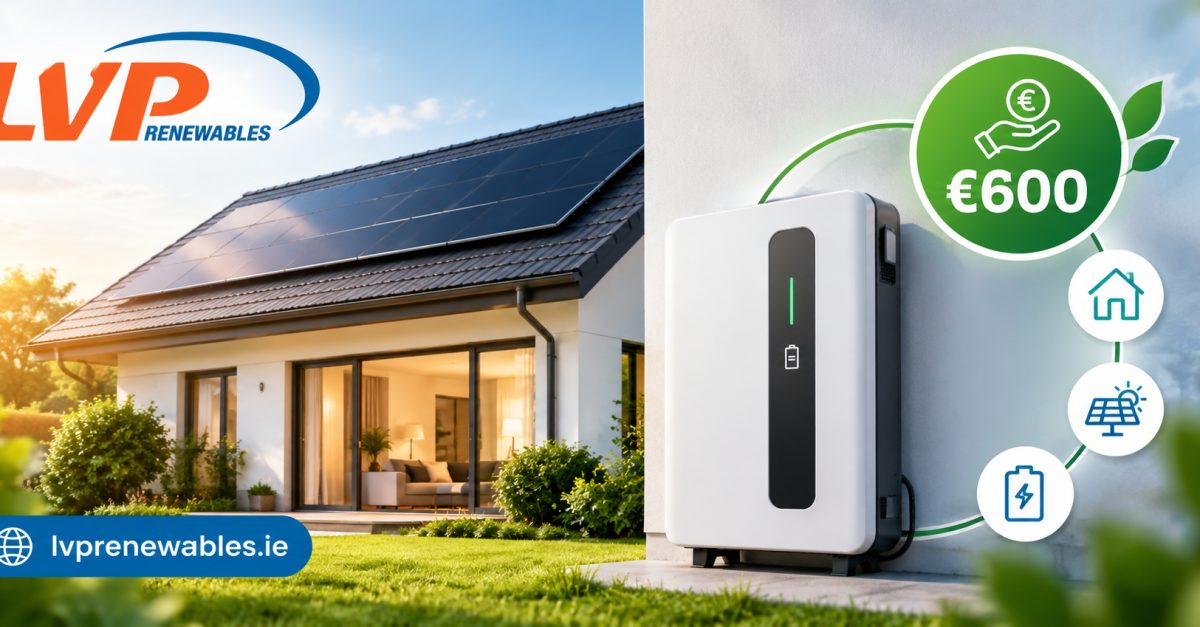
The 2026 rules also include a separate battery grant. An eligible home battery of 5kWh or larger may qualify for a flat-rate €600 grant. A battery below 5kWh is not eligible for this battery grant.
Where a homeowner is installing both solar PV and a battery, both measures can be included in one application if the scheme conditions are met. The maximum standard support can therefore be up to €2,400 in total: €1,800 for solar PV and €600 for an eligible battery. The battery grant is separate from the solar PV grant and should not be confused with the older information that said battery storage was not covered.
Enhanced Support for Certain Households
Enhanced support is available for some homeowners who receive qualifying Department of Social Protection payments. Eligible applicants may receive up to €8,400 for solar PV up to 4kWp and an additional €600 for a battery of 5kWh or more. This creates a possible combined support level of up to €9,000.
The enhanced amount is not available to every homeowner. The qualifying payment, property and application conditions must be checked before relying on the higher grant in a project budget. Some targeted supports also apply to specific rental or fully funded energy-upgrade schemes.
Agricultural and Non-Domestic Solar Supports
Agricultural projects and business or community buildings are not assessed under the ordinary domestic Solar PV grant. TAMS 3 agricultural support and non-domestic solar programmes have separate rules, application windows, investment limits and technical requirements. The support level can be significantly different from the domestic grant, so a farm, school, business or community organisation should use the relevant current scheme guidance rather than applying domestic grant figures.
The SEAI Non-Domestic Microgen Grant supports eligible non-domestic solar PV systems up to a stated maximum system size, with tiered funding. The amount available depends on the scheme rules and the applicant type. These figures should not be presented as a standard homeowner grant.
Eligibility Criteria for the Domestic Solar Grant
The key domestic eligibility conditions remain separate from the change in BER categories. Under the updated 2026 SEAI information, the home must have an MPRN and must have been built and occupied before 2025. The scheme is available to eligible homeowners, including private landlords, and can also apply to certain owner management companies and approved housing bodies.
Other important conditions include:
•The applicant must use an SEAI-registered solar PV company.
•The installation must use eligible new equipment and meet the scheme’s technical requirements.
•Electrical work must comply with the relevant safety and certification requirements.
•The contractor must complete the required Declaration of Works and supporting documentation.
•A grant offer must be received before the installation starts.
•A post-works BER assessment is required where the scheme calls for it before payment is drawn down.
•Previous grant funding for solar PV or battery storage at the same MPRN can affect eligibility.
The exact terms in your Letter of Offer are important. The grant may be limited to the named contractor, system size, measure and grant amount shown in the offer. If you want to change the contractor or system design, contact SEAI before work begins and obtain confirmation.
Why the New BER Scale Is Still Good News for Solar Homeowners
Although the simplified scale does not automatically increase a standard solar grant, it may make the benefits of energy improvements easier to understand. Under the old system, the difference between ratings such as B3 and B1 could be difficult for an average buyer or tenant to interpret quickly.
Under the new system, moving from C to B or from B to A may be easier to communicate. A0 also gives formal recognition to the most energy-efficient homes that do not use fossil fuels. Solar PV can contribute to a home’s renewable energy performance, especially when it is combined with good insulation, efficient heating, airtightness and appropriate controls.
This matters for several reasons:
•A solar installation can contribute to a stronger overall energy profile, although the exact BER result depends on the complete property.
•Buyers and renters may find it easier to compare homes using the simplified rating categories.
•The updated certificate provides more information about renewable energy contribution and energy use.
•A home that combines solar PV with insulation and efficient heating may be better placed to achieve a high rating.
•The new A0 category highlights the performance of highly efficient, fossil-fuel-free buildings.
Solar panels alone do not guarantee an A0 rating. The result depends on the building fabric, heating system, hot water, ventilation, renewable energy contribution and other factors assessed by the BER methodology. Treat the potential BER improvement as one benefit of a properly designed energy upgrade, not as a guaranteed rating promise.
How to Apply for Your Solar Panels Grant
The application process has not been removed because of the BER scale change. A typical process is as follows:
1.Get a quote and site assessment. Choose an SEAI-registered installer and ask for an itemised quotation showing the system size, expected generation, equipment, warranties and total price.
2.Complete the grant application. Submit the Solar PV application, and include the required property, MPRN and contractor details before any work starts.
3.Wait for the Letter of Offer. Do not allow installation work to begin before the grant offer is issued. The offer normally gives you eight months to complete the approved works and submit the required documents.
4.Arrange the grid connection process. Your installer should manage the relevant ESB Networks paperwork and connection requirements.
5.Proceed with installation. The registered contractor installs the solar PV system and, if included, the eligible battery according to the approved design.
6.Book the post-works BER assessment. A BER assessor will issue the certificate under the new A0-to-G format if the assessment takes place after 24 May 2026.
7.Submit completion evidence. The installer will provide documentation such as the Declaration of Works, electrical certificates, invoice, photographs and grid-connection records. Payment follows after SEAI accepts the required evidence.
An experienced SEAI-registered installer, such as LVP Renewables, may coordinate the BER assessment and grant paperwork on your behalf. Even so, homeowners should read the Letter of Offer, keep copies of all documents and confirm that the quoted grant amount matches the approved application.
The Bottom Line
Ireland’s new BER scale is primarily a simplification and comparability change, not a new barrier to ordinary solar funding. From 24 May 2026, BER certificates use the categories A0, A, B, C, D, E, F and G, and existing certificates remain valid for 10 years from their issue date.
For standard domestic solar PV, the grant rules are separate from the new rating format. The current standard Solar PV support is up to €1,800, while an eligible battery of 5kWh or larger may qualify for an additional €600. Enhanced support of up to €9,000 may be available to qualifying households under the relevant 2026 conditions.
The most important steps remain unchanged: use an SEAI-registered installer, apply before work begins, wait for the Letter of Offer and complete the post-works documentation. The new BER scale may make your home’s energy performance easier to explain, but it does not guarantee a particular rating or grant amount.
FAQs
Will the new BER scale reduce or remove SEAI grants for solar panels?
No. The introduction of the A0-to-G scale does not by itself remove the standard Solar PV grant. Grant eligibility depends on the current SEAI scheme conditions, property, contractor, application and completed documentation.
Do I need to redo my BER if I already have solar panels installed?
No. Existing BER certificates remain valid for 10 years from their issue date. You do not normally need to replace a valid certificate merely because Ireland introduced the simplified scale.
Is a minimum BER rating required for the standard Solar PV grant?
The ordinary individual Solar PV grant is not generally based on achieving a minimum BER category. However, a post-works BER assessment may be required before payment is released, and other SEAI schemes can have separate performance requirements.
Is the grant application form for solar panels different under the new system?
The core application process remains in place. You still need to apply before installation, use an SEAI-registered contractor and complete the required documents. Your post-works BER certificate may use the new A0-to-G format.
What is the current standard SEAI solar grant?
The standard domestic Solar PV grant is calculated at €700 per kWp for the first 2kWp and €200 per additional kWp up to 4kWp, with a maximum of €1,800.
Is there now a battery grant?
Yes. An eligible home battery of 5kWh or larger may qualify for a flat-rate €600 grant. A battery below 5kWh does not qualify for that battery grant.
Can solar panels help me reach the new A0 BER rating?
Solar PV can contribute to a high BER rating, particularly when combined with strong insulation and efficient heating. However, solar panels alone do not guarantee A0. The final rating depends on the complete energy performance of the building and the BER assessment methodology.
When did the new BER scale start?
The simplified BER scale came into effect on 24 May 2026. The new categories are A0, A, B, C, D, E, F and G, with the old subcategories removed.