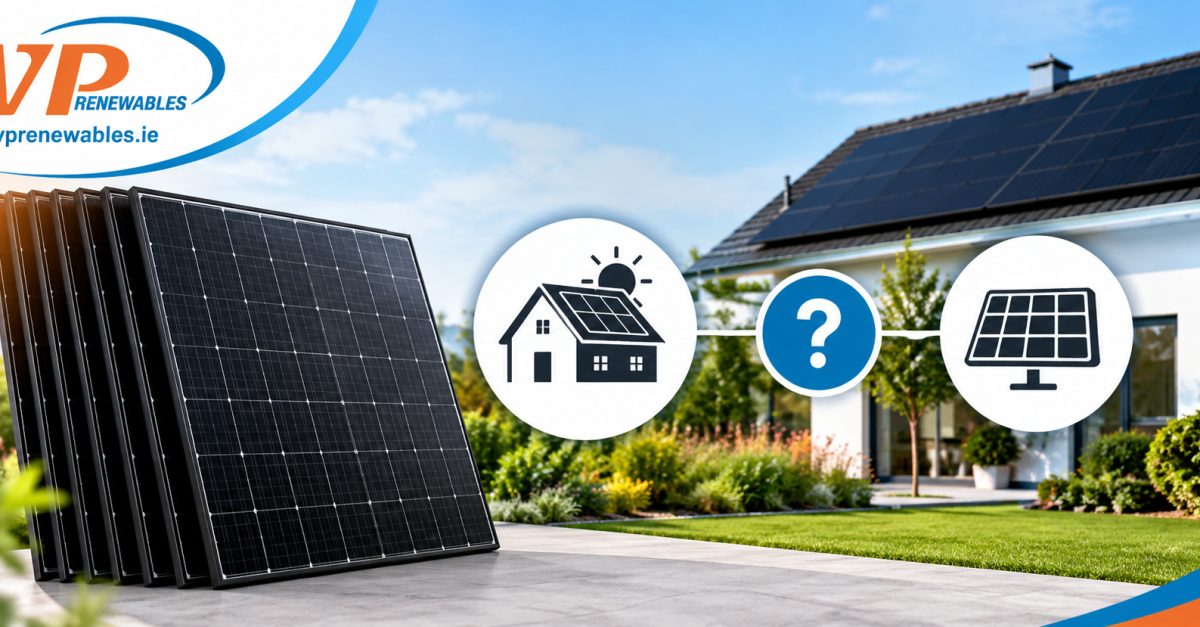
12kW solar system is a substantial solar photovoltaic (PV) array, usually considered by larger homes, farms, or properties with significant daytime electricity use. The number of panels depends on each panel’s rated output: a system made with 400W panels needs 30 panels to reach 12kWp, while higher-wattage panels reduce the total count.
That calculation is only the starting point. Roof layout, shading, inverter capacity, the property’s electricity use and the connection to the grid all affect the final design. Below, we explain how to estimate the panel count, space, cost and potential generation for a 12kW solar system in Ireland.
What is a 12kW solar system?
A solar system’s size is its rated power capacity. Solar installers normally describe a PV array in kilowatts-peak (kWp), the combined peak rating of its panels under standard test conditions. For example, 30 panels rated at 400W each add up to 12,000W, or 12kWp.
The terms kW and kWp describe power, not the amount of electricity generated over time. Electricity generation is measured in kilowatt-hours (kWh). A 12kWp array does not produce 12kWh every hour or the same amount every day. Output changes with daylight, season, weather, orientation, shading and system losses.
A system of this size may suit a large property with high annual consumption, an electric vehicle (EV), a heat pump, a home office or workshop, or a farm with suitable daytime demand. It can also be considered where the owner expects electricity use to increase. For many ordinary homes, however, 12kWp may be more capacity than is needed. The right size should be based on actual and planned electricity use, not panel count alone.
How many solar panels do you need for a 12kW system?
Use this simple calculation:
Number of panels = 12,000W ÷ the rated wattage of one panel
Because you cannot install a fraction of a panel, round any result up to the next whole panel. The table shows the approximate panel count and the capacity those whole panels provide.
- 350W panels: 12,000 ÷ 350 = 34.29, so you need 35 panels, giving a total capacity of 12.25kWp.
- 400W panels: 12,000 ÷ 400 = 30, so you need 30 panels, giving a total capacity of 12.00kWp.
- 450W panels: 12,000 ÷ 450 = 26.67, so you need 27 panels, giving a total capacity of 12.15kWp.
- 500W panels: 12,000 ÷ 500 = 24, so you need 24 panels, giving a total capacity of 12.00kWp.
- 550W panels: 12,000 ÷ 550 = 21.82, so you need 22 panels, giving a total capacity of 12.10kWp.
So, a 12kW solar panel system commonly needs somewhere between 22 and 35 panels, depending on the module rating. With 400W panels, the answer is exactly 30 panels. With 450W panels, 27 modules give 12.15kWp, slightly above the 12kWp target.
The result may be a little above or below the target in a real design. Modules are sold in set ratings, and the installer must also consider roof fit, inverter selection and the property’s electrical connection. The panel rating is the panel’s nominal capacity; it is not a promise of the same output in everyday conditions.
How to calculate the panel count
For a 400W module, divide 12,000 by 400. The answer is 30, so 30 panels produce a combined rated capacity of 12kWp.
For a 450W module, divide 12,000 by 450. The answer is about 26.67, so round up to 27 panels. Multiply 27 by 450W and the installed array is rated at 12,150W, or 12.15kWp.
These examples show why solar panel wattage matters. Higher-wattage modules can reach a similar system capacity with fewer panels, which can help where roof space is limited. But compare module dimensions, efficiency, warranty and price too. Fewer panels do not automatically mean a lower total installation cost.
Solar panel roof space requirements for a 12kW system
Panel dimensions vary by manufacturer and wattage. As a planning guide, a typical residential module around 400–450W is approximately 1.7m by 1.1m, or close to 1.9m² of panel surface. At that size, 30 panels occupy roughly 57m² of panel surface before allowing for roof edges, spacing, access routes or obstacles. Higher-output modules may have a larger footprint, so the roof area does not always shrink in proportion to the panel count. Check the exact dimensions on the proposed product datasheet.
The usable roof area may need to be larger than the panels’ combined surface area. A survey should account for:
•Orientation and pitch: South-facing roofs often give strong annual output, while east- and west-facing slopes can spread generation across more of the day. Roof pitch also affects performance and mounting design.
•Shade: Trees, nearby buildings, chimneys and roof features can reduce output. The installer should assess when shadows fall, not just whether the roof looks sunny at midday.
•Obstacles and clearances: Skylights, vents, chimneys, roof valleys, gutters and roof-edge margins reduce the area available for panels.
•Roof condition and structure: The roof covering, supporting structure, access and wind exposure need to be considered before adding equipment.
•Multiple roof directions: Panels may be placed on more than one roof slope, but different orientations can affect inverter and string design.
A roof can look large yet have limited usable space once these factors are mapped. Ask the installer to show the proposed panel layout and state the module dimensions used in the roof-space estimate.
12kW solar system cost in Ireland
A 12kW solar system cost depends on the panels, inverter, mounting equipment, roof access, wiring, electrical work and complexity of the installation. Battery storage, scaffolding, roof repairs or an upgrade to the electrical supply can add to the total. A 12kWp system is larger than a typical household installation, so it should be priced from a site-specific design rather than a simple per-panel multiplication.
As a rough budgeting estimate, allow approximately €16,000–€24,000 before grants for a straightforward roof-mounted 12kWp solar PV installation, excluding a battery. This is not a guaranteed market price or a quotation. It is a planning range informed by an Irish installer’s published estimate of €14,000–€18,000 before grants for a standard 10kW roof system; a 12kWp project may cost more, and its actual price depends on the design and site. Published general system ranges also vary considerably.
Request a written quotation that separates the PV array, inverter, battery (if included), electrical work and any additional costs. Compare the expected annual generation and assumptions as well as the 12kW solar panel system price. Ask whether the figure is before or after grant support and whether any grant has been deducted upfront.
How much electricity can a 12kW solar system produce?
For an Irish estimate, the European Commission’s PVGIS model calculates monthly and annual PV output using a location, system size, panel tilt and orientation, technology and assumed system losses. It is a planning estimate, not a performance guarantee.
For illustration, PVGIS modelling for 1kWp fixed arrays at a 30-degree tilt, south-facing, with 14% system losses gives approximately 919kWh per kWp per year in Galway, 972kWh in Dublin and 986kWh in Cork. Scaled to 12kWp, that is roughly 11,000–11,800kWh per year across these sample locations. Actual results may be lower or higher depending on the property and the weather.
That works out to a year-round daily average of about 30–32kWh, but generation is not evenly distributed. Long summer days can produce much more than a winter day, when daylight hours are short. The property’s county, roof direction and pitch, shade, module temperature, inverter configuration and system condition all affect actual output. For a tailored estimate, ask the installer to model your address and the specific roof slopes rather than using a national average. The model’s input assumptions should appear in the quotation.
Remember that annual generation is not the same as the amount of electricity you use directly. If the array produces more than the property needs at a particular time, the surplus may be exported, subject to the system and connection arrangements. Your electricity supplier determines export payment terms; ESB Networks manages the network connection.

Factors that affect the system design
The panel count is one part of a wider design. The installer must select an inverter suited to the array, confirm how panels will be grouped, and account for shade and multiple roof directions. A larger DC panel capacity may be paired with a different-rated inverter, but the system design must remain within relevant equipment and grid-connection requirements.
Connection capacity deserves particular attention for a large array. ESB Networks describes microgeneration limits of up to approximately 6kVA on a single-phase supply and approximately 11kVA on a three-phase supply. A 12kWp panel array does not necessarily mean a 12kW AC inverter, so have the installer confirm the inverter output, export arrangement and the correct connection route with ESB Networks before agreeing the design.
Other practical considerations include the condition of the roof, cable routes, the consumer unit, the location of the inverter and battery, and whether planned electrical upgrades are needed. The proposed layout should also account for safe access and the relevant installation standards.
Does a 12kW solar system need a battery?
No. A 12kW solar system can operate without a battery. A battery stores some surplus electricity generated during the day so it can be used later, which may increase the share of solar power consumed at home. This can be useful when household demand is higher in the evening than during daylight hours.
A battery adds to the upfront cost and has a finite capacity. It cannot store summer electricity for winter, and it does not increase the panels’ generation. Whether it makes sense depends on how much surplus the system is likely to produce, when the household uses electricity, battery capacity and price, and the value of exported electricity. Ask for the quotation to show expected self-consumption and export both with and without storage.
SEAI’s current domestic scheme page lists a separate €600 battery grant for a battery of 5kWh, subject to the scheme’s conditions. Check the current rules before applying.
Is a 12kW solar system suitable for a home in Ireland?
It can be suitable for a larger, high-consumption home, especially where an EV, heat pump or other significant electrical load is in use or planned. A farm or mixed-use property with daytime demand may also be able to use a larger share of the generation as it is produced.
For a typical Irish home without unusually high electricity use, 12kWp may be more than necessary. A large array can export a greater share of its summer output if household demand is low at that time. Review at least 12 months of electricity bills, identify new loads you genuinely expect to add, and compare system designs against that demand. SEAI advises homeowners to consider how much of the generated electricity can be used in the home when sizing PV.
The best design is not necessarily the biggest array that fits on the roof. It is the system that balances annual electricity use, daytime consumption, roof suitability, the value of exports and installation cost.
Grants and regulations in Ireland
In the Republic of Ireland, SEAI’s current Solar Electricity Grant page lists a standard grant of €700 per kWp for the first 2kWp, then €200 per additional kWp up to 4kWp, with a maximum standard PV grant of €1,800. A 12kWp system does not receive a larger standard PV grant simply because it is bigger.
The current SEAI page says the home must have an MPRN and must have been built and occupied before 2025. It also says the applicant must have grant approval before work starts, and approved work must be completed within eight months. Previous solar PV grant funding at the same MPRN can affect eligibility. Rules can change, and information pages may not always be updated at the same time, so check the live SEAI scheme terms and confirm your eligibility before signing or starting work.
The SEAI scheme requires a registered company and supporting completion documentation. ESB Networks also sets the relevant connection process. For microgeneration, its guidance refers to the NC6 notification and equipment and installation requirements; the installer should confirm whether the intended system falls within that route or needs a different connection application. Grant eligibility, planning considerations and electrical requirements depend on the property and design. Do not assume that every home or 12kWp installation qualifies for every grant or connection route.
How to choose the right solar panel system
When comparing solar panel installation in Ireland, get more than one written quote and check that each is based on the same system size and assumptions. Ask each installer for:
•The panel make, model, wattage, dimensions and product warranty.
•The inverter make, rated output, warranty and compatibility with the proposed array.
•A roof layout showing panel locations, orientations and any shading assumptions.
•Estimated annual generation in kWh, with the location, tilt, direction and system-loss assumptions stated.
•A complete price, showing what is included, any optional battery, grant assumptions and possible extra work.
•Expected self-consumption and export, plus any maintenance or monitoring arrangements.
•Confirmation of the installer’s relevant registration, installation standards, connection paperwork and after-sales support.
A tailored quotation should explain why a 12kW solar panel system is being recommended for the property’s electricity demand. Check product and workmanship warranties separately, and make sure you understand who to contact if the system needs attention after installation.
Conclusion
The number of panels in a 12kW solar system depends on panel wattage: 30 panels rated at 400W make exactly 12kWp, while other panel ratings produce a nearby capacity with a different panel count. Roof area, usable space, shading, orientation, inverter and grid connection all influence what can actually be installed.
For an Irish property, a well-sited 12kWp system could generate around 11,000–12,000kWh per year in the illustrative PVGIS examples above, but a location-specific design is essential. Cost and grant eligibility also vary, and a 12kWp array may be larger than many ordinary homes need. LVP Renewables can help assess your roof and electricity requirements. Visit lvprenewables.ie to request a tailored solar quotation.
FAQs
How many 400W solar panels are needed for a 12kW system?
You need 30 panels rated at 400W each. Together, they provide a rated capacity of 12,000W, or 12kWp.
How much roof space is required for a 12kW solar system?
A 12kWp system made from 30 typical 400W modules may use about 57m² of panel surface, using an approximate 1.9m² footprint per panel. Roof-edge margins, spacing, obstacles and access mean the required clear roof area may be larger. The exact module dimensions and roof layout determine the final figure.
How much electricity does a 12kW solar system produce in Ireland?
As a planning estimate, around 11,000–12,000kWh a year is plausible for a well-oriented 12kWp array under the PVGIS assumptions described above. Location, roof direction and pitch, shading, weather and system design change the result.
Is a 12kW solar system suitable for a typical Irish home?
Not always. It may suit a large home with high electricity use, an EV or a heat pump, but could be oversized for many typical households. Base the decision on actual and planned demand, roof suitability, daytime usage and a professional assessment.