What could 2,500 solar panels deliver in Ireland?
The answer depends first on the wattage of each panel. Panel count alone does not define a solar farm’s capacity. With 500-watt modules, 2,500 panels add up to 1,250 kilowatt-peak (kWp), or 1.25 megawatt-peak (MWp). At 450 W each, the same count is 1.125 MWp; at 550 W, it is 1.375 MWp. The “p” means peak rated output under standard test conditions, not constant power throughout the day.
For a 1.25 MWp design, an early Irish output estimate is approximately 1.06–1.19 gigawatt-hours (GWh) a year. This scales Teagasc’s indicative range of 850–950 MWh annually for each MW of solar PV. It is a planning estimate, not a promised yield. Actual production must be modelled for the exact site and system design.
That makes 2500 solar panels a substantial commercial-scale project. Whether it makes financial sense depends not just on the module price, but on the ground works, mounting, grid connection, planning, electricity sales and the site’s ability to use power when the array produces it.
Estimated 2500 solar panels cost in Ireland
A single reliable price cannot be quoted from panel count alone. A published Irish developer benchmark puts utility-scale solar construction at roughly €700,000–€900,000 per MW. Applied as a rough comparison to a 1.25 MWp array, that suggests about €875,000–€1.125 million for the core project. Treat this as an early budgeting range, not a supplier quotation or guaranteed turnkey price. Published benchmarks can include different scopes, and site-specific grid and development costs can change the total materially.
The 2500 solar panels price is only one line in the budget. A project estimate should separate:
•PV modules, inverters, transformers, switchgear, cabling, monitoring and export metering.
•Mounting structures, foundations or driven piles, access tracks, drainage, fencing and civil works.
•Engineering, installation labour, testing and commissioning.
•Planning and environmental studies, legal and land costs, insurance, financing and contingency.
•Grid studies, connection assets and any network reinforcement or export limitations.
The commercial solar installation cost is affected by module selection and system layout, but also by ground conditions, slope, cable distance, access, equipment lead times and the capacity available at the proposed connection point. Ask for an itemised, site-specific scope that states what is included and excluded. A low headline price may exclude planning, land, financing, taxes or major grid works.
Solar farm land requirements for 2,500 panels
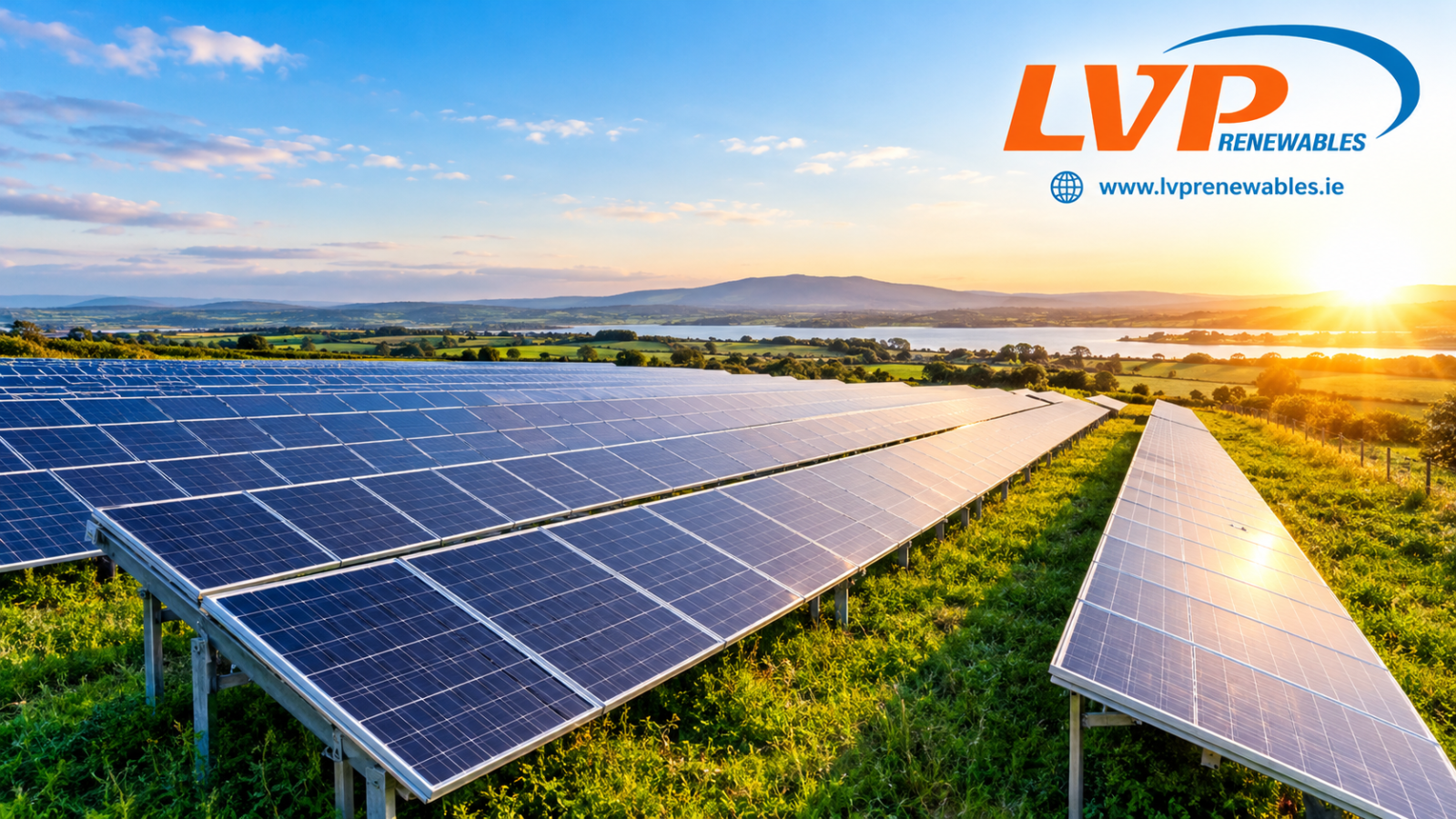
Teagasc’s rule of thumb for a typical solar park is four to five acres (about 1.5–2 hectares) per MW. A 1.25 MWp scheme therefore points to approximately five to 6.25 acres, or about 2–2.5 hectares, as a starting estimate. This is the approximate overall site area, not the area physically covered by the panels.
Rows need enough spacing to limit shading and allow safe maintenance access. The site must also accommodate inverters, transformers, switchgear, cable routes, tracks, drainage and boundary setbacks. Irregular boundaries, slopes, hedgerows, watercourses, flood risk, ecology, archaeology or poor ground can reduce the usable area. A land survey and planning constraints review are essential before relying on a simple acres-per-MW figure.
A relatively level, unshaded site near a suitable grid connection can help control both the land footprint and project cost. Where possible, developers may retain compatible agricultural use, such as managed grazing, subject to design, safety and planning conditions.

Irish sunlight, orientation and annual generation
Ireland’s climate is suitable for solar PV, but output is seasonal. Long daylight hours and higher sun in spring and summer tend to produce more power; short winter days limit generation. Teagasc notes that roughly three-quarters of annual energy can be generated between April and September for solar PV systems. Panels can still produce electricity on bright overcast days, although direct sunshine generally raises output.
A fixed, south-facing layout is a common way to capture strong annual generation, but the best orientation and tilt depend on landform, row spacing and the project’s revenue strategy. East–west arrays may spread output across more of the day, for example, but need project-specific modelling. Trees, buildings, terrain, horizon shading, soiling, snow, inverter availability, cable losses and export restrictions also affect the energy delivered.
Use the European Commission’s PVGIS tool or a qualified designer’s equivalent site-specific model to assess coordinates, tilt, orientation and losses. Do not treat a national average as a guarantee for a particular county or field.
Generation, electricity use and revenue potential
A 1.25 MWp array with the indicative output above could make around 1,060–1,190 MWh a year. The value of that electricity depends on how it is used or sold:
•On-site use: A farm or business can offset purchased electricity when generation coincides with demand. Self-consumption may be more valuable per unit than exporting, but the savings depend on the organisation’s actual import tariff and load profile.
•Export or power purchase agreement (PPA): A project may sell eligible output to a supplier or buyer under a contract. The price, term, metering, balancing, curtailment and volume terms vary. Do not assume that all generated electricity can be exported at a fixed price.
•Support schemes: Applicable grants or support payments can change the project economics, but eligibility is scheme-specific and should be confirmed before including support in a financial model.
For an illustration only, if every unit in the estimated 1.06–1.19 GWh were sold at a hypothetical €0.08–€0.12/kWh, gross annual electricity revenue would be roughly €85,000–€143,000 before operating costs, curtailment, market charges, tax and financing. Those rates are modelling assumptions, not a current Irish tariff or offer. For self-consumption, substitute the value of avoided purchases for the export price and account for the timing of use.
Solar farm payback period: what changes the result?
A simple payback calculation divides the project’s net initial cost by annual net cash benefit. Using the broad capital range above, a project with strong generation and favourable contracted or self-consumed electricity may recover its initial investment sooner than a project with expensive grid works, lower export value or significant curtailment. A simple arithmetic example can produce a wide range, but it is not an investment forecast: it leaves out financing, taxes, degradation, replacement costs, downtime and future electricity prices.
A credible solar farm payback period assessment should model, at minimum:
•Final installed cost, including grid connection and development expenses.
•Hourly generation and the proportion used on site versus exported.
•Contracted export terms, power prices, curtailment and network constraints.
•Operations and maintenance, insurance, land rent and asset-management costs.
•Inverter replacement, panel degradation, financing, tax and the project’s operating life.
•Grant or support eligibility and the timing and conditions of any award.
For a business with daytime electricity demand, a good match between solar output and consumption can improve value. For an export-led farm, connection capacity and a bankable sales agreement are central. A payback figure should only be presented alongside its assumptions.
Planning, grants and grid connection in Ireland
Do not assume that rooftop solar exemptions apply to a ground-mounted solar farm. The Government’s solar-planning page describes exemptions primarily for specified rooftop installations and notes that conditions and Solar Safeguarding Zones apply. A field-scale project should be discussed with the local planning authority and assessed under current planning rules. Screening may need to consider landscape and visual effects, ecology, water and drainage, archaeology, access, heritage and nearby homes. Obtain planning advice before committing to construction expenditure.
The SEAI Non-Domestic Microgeneration Grant supports eligible businesses, farms, public bodies, schools, community centres and non-profits for qualifying systems up to 1,000 kWp. SEAI’s current published grant table sets out support by capacity band and requires applicants to receive a letter of offer before work begins. A 1.25 MWp project is larger than the stated 1 MWp cap for grant-funded system capacity, so do not assume all 2,500 panels qualify. A qualifying self-consumption portion or other support route would need to be assessed against current scheme rules. Grant levels and application windows can change; verify current terms with SEAI before budgeting.
A project of this scale also needs early grid-connection engagement. ESB Networks explains that connection assessments set out the proposed connection method and associated costs in relevant cases, and that connection arrangements depend on the project and network. A nearby line does not necessarily mean that there is available export capacity. Application route, voltage, connection works, network constraints and export limits can affect feasibility, timing and cost. Confirm the project’s connection pathway with the relevant network operator before finalising the financial case.
Ongoing maintenance and operations
Solar farms have no moving parts in the panel field, but they still need active oversight. A maintenance plan typically includes remote performance monitoring, periodic inspections, vegetation control, checks of electrical connections and mounting hardware, inverter servicing and prompt repair of faults. The operator may also need to maintain access tracks, drainage, fencing, security and site records.
Budget for insurance, land lease, monitoring, asset management and possible inverter or component replacement over the project life. Keeping vegetation below panel edges and managing shading helps preserve performance. The owner should agree who is responsible for maintenance, response times, warranties and reporting before commissioning.
At-a-glance estimate
Assuming each panel is rated at 500 W, a 2,500-panel system would have a DC capacity of 1,250 kWp, or 1.25 MWp. It would require an estimated five to 6.25 acres (about 2–2.5 hectares) and could generate approximately 1,060–1,190 MWh per year under the broad Irish yield benchmark.
A published cost benchmark suggests a core project cost of roughly €875,000–€1,125,000, before resolving project-specific additions and exclusions. The payback period depends on the final installed cost, the value of electricity used on site or exported, grid connection, operating costs and financing. These are screening estimates, not guaranteed figures; confirm them with a site layout, connection assessment and commercial model.
FAQs
How much does it cost to build a 2,500-panel solar farm in Ireland?
At 500 W per module, 2,500 panels make a 1.25 MWp array. A broad published Irish utility-scale benchmark implies roughly €875,000–€1.125 million for the core project. Treat this as a preliminary indication only: the land, planning, grid connection and project scope can change the final figure substantially.
How much land do 2,500 solar panels need?
Using Teagasc’s four-to-five-acre-per-MW estimate, a 1.25 MWp project would need about five to 6.25 acres, or two to 2.5 hectares. The final layout may need more land if constraints, access routes, drainage or setbacks reduce the usable area.
How much electricity can 2,500 solar panels generate per year in Ireland?
With 500 W panels, the 1.25 MWp system could produce approximately 1.06–1.19 GWh annually using Teagasc’s indicative yield range. Site location, orientation, shading, weather, system losses and grid export limits affect actual output.
What is the payback period for a solar farm in Ireland?
There is no universal payback period. It depends on total installed cost, electricity used on site, export contract, grant eligibility, grid works, operating costs, finance and generation. Ask for a project-specific cash-flow model with explicit assumptions rather than relying on a single headline number.
Conclusion: price the whole project, not just the panels
For 2,500 modules rated at 500 W, a sensible first pass is a 1.25 MWp solar farm, around five to 6.25 acres, and roughly 1.06–1.19 GWh of annual generation. A preliminary cost benchmark suggests close to €875,000–€1.125 million before the specific site’s additions and exclusions are resolved. These are not guaranteed costs, yields or returns: connection capacity, planning, land conditions and the value of the electricity can change the result materially.
For professional advice on commercial solar design, project costs and next steps, contact LVP Renewables to discuss your site and energy requirements.