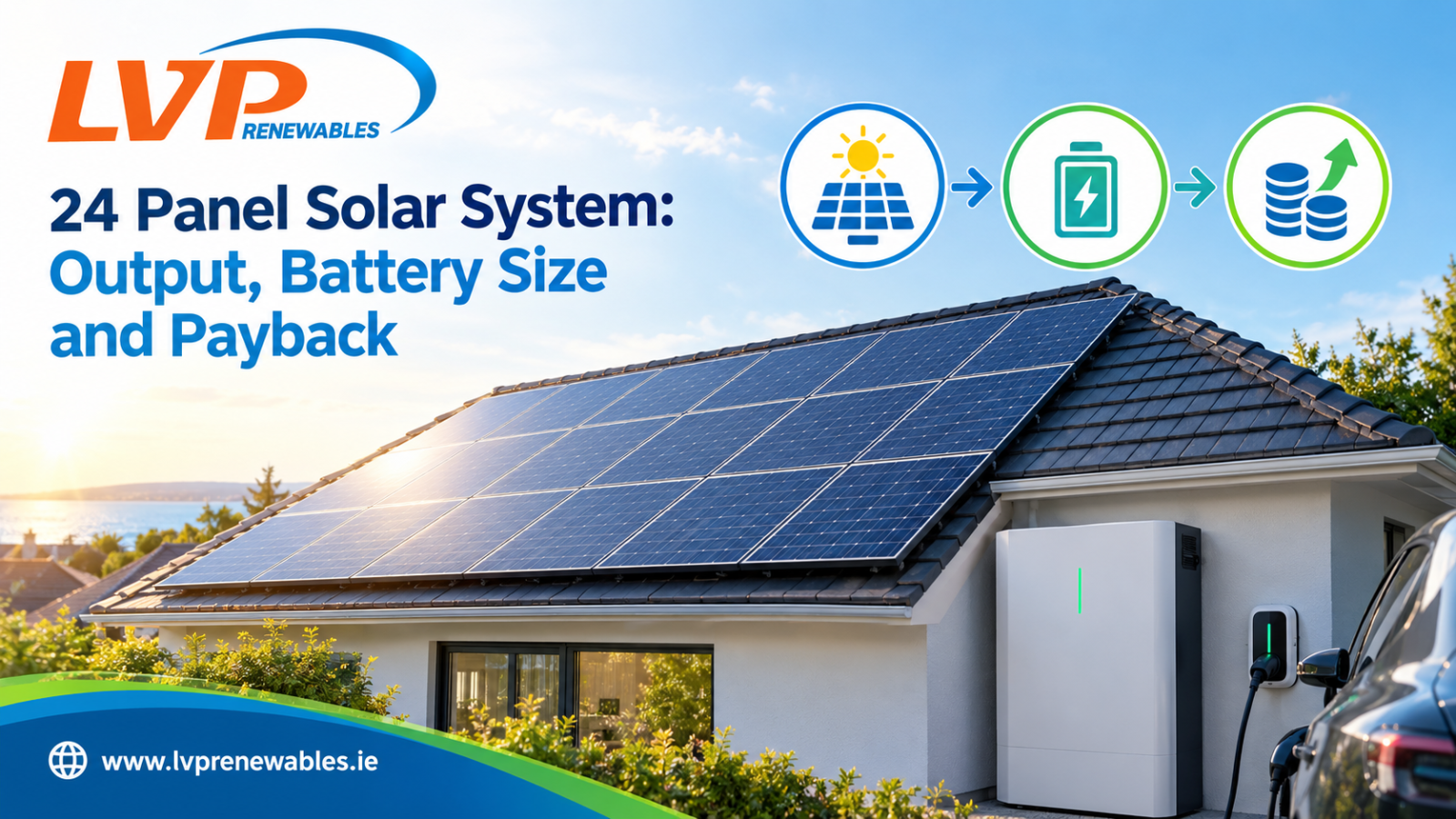
A home with space for 24 solar panels can generate a sizeable amount of electricity, but a large array is not automatically the best value for every property. The right design depends on how much power the household uses, what the roof can safely accommodate and whether a battery can shift surplus electricity to times when the home needs it.
This guide estimates the capacity, annual generation, roof area, installation cost and payback for a 24-panel solar PV system in Ireland. It also compares 5, 10 and 15 kWh battery options and explains the current SEAI grant routes. Prices and savings are examples, not a fixed LVP Renewables quote or a promise of performance.
What is a 24-panel solar PV system?
Solar photovoltaic panels turn daylight into direct-current electricity. An inverter converts it into the type of electricity used by household appliances. The number of panels does not determine capacity on its own: each module has a wattage rating, and the combined system capacity is measured in kilowatts-peak (kWp).
For 24 modules, three illustrative panel ratings give these system sizes:
•24 × 400W = 9,600W, or 9.6 kWp
•24 × 440W = 10,560W, or 10.56 kWp
•24 × 450W = 10,800W, or 10.8 kWp
Watts describe rated power, and kWp describes the array’s peak capacity under standard test conditions. Annual electricity generation is measured in kilowatt-hours (kWh). A 10.56 kWp system does not generate 10,560 kWh every year by definition; the result depends on the roof, weather, shading and system design.
A 24-panel system is a substantial domestic installation. Before choosing one, compare its expected production with actual electricity bills and likely future demand, such as an EV or heat pump. LVP Renewables’ photovoltaic panel information and battery storage page describe the main equipment options.
How much electricity do 24 solar panels generate in Ireland?
A 24 panel array may generate approximately 8,500–9,600 kWh a year, depending on panel wattage and roof conditions. For a middle example of 24 × 440W panels, or 10.56 kWp, an indicative scaled estimate is around 9,400 kWh annually. The estimate uses published Irish guide figures for 20 panels at about 7,800 kWh and 22 panels at about 8,600 kWh; the guide does not provide a direct 24-panel forecast.
The three wattage examples work out approximately as follows:
•24 × 400W (9.6 kWp): about 8,500 kWh per year, averaging roughly 23 kWh per day.
•24 × 440W (10.56 kWp): about 9,400 kWh per year, averaging roughly 26 kWh per day.
•24 × 450W (10.8 kWp): about 9,600 kWh per year, averaging roughly 26 kWh per day.
These are annual averages, not an expected amount every day. For the 440W example, 9,400 kWh averages about 783 kWh a month. Summer days are longer and brighter, so generation is normally much higher in spring and summer than in winter. Cloud cover, low sun and shorter winter days reduce production.
The actual 24 solar panels output also depends on roof orientation and tilt, trees or chimney shade, location in Ireland, module efficiency, inverter sizing and electrical losses. East- or west-facing panels can shift production toward morning or afternoon. A site-specific estimate should use the actual roof and shading. The European Commission’s PVGIS tool and the SEAI solar electricity calculator can help with estimates, but the SEAI calculator models a simple PV system and does not include battery effects.
24 solar panels cost in Ireland: PV, battery and grant
A 24 panel installation’s price depends on more than the panels. Inverter capacity, mounting equipment, roof type, access, scaffolding, labour and electrical work all affect the PV quote. Battery storage, a hybrid inverter, hot-water diverter or EV charging equipment should be priced separately so the homeowner can see what each item adds.
The market guide used here publishes a price for 22 panels—about 9.7 kWp—of €15,500–€17,000 before grant. Its 20-panel price is €14,000–€15,500, a €1,500 step between the two published rows. Extending that same increment by another two panels gives a rough 24-panel estimate of €17,000–€18,500 before grant. This is a transparent extrapolation, not a price listed directly by the guide and not an LVP Renewables quotation.
For homes that meet the standard SEAI scheme rules, a system above 4 kWp can receive up to €1,800 for solar PV. That would put this estimated PV-only price at roughly €15,200–€16,700 after the maximum standard grant. The battery is additional: SEAI’s battery page says an installed home battery can cost in the order of €3,500–€5,500, while an Irish market guide lists a 10 kWh battery at about €5,000–€6,500. A qualifying battery of at least 5 kWh may receive a separate €600 grant.
For one example with a 10 kWh battery, the estimated combined PV-and-battery cost after maximum standard grants is approximately €19,600–€22,600: €15,200–€16,700 for the PV array, plus €5,000–€6,500 for the battery, less the €600 battery grant. Quotes can differ if a hybrid inverter upgrade or other electrical work is needed. LVP’s pricing and consultation page explains how to request a property-specific quotation; its published packages are not a fixed price for every 24-panel system.

How much roof space do 24 solar panels need?
LVP lists a package of ten 460W panels using about 20 square metres of roof area. At a similar panel size, 24 modules would need about 48 square metres of panel surface before allowing for roof edges, ridges, access and clearances. With different panel dimensions, a reasonable preliminary range is roughly 43–53 square metres of panel surface.
A practical layout might use three rows of eight panels on a large roof face. Another option is to split the array across two suitable roof sections if a chimney, skylight or dormer interrupts the available space. A split across different orientations can change when the system generates electricity.
The total usable roof area has to account for more than module dimensions. Roof condition, mounting rails, roof edges, vents, shade and safe access all matter. A professional survey is needed to check whether 24 solar panels can be positioned safely and whether the roof’s orientation and structure suit the proposed system.
What battery size is suitable for 24 solar panels?
A home battery stores some surplus solar electricity for later use. It shifts energy through the day; it does not generate additional electricity. Capacity is measured in kWh, which indicates how much energy can be stored. Battery power is measured in kW, which indicates how quickly it can charge or deliver electricity. The usable capacity may be less than the headline rating, and charging and discharging involve losses.
A 5 kWh battery may suit a household with modest evening demand and offers a smaller amount of stored energy. It is also the minimum size eligible for SEAI’s current battery grant. A 10 kWh battery provides more evening capacity and may suit a larger home or a household with an EV or heat pump, but only if there is enough solar surplus or tariff value to use it. A 15 kWh battery may fit a high-use household with substantial evening demand, but it is a larger investment and may not fill regularly in winter. The 24-panel count alone does not determine the right battery size.
SEAI advises homeowners to look at electricity use from about 4pm onwards, using smart-meter data if available. It also notes that battery systems commonly come with a 10-year warranty and that buyers should check capacity-retention and cycle terms for the specific product. The actual warranty, usable capacity and service life vary by model and use.
Indicative battery prices vary by capacity and product. The market guide lists a 5 kWh battery at around €3,000–€4,500, a 10 kWh model at €5,000–€6,500, and one 13.5 kWh product at €9,000–€11,500. These are not directly comparable models or a guaranteed 15 kWh price. A final quote should state whether the battery, inverter changes, controls and installation are included.
How much can 24 solar panels save on electricity bills?
Savings mainly come from electricity generated and used in the home instead of bought from a supplier. A battery can store some daytime surplus for evening demand. Any electricity not used or stored may be exported for payment, subject to the supplier’s export tariff.
Here is an illustrative calculation for the 24 × 440W system generating about 9,400 kWh a year. Assume the household uses 50% of generation directly or from the battery, and exports the other 50%:
•Used at home: 4,700 kWh × €0.35 per kWh avoided import cost = €1,645 in bill savings.
•Exported: 4,700 kWh × €0.20 per kWh = €940 in export income.
•Illustrative combined annual benefit: €1,645 + €940 = €2,585.
The 35c import rate and 20c export rate are example assumptions published by LVP actual tariffs differ by supplier and plan. The 50% self-consumption share is an assumption, not a promised result. It depends on when the household uses electricity and how much the battery can charge and discharge. Each solar kWh is counted once—either as avoided grid electricity or as an export credit—not both. Standing charges remain payable. SEAI’s calculator also notes that self-consumption depends on whether anyone is home using appliances while solar electricity is being generated.
What is the payback period for a 24-panel solar system?
A simple payback estimate divides the net upfront cost by the estimated annual financial benefit:
Net installation cost after eligible grants ÷ annual financial benefit = simple payback
For the 10 kWh battery example, the midpoint of the estimated combined price range is €21,100. Dividing this by the illustrative annual benefit of €2,585 gives a simple payback estimate of about 8.2 years. This assumes the homeowner qualifies for the full standard €1,800 PV grant and the €600 battery grant, and that the 50% self-consumption assumption is achieved.
It is not a guaranteed return. The final quote, export rate, electricity price, roof orientation, battery use and household demand can all change the result. Financing, maintenance, inverter or battery replacement and future tariff changes are not included. SEAI’s calculator models simple PV payback and does not model the additional cost or benefit of a battery, so battery-inclusive payback should be treated as a household-specific estimate, not an official forecast.
Can you get an SEAI grant for 24 solar panels?
Under the standard domestic scheme, SEAI offers €700 per kWp for the first 2 kWp, then €200 for each additional kWp up to 4 kWp, with the PV grant capped at €1,800. A 24-panel system is much larger than 4 kWp, so it would reach the standard cap if the homeowner and installation qualify.
Standard eligibility includes a home with an MPRN that was built and occupied before 2025, with no previous SEAI solar PV funding at that MPRN. The applicant needs grant approval before work starts and must use an SEAI-registered solar PV company. The grant offer allows eight months to complete the work and submit the required documents.
SEAI also offers a separate €600 battery grant for a battery of at least 5 kWh. The home must meet the scheme conditions, including the build-date and previous-funding rules, and the grant offer must be in place before installation. Solar PV and battery grants can be applied for through one application.
There is also enhanced support for homeowners who personally receive certain qualifying Department of Social Protection payments. SEAI describes this as support for solar PV systems up to 4 kWp and a qualifying battery, with enhanced PV funding up to €8,400 plus €600 for a battery. This is a separate, restricted route—not a general grant for a 24-panel system of around 10 kWp. Check the current SEAI eligibility details before using it in a budget.
Is a 24-panel solar system right for your home?
A 24-panel system may suit a large home, a high electricity user, or a household planning for an EV or heat pump. It requires a large suitable roof and a higher budget than a smaller array. If daytime demand is low and export payments are modest, some extra generation may be worth less than expected.
Before deciding, review annual electricity bills and when power is used. Consider whether a battery would regularly charge from surplus, and whether a smaller array could meet most of the household’s needs at lower cost. The best system size is based on real consumption, roof suitability, budget and future plans—not simply on bedroom count.
FAQs
How much do 24 solar panels cost in Ireland?
A direct 24-panel price is not listed in the cited market guide. Extending its 20-to-22-panel price step gives a rough PV estimate of €17,000–€18,500 before grant, or €15,200–€16,700 after an assumed €1,800 standard grant. Battery storage is additional.
How much electricity do 24 solar panels generate annually?
A 24-panel array may generate around 8,500–9,600 kWh a year on a suitable roof. A 24 × 440W example is estimated at about 9,400 kWh, but actual generation varies with the property and system design.
What battery size is suitable for 24 solar panels?
There is no fixed battery size based on panel count. Compare evening demand and daytime surplus with 5, 10 or 15 kWh options, and check the usable capacity and grant conditions. Smart-meter data can help show what the home uses after 4pm.
How much roof space is required for 24 solar panels?
Allow approximately 43–53 square metres of panel surface as an initial guide. Clearances, roof features, shade and access mean the installer needs to assess more area than the panel surface alone.
How long does a 24-panel solar system take to pay for itself?
In the example here, a PV system with a 10 kWh battery has a simple payback estimate of about 8.2 years. Actual payback depends on the final installation cost, grants, household use, battery operation and electricity tariffs.
Conclusion
A 24-panel system using 440W modules has a rated capacity of 10.56 kWp and may generate about 9,400 kWh annually on a suitable Irish roof. It can need around 48 square metres of panel surface before clearances. A battery may shift surplus to evening use, but the right capacity depends on the household’s after-dark demand—not just the number of panels.
For anyone comparing “24 solar panels cost”, separate the PV price from the optional battery and check grant eligibility before assuming a net price. Treat output, savings and the 8.2-year payback example as estimates. For a personalised solar PV and battery storage assessment, visit LVP Renewables or request a quotation.