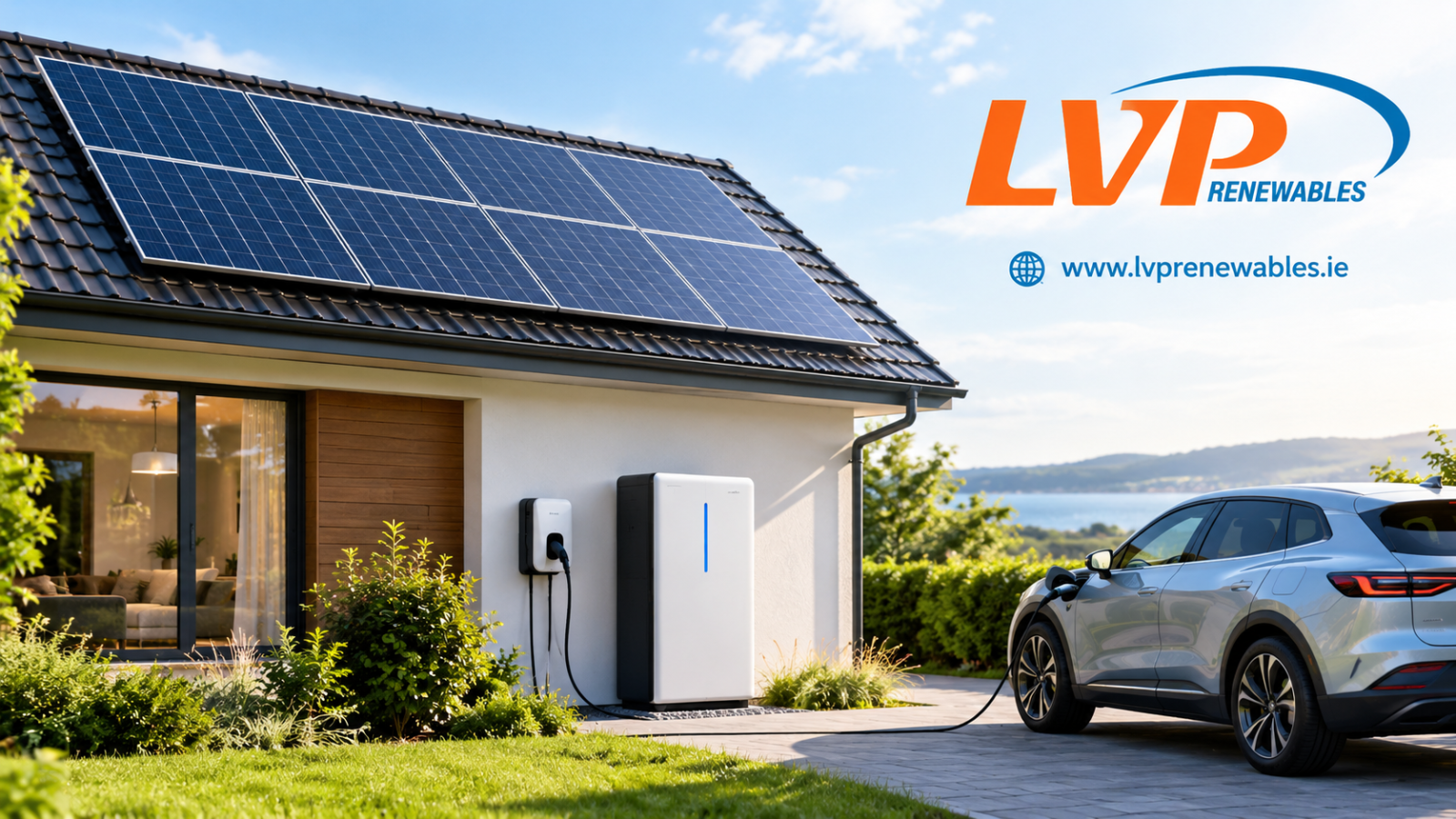
22-panel solar PV system with battery storage and a smart EV charger can help a household use more of its own electricity and charge an electric car at home. It is also a substantial investment, and the benefits depend on the roof, the household’s electricity use, EV mileage and when the car is plugged in.
This guide explains how much a system might generate, how much roof area it needs, and how to think about the combined price, grants, savings and payback. The examples use current Irish market information, but they are estimates—not guaranteed output or a quotation from LVP Renewables.
What is a 22-panel solar PV system?
Solar photovoltaic (PV) panels convert daylight into direct-current electricity. An inverter changes it into alternating current for household appliances. Electricity used at the time can power the home or, if the EV is connected and charging, the car. Surplus may be exported to the grid or stored in a home battery for later use.
The wattage of each panel describes its rated power. The combined system capacity is measured in kilowatts-peak (kWp), while electricity generated or used over time is measured in kilowatt-hours (kWh). These units are related but not interchangeable.
For 22 panels, the capacity examples are:
•22 × 400W panels = 8,800W, or 8.8 kWp
•22 × 440W panels = 9,680W, or 9.68 kWp
•22 × 450W panels = 9,900W, or 9.9 kWp
Capacity alone does not determine the annual electricity generated. Roof orientation, weather, shading, inverter configuration and system losses all affect output. A system should be designed around household consumption, EV mileage and future energy needs, rather than panel count alone. LVP Renewables’ PV panel information and battery storage page introduce its related products and services.

How much electricity do 22 solar panels generate in Ireland?
A suitable, reasonably unshaded 22-panel array could generate roughly 7,800–8,800 kWh a year, depending on panel wattage and roof conditions. For the middle example—22 × 440W panels, or 9.68 kWp—an Irish market guide estimates approximately 8,600 kWh annually. The expected output of a 22-panel solar PV system should be checked for the actual roof before sizing a battery or charger.
That works out to an annual average of about 717 kWh per month or 23.6 kWh per day. It is only an average. Long, bright days in spring and summer usually produce much more than short winter days. Cloudy weather and low winter sun reduce output, though panels still generate electricity from daylight when it is overcast.
The actual 22 solar panels output depends on several factors:
•Roof direction and tilt: South-facing panels often provide strong annual production. East- or west-facing roofs can shift generation toward morning or afternoon, which may better match some household routines.
•Shade: Trees, chimneys, dormers and neighbouring buildings can reduce production if they shade the array.
•Location: Solar resource varies across Ireland. The exact roof and local surroundings also matter.
•Panel and system efficiency: Inverter conversion, wiring and other system losses mean delivered electricity is lower than the combined panel rating.
•Inverter and layout: The design must account for the array’s capacity and any different roof orientations or shaded areas.
The European Commission’s PVGIS tool can estimate production for a location and system configuration. An installer should refine this using the measured roof, orientation and shading. Treat production estimates as forecasts, not guaranteed results.
22 solar panels cost in Ireland: PV, battery and charger
Homeowners searching “22 solar panels cost” should budget for more than the modules. An installed system also includes an inverter, electrical equipment, mounting hardware, labour and commissioning. Roof type, access, scaffolding and any consumer-unit upgrades can affect the PV quote. Battery capacity and type, EV charger model, cable distance and smart energy controls add separate costs.
A current Irish cost guide lists a 22-panel, approximately 9.7 kWp solar PV system at €15,500–€17,000 before grant, or €13,700–€15,200 after an assumed €1,800 SEAI PV grant. The guide’s figures are indicative supply-and-install benchmarks, not LVP Renewables prices.
For a complete budget, consider the add-ons separately:
•A 5 kWh home battery is listed at roughly €3,000–€4,500 in the same market guide, before any eligible battery grant.
•LVP Renewables gives an indicative €800–€1,500 before grant range for a home EV charger installation. The final price depends on cable run length and whether electrical upgrades are needed.
•A longer cable route, consumer-unit work or a more complex installation may add to the charger or system price. Ask the installer to itemise any extra work.
Using those benchmarks, the combined PV, 5 kWh battery and charger could total approximately €19,300–€23,000 before grants. If the household qualifies for the maximum standard PV grant of €1,800, the separate €600 battery grant and the €300 home charger grant, the combined illustrative net cost would be around €16,600–€20,300. These are separate schemes with separate eligibility rules; do not assume that all three grants will be approved.
When comparing quotes, check the full equipment list and scope of work—not just the panel count. LVP’s pricing and consultation page describes its published package information and how to request a tailored quotation. It does not establish a fixed price for every solar, battery and EV charger combination.
How much roof space do 22 solar panels need?
Many modern residential panels cover close to 2 square metres each, although dimensions vary by model and wattage. For 22 panels, allow roughly 44–53 square metres of panel surface as a planning range. LVP’s published example of ten 460W panels covering about 20 square metres is a reference point for similarly sized modules; 22 panels of that size use about 44 square metres before clearances.
A simple arrangement could use two rows of eleven panels on one suitable roof face. A split layout may work better if a chimney, skylight or dormer interrupts the roof, or if more than one roof section is appropriate. Different orientations can affect when electricity is generated.
The usable roof area must also account for roof edges and ridges, mounting equipment, chimneys, skylights, vents, shade and safe access. A professional survey confirms the layout, roof condition and clear area. Panel surface area alone is not enough to determine whether 22 solar panels will fit.
Why add battery storage to 22 solar panels?
A home battery stores some surplus solar electricity during the day so it can be used later, for example in the evening or at night. Its rated capacity is measured in kilowatt-hours (kWh), which describes how much energy it can store. The usable capacity can be lower than the headline figure, and charging or discharging also involves energy losses.
A battery may reduce grid imports when the household is using power after sunset. It can also support EV charging if the car is connected at the right time. But a battery does not increase the panels’ generation, and a larger battery is not automatically more economical. The right size depends on household demand, daytime surplus, EV charging habits, tariff structure and the battery’s cost. Warranty terms and expected service life vary by product and use, so check the model’s warranty period, throughput limits and retained-capacity terms before comparing prices.
One current market guide lists a 5 kWh battery at around €3,000–€4,500 before grant, and SEAI lists a separate €600 grant for a qualifying 5 kWh battery under its current terms. Compare the battery’s extra cost with the value of the export payments it would replace and the electricity purchases it might avoid. Review LVP’s battery storage information and request a battery-specific quotation.
Can 22 solar panels charge an electric car?
Solar electricity can charge an EV through a compatible home charger, but the amount depends on the car’s location, charging schedule and available solar surplus. A smart charger can adjust charging to home demand and solar generation. LVP’s Zappi charger has ECO and ECO+ modes that respond to solar surplus; its ECO+ mode can pause charging when too much electricity would otherwise be imported.
SEAI gives an example of EV consumption at about 14–15 kWh per 100 km, with higher use—around 20 kWh per 100 km—possible at high speeds or in adverse conditions. Using 15 kWh per 100 km as a simple assumption, a driver covering 12,000 km per year would use about 1,800 kWh annually for driving. Actual consumption and charging losses vary by vehicle and conditions. The car’s traction-battery capacity is model-specific and measured in kWh; it is not the same as the capacity of a home battery. The charger’s kW rating describes power, not the amount of stored energy.
The 8,600 kWh solar-output example is greater than that simple annual EV-energy estimate, but this does not mean solar will cover every charge. The car may be away from home during sunny hours, household appliances also use electricity, and winter production is lower. A typical single-phase home charger can be rated at 7 kW the LVP Zappi page also lists a 22 kW three-phase option, which requires a suitable property and compatible vehicle. If charging cannot wait for solar, the household may use grid electricity or schedule charging on an off-peak tariff. Check the current rates on your own plan.
A home battery can shift some daytime solar into evening charging, but it is much smaller than an EV’s traction battery and may also be needed for household loads. Solar can cover part or all of some charging sessions when the car is parked during generation; the contribution will vary through the year.
How much can you save with solar panels, a battery and an EV charger?
Savings come from electricity the household no longer needs to buy, plus any payment for exported surplus. Solar energy used for EV charging is part of the home’s self-consumption. It should not be counted a second time as a separate solar saving.
Here is an illustrative calculation for the 9.68 kWp 440W-panel example producing 8,600 kWh per year. Assume the battery and EV charging schedule allow the household to use 50% of the generation at home, including for the car:
•Used at home or for EV charging: 4,300 kWh × €0.35 per kWh of avoided imports = €1,505 in bill savings.
•Exported to the grid: 4,300 kWh × €0.20 per kWh = €860 in export income.
•Combined illustrative annual benefit: €1,505 + €860 = €2,365.
The 35c import rate and 20c export rate are example assumptions shown on LVP’s price page; actual rates depend on the electricity supplier and tariff. The 50% self-consumption share is also an assumption, not a promise. The calculation includes solar used for EV charging within the 4,300 kWh self-use total. It does not add a second saving for public charging avoided, or assume every EV charge is solar-powered. If the car is usually away during the day, solar charging may be limited. The SEAI solar electricity calculator also considers location, panel direction, system size, electricity price and daytime occupancy when estimating solar savings.
Can you get an SEAI grant for solar panels and a battery?
The current standard SEAI solar PV grant pays €700 per kWp for the first 2 kWp and €200 for each additional kWp up to 4 kWp, with a maximum grant of €1,800. A 22-panel array exceeds 4 kWp, so it could reach that cap if the homeowner and installation meet the scheme requirements.
SEAI says the home must have an MPRN, must have been built and occupied before 2025, and must not have received previous solar PV funding at that MPRN. Apply and receive grant approval before work begins, and use an SEAI-registered solar PV company. The scheme allows eight months after approval to complete the installation and submit the required documents.
SEAI also lists a separate €600 grant for a qualifying 5 kWh battery. The home EV charger grant is a separate scheme, offering up to €300 for the purchase and installation of an eligible smart charger. SEAI requires off-street parking associated with the home, a charger listed on its Smart Charger Register, a Safe Electric registered electrical contractor, and approval before work starts. The property must not already have received an EV home charger grant or the specified pre-2018 ESB Ecars charger support. The charger grant offer is valid for six months.
The EV charger grant is not part of the solar PV grant. Check each scheme’s current conditions before budgeting, and do not count a grant until eligibility and approval are confirmed.
What is the payback period for a solar, battery and EV charging system?
A simple payback estimate divides the net installation cost by estimated annual financial benefits:
Net cost after eligible grants ÷ estimated annual benefit = simple payback period
For the example above, use the midpoint of the combined net cost range, €18,450, and the estimated annual solar benefit of €2,365. The simple calculation is €18,450 ÷ €2,365, or about 7.8 years. This calculation assumes that the relevant PV, battery and charger grants are approved and uses the illustrative import, export and self-consumption assumptions already stated.
This is not a guaranteed return, and it does not include the cost of the EV itself or any fuel savings from replacing a petrol or diesel car. It also does not add a separate public-charging saving, because the annual benefit example already counts the solar electricity used at home or for the EV. Actual results depend on installation costs, EV mileage, battery use, daytime charging, export rates, electricity tariffs, equipment replacement and household demand. A different set of assumptions can produce a shorter or longer payback period.
Is a 22 panel solar system right for your home?
A 22 panel system may suit a large home, a high electricity user, an EV owner or a household expecting to add a heat pump. It also needs substantial roof area and a budget for the PV array and any battery or charger. More panels are not automatically better if the household cannot use or export the output at a reasonable value.
Review annual electricity bills, likely EV mileage, daytime occupancy and future plans. Check whether the car is usually parked at home during solar production, and whether the roof has enough clear, suitable area. The ideal system is based on actual demand, roof conditions and budget—not only on the number of bedrooms or the desire to charge an EV with solar.
FAQs
How much do 22 solar panels cost in Ireland?
A current guide lists a 22-panel, 9.7 kWp PV system at €15,500–€17,000 before the SEAI PV grant, or €13,700–€15,200 after an assumed €1,800 grant. Add a 5 kWh battery and EV charger separately; a combined eligible-grant example comes to roughly €16,600–€20,300 net.
How much electricity do 22 solar panels generate?
A 22-panel system may produce around 7,800–8,800 kWh annually under suitable conditions. The 22 × 440W example is estimated at about 8,600 kWh, but the roof, shade and system design affect actual generation.
What battery size is suitable for 22 solar panels?
There is no single correct size. Compare usable battery capacity with evening household use, available solar surplus, EV charging schedules and the cost of the battery. A larger capacity can cost more without providing proportionally greater value.
Can 22 solar panels charge an electric car?
They can contribute to home charging when the EV is parked during solar generation. A smart charger can use surplus, but seasonal output, household loads and driving times mean the grid may still be needed.
Can I get an SEAI grant for solar panels and battery storage?
Potentially. SEAI lists up to €1,800 for solar PV and a separate €600 for a qualifying 5 kWh battery, subject to scheme rules and prior approval. The home charger grant is separate and can provide up to €300 for an eligible smart charger.
Conclusion
A 22 panel solar PV system using 440W modules is about 9.68 kWp and may generate around 8,600 kWh a year on a suitable roof. It can support household electricity use and some EV charging, while a battery can shift part of the daytime surplus into evening use. The combined installation may need roughly 44–53 m² of panel surface, with additional roof area for clearances and layout.
The full investment behind the search “22 solar panels cost” also depends on battery and charger prices, grant eligibility and household routines. Use the cost and payback figures as transparent examples, not guarantees. For a tailored solar PV, battery storage and EV charger assessment, visit LVP Renewables or request a quote.