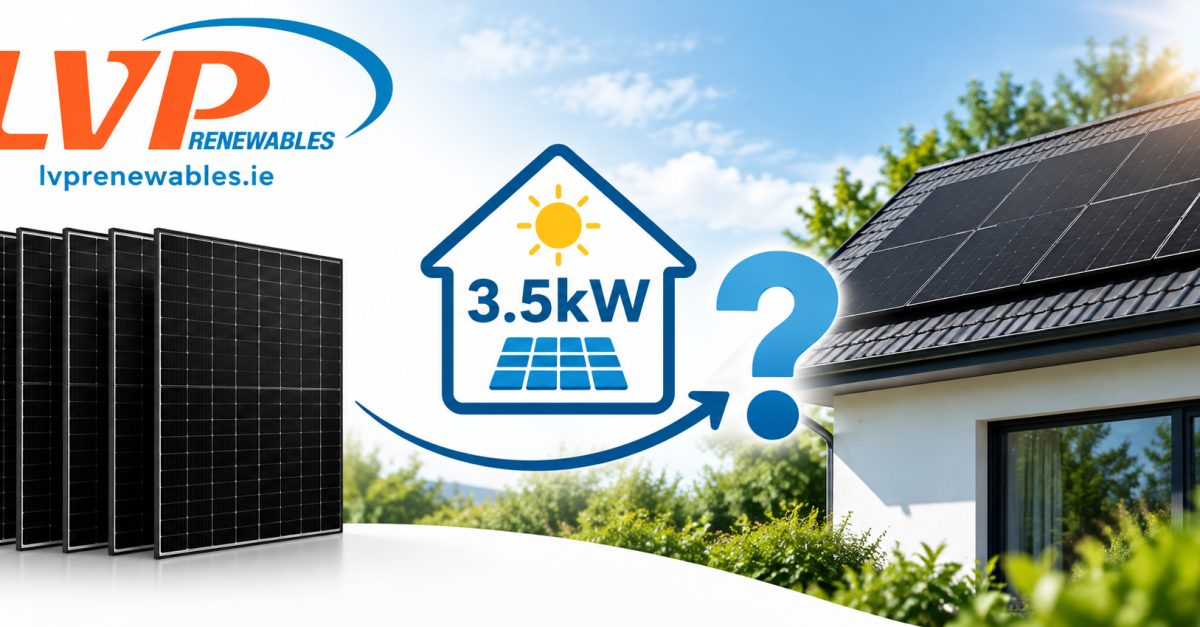
For a solar array rated at 3.5kWp, the number of panels depends on the wattage of each module. The quick answer is 10 panels at 350W, 9 at 400W, 9 at 430W, 8 at 450W, or 7 at 500W to reach or exceed 3.5kWp. Those combinations do not all land on exactly the same capacity: for instance, nine 430W panels add up to 3.87kWp, while eight total 3.44kWp and fall just short.
That distinction matters when checking roof fit, expected generation, quotes and grant calculations. A 3.5kW array is the panels’ combined peak rating, not a promise that it will produce 3.5kW continuously or a fixed amount of electricity every day.
For early budgeting in Ireland, a 3.5kW PV system may cost roughly €5,500–€7,500 before grant without a battery. This is a planning estimate derived from published Irish installed-price guidance for a 3kW system and a broad €1,500–€2,000 per installed kW benchmark. The final cost can fall outside it, especially where access, roof work or electrical changes are needed.
How many solar panels make a 3.5kW system?
The calculation is: number of panels × wattage per panel = total array capacity. Since panels are installed as whole modules, you round up if the calculation needs a fraction of a panel.
- 350W panels: 10 × 350W = 10 panels, producing 3,500W (3.50kWp).
- 400W panels: 9 × 400W = 9 panels, producing 3,600W (3.60kWp).
- 430W panels: 9 × 430W = 9 panels, producing 3,870W (3.87kWp).
- 450W panels: 8 × 450W = 8 panels, producing 3,600W (3.60kWp).
- 500W panels: 7 × 500W = 7 panels, producing 3,500W (3.50kWp).
If the goal is to stay close to 3.5kWp, nine 400W panels make 3.6kWp and eight 450W panels also make 3.6kWp. Eight 430W panels, however, make 3.44kWp, slightly below the target. The ideal option also depends on the panel dimensions, inverter design and the available roof layout.
A quote might use “3.5kW system” as a rounded label even when its panels total 3.6kWp or another nearby figure. Ask the installer to state the exact total DC module capacity in kWp. Use that number, rather than the rounded label, when comparing annual generation forecasts and grant estimates.
What does 3.5kW PV mean?
A 3.5kW PV system—often typed into search as “3.5 kw pv”—is usually described more precisely as 3.5kWp: 3.5 kilowatts peak of panel capacity under standard test conditions. Solar cells convert daylight into direct-current electricity. An inverter changes that DC power into alternating current for household use. A typical grid-connected installation also has mounting rails, cabling, electrical protection and connection equipment. A battery is optional.
Peak capacity and energy generation are different measurements. Kilowatts describe power at a moment. Kilowatt-hours describe energy accumulated over time, such as the electricity used on a bill. A 3.5kWp array will produce varying power through the day and year. Shade, cloud, panel direction, temperature, system losses and the inverter all influence the amount delivered.
3.5kW solar panel roof space
Most domestic panels are roughly 1.7–1.8m long and about 1.1m wide, but dimensions vary by model and wattage. One current 450W Irish retail listing, for example, measures 2.08m × 1.13m—larger than a typical residential module. Always use the model’s datasheet when planning the layout.
For common 350–450W residential panels, a 3.5kWp array might have around 16–21m² of panel surface, depending on the combination and product dimensions. Higher-output panels can reduce the number of modules but may themselves be larger. SEAI uses approximately 20m² as a reference for a well-located 3kW home system, which is a helpful broad planning figure, not a guaranteed roof-area requirement for every current panel layout.
The usable roof area needs to account for more than the panel footprints. A layout may need clearance from roof edges and ridges, and must work around chimneys, skylights, vents and shaded sections. SEAI’s household guidance says roof panels should be at least 50cm from the roof edge.
Measure usable roof area, not the whole roof
For a first estimate, note the length and width of the clearest roof planes and identify which direction they face. Mark any obstructions that could cast shade. Do not assume the full roof surface can be covered. A professional survey will check pitch, structure, access, shade at different times of day and the required clearances.
Roof shape can also change the panel count that fits. A broad rectangle may accommodate modules in a simple grid. A roof broken up by dormers or skylights can leave awkward spaces that are too narrow for another full panel. Flat roofs need mounting frames and row spacing to limit inter-row shading, which can increase the footprint.
3.5kW solar system cost in Ireland
Published Ireland-specific pricing provides a practical starting point, but there is no standard fixed retail tariff for every 3.5kWp job. Energy Hero’s 2026 guide estimates a 3kW installed system at €5,500–€7,500 before grant. Switcher.ie gives a broad domestic benchmark of around €1,500–€2,000 per installed kW. Multiplying the latter by 3.5 suggests €5,250–€7,000, but it is only arithmetic based on a general benchmark. Small jobs can have proportionally higher fixed costs.
For early budgeting, allow around €5,500–€7,500 before grant for a typical grid-connected 3.5kWp installation without a battery, then get a property-specific quote. An indicative standard SEAI grant for an exactly 3.5kWp system is €1,700, which would imply a potential net price of roughly €3,800–€5,800 if the household and installation qualify. This is not a confirmed offer or guarantee of grant approval.
Panel-only cost versus a full installation
A single 450W panel listed by an Irish electrical retailer costs about €127 including VAT at the time checked. Eight of those panels would total 3.6kWp and cost about €1,017 for the modules alone at that retail price. This is only an example of panel cost, not the price of a complete system. It excludes the inverter, mounting, cabling, electrical protection, access equipment and labour. Retail prices and availability can change.
A full installed quote covers much more than the modules. It should specify panels, inverter, mounting hardware, cabling, isolators, installation, testing and commissioning. Depending on the property and quote, it may also include scaffolding, monitoring, grid-connection paperwork and a post-work BER assessment. Residential solar PV supply and installation may qualify for 0% VAT, but check the tax treatment and any exclusions on the quote.
Factors that affect the final price
Panel brand and efficiency: Premium modules can produce more power from a limited roof area, but the highest wattage does not automatically give the best value. Compare product warranties, efficiency, dimensions and the total array rating.
Inverter type: A string inverter can suit a simple roof with one orientation and little shade. Microinverters or optimisers may be considered for multiple roof faces or partial shading. These choices change equipment and installation costs. Ask why the design suits your roof and whether future expansion is practical.
Roof mounting and access: Roof type, height, pitch and condition influence the mounting kit and labour. Scaffolding or specialist fixings can increase the quote. Any roof repairs should be identified before installation.
Electrical work: Cable length, the condition of the consumer unit and required protective devices can affect costs. Confirm that testing, commissioning and connection paperwork are included.
Battery storage: A battery lets a home use some daytime surplus later, often in the evening. It is a substantial additional investment. SEAI says installed household batteries can cost around €3,500–€5,500 and offers a separate €600 grant for eligible batteries of 5kWh or more. Check the current terms.
Expected electricity generation in Ireland
SEAI estimates that a well-located 3kW home PV system can generate about 2,600kWh per year. Scaling that example to 3.5kWp gives an approximate planning estimate of 3,030kWh annually, or about 8.3kWh per day averaged across a year. This is a simple capacity-based estimate, not an address-specific forecast.
A separate Irish solar guide uses about 860kWh per kWp each year for a typical central-Ireland home. Applied to 3.5kWp, that gives roughly 3,010kWh a year, close to the SEAI-scaled estimate. The exact output changes with location, roof direction, pitch, shade and system design.
Ireland’s solar output is seasonal. SEAI notes that around 75% of annual PV generation occurs from May to September. Panels continue to generate on cloudy days, but heavy cloud reduces output. South-facing, unshaded roofs generally produce more over the year; east- and west-facing arrays shift more of their generation into morning or afternoon, which may better match household use.
Self-consumption, export payments and payback
The value of solar electricity depends on when it is generated and when the home uses it. Electricity used immediately can replace units bought from the supplier. Any surplus may be exported under the Clean Export Guarantee, with rates set by individual suppliers. Electric Ireland, for example, publishes a current export rate of 19.5c/kWh and says the rate is variable. It is an example, not a guaranteed rate for every customer.
For an illustration only, assume a 3.5kWp system produces 3,010kWh in a year, the household uses 40% directly, and exports 60%. At a sample import price of 31.3c/kWh and the cited 19.5c/kWh export rate, the annual value is about €730: approximately €377 from self-used electricity and €353 from exports. The import-rate example is a published Electric Ireland plan and is not universal.
If the system costs €3,800–€5,800 after an assumed €1,700 grant, that example implies simple payback of approximately 5–8 years. It excludes maintenance, possible inverter replacement, changing tariffs, battery costs and the time value of money. It also assumes a specific self-consumption split. A household that is out all day may export more, while shifting appliances to sunny hours may increase direct use.
SEAI’s calculator estimates savings and simple payback using location, roof direction, system size, the quote and how often someone is at home during daylight. It notes that standing charges remain and its simple calculation does not model a battery or immersion diverter. Use the calculator with your actual quote and tariff rather than treating a generic saving as guaranteed.

Is a 3.5kW PV system suitable for your home?
A 3.5kWp array can suit a smaller or medium-sized household with moderate electricity demand, especially where the roof has around 20m² or more of suitable space. It may also be appropriate where a larger system will not fit. SEAI’s 3kW example already represents over 40% of average Irish household demand, so a 3.5kWp array can provide a meaningful contribution, though it will not necessarily cover all usage.
Check your annual electricity consumption and daytime usage before deciding. If you plan to add an electric vehicle, heat pump or other large electrical load, ask for a comparison with a larger array. The additional panels may cost less when installed with the original system than added later, and fixed setup costs are spread across more capacity.
SEAI solar PV grant in 2026
The current standard domestic SEAI grant is €700 per kWp for the first 2kWp, then €200 per additional kWp up to 4kWp, with the standard grant capped at €1,800. For a 3.5kWp system, the calculation is €1,400 for the first 2kWp plus €300 for the next 1.5kWp, giving an indicative standard grant of €1,700. SEAI states that grants are paid pro rata, subject to scheme rules and approval.
The home must have an MPRN and must have been built and occupied before 2025. It cannot have previously received solar PV grant funding at that MPRN. Applicants must use an SEAI-registered company and receive the grant offer before work starts. The installation has to meet scheme requirements, and a post-work BER is required before grant drawdown.
SEAI’s 2026 rules widened the home-age eligibility threshold from 6 October 2026. Check the official SEAI Solar PV grant page before relying on older articles or signing a contract.
Compare quotes and choose an installer
Request two or three itemised quotes with the same target system size. Compare exact panel models and total kWp, inverter type, predicted annual generation, roof layout, mounting, scaffolding, electrical works, VAT, warranties and exclusions. Ask separately for any battery price so you can compare like with like.
Check the installer is on SEAI’s current registered list if you plan to claim a grant. Ask for references and a written contract. Ensure the proposal explains how the panels fit your roof and gives an annual generation estimate based on your county, orientation and shading. SEAI recommends comparing quotes and waiting for the grant offer before work begins.
LVP Renewables provides residential solar PV and battery solutions in Ireland. To confirm whether 3.5kWp fits your roof and electricity use, request a personalised solar PV quote from LVP Renewables.
FAQs
How many panels do I need for a 3.5kW PV system?
It takes 10 × 350W, 9 × 400W, 9 × 430W, 8 × 450W or 7 × 500W panels to reach or exceed 3.5kWp. The resulting capacity ranges from exactly 3.5kWp to 3.87kWp.
How much roof space does a 3.5kW solar system need?
Allow roughly 16–21m² for panel surface with common residential modules, then add space for edges, ridges, obstructions and layout clearances. The exact amount depends on panel dimensions and roof design.
What is the 3.5kW solar system cost in Ireland?
A reasonable early budget is around €5,500–€7,500 before grant, based on published Irish installed-price guidance. An eligible exact 3.5kWp system may qualify for a standard grant of €1,700, but a written site-specific quote and SEAI approval determine the actual cost.
How much electricity can 3.5kWp generate in Ireland?
A broad planning estimate is about 3,000–3,030kWh per year, scaled from SEAI’s 3kW output reference and another Irish yield estimate. Actual output varies with location, roof direction, shading and weather.
Conclusion
The number of panels needed for 3.5kWp depends on their wattage: the practical combinations in this guide range from 7 high-wattage modules to 10 smaller ones. Their physical sizes and your roof layout determine whether the array will fit, while inverter choice, roof access and electrical work shape the installed price. Use €5,500–€7,500 before grant as an indicative planning range, not an installer offer; verify the exact kWp and SEAI grant eligibility before work begins. For advice based on your roof and energy use, request a personalised quote from LVP Renewables.