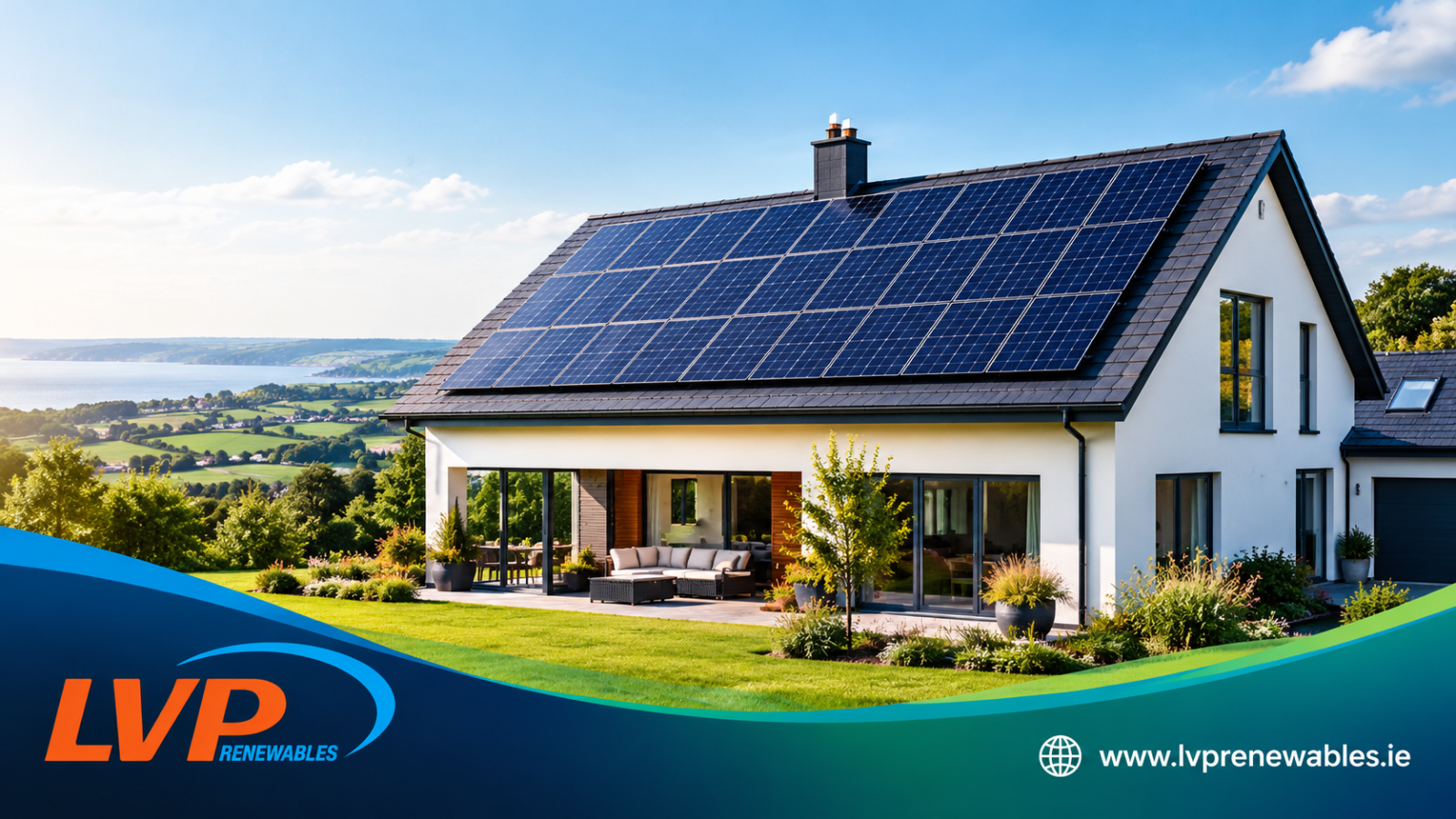
40-panel solar PV system is a substantial installation. It may suit a large Irish home with high electricity consumption, an electric vehicle (EV), a heat pump or significant daytime use. But a big roof alone does not mean that 40 panels are the right choice. Before committing, compare the 40 solar panels cost with your household’s expected generation, ability to use that electricity and available export payments.
Depending on panel wattage, 40 modern panels create an array of around 16–18 kilowatt-peak (kWp). A well-positioned system of that size could generate roughly 14,000–16,000 kilowatt-hours (kWh) a year using a national Irish production benchmark. It may need about 72m² of panel surface, before allowing for roof obstacles, clearances and layout. Costs and savings vary widely, so these figures are a starting point for a site-specific assessment, not a quote or guaranteed return.
What Is a 40-Panel Solar PV System?
Solar photovoltaic panels convert daylight into direct-current (DC) electricity. An inverter converts it into alternating current (AC) for household appliances. The system’s peak capacity is the combined rated power of the panels, measured in kilowatts-peak (kWp). Annual electricity production is measured in kilowatt-hours (kWh), and depends on sunlight, roof conditions and system losses.
Here are three illustrative panel combinations:
•40 × 400W panels: 16,000W, or 16.0kWp.
•40 × 440W panels: 17,600W, or 17.6kWp.
•40 × 450W panels: 18,000W, or 18.0kWp.
A 17.6kWp rating does not mean the system produces 17.6kW continuously. Output changes through the day and year. The array’s DC panel rating may also differ from the inverter’s AC capacity, so the installer should explain the proposed design and any grid-connection requirements.
The number of panels should be chosen against annual electricity demand, when the home uses electricity, roof suitability and future plans. A 40-panel system may generate more than a household can use directly, especially on bright summer days. In that case, some electricity will be exported to the grid rather than displacing a household purchase at the full import tariff.
How Much Electricity Do 40 Solar Panels Generate in Ireland?
SEAI estimates that a well-located domestic system with about 20m² of panels and approximately 3kW of capacity could produce around 2,600kWh annually. That is a useful benchmark of roughly 867kWh per kWp per year, but it is not a guarantee for a particular property. SEAI also notes that solar PV works on overcast days at a lower output and that roughly 75% of annual generation occurs from May to September.
Applying that benchmark to the example system sizes gives these approximate annual totals:
•16.0kWp (40 × 400W): about 13,900kWh per year, or 38kWh per day averaged over the year.
•17.6kWp (40 × 440W): about 15,250kWh per year, or 42kWh per day on an annual average.
•18.0kWp (40 × 450W): about 15,600kWh per year, or 43kWh per day averaged over the year.
A broader planning range of approximately 13,000–18,000kWh per year allows for different roofs, panel ratings and system performance. A site-specific estimate may fall outside that range. Ask the installer to show the location, orientation and shading assumptions in the projected output. SEAI’s solar electricity calculator can also help homeowners explore an initial estimate.
The daily averages do not describe a typical day in each season. Long days can create high generation in summer, while short daylight hours and low sun reduce winter production. Solar output does not follow household demand automatically: a family may use more electricity in the evening, when panels are no longer producing.
The main factors affecting 40 solar panels output are:
•Roof direction and tilt: South-facing panels can generate strongly across the year. East- or west-facing sections may shift generation toward morning or evening, often with a different annual yield.
•Cloud cover and daylight: Panels generate from daylight rather than heat, but cloudy spells and winter days reduce output.
•Shading: Trees, chimneys, dormers and neighbouring buildings can shade some modules and affect array performance.
•Location: Solar resource varies by location in Ireland, so the address matters in a yield estimate.
•Equipment and system losses: Panel efficiency, inverter selection, cabling and conversion losses affect how much electricity reaches the home.
•Array and grid design: Inverter capacity, roof sections and export connection conditions can influence system configuration.
For a system of this size, the installer should confirm the AC inverter capacity and grid application route. CRU guidance says microgeneration systems below 6kW on a single-phase connection or below 11kW on a three-phase connection use an NC6 notification; larger systems up to 50kW use the NC7 process. A 16–18kWp panel array does not by itself determine the inverter size or approval route, so this needs to be checked against the design and property connection.
What Is the 40 Solar Panels Cost in Ireland?
The 40 solar panels cost depends on whether the quote covers only PV panels and inverter or also includes storage, electrical work, a hot-water diverter or EV charging equipment. Irish consumer guidance gives a broad residential installation estimate of about €1,500–€2,000 per kW installed. Applying that rate to a 16–18kWp array gives an indicative range of approximately €24,000–€36,000 before grant.
This is a capacity-based extrapolation from a general market range, not a published price for a 40-panel package. The total may not rise in a straight line with system capacity. Multiple roof areas, inverter design, export connection requirements and access can affect the quote. For context, this is a much larger array than LVP’s example 20-panel, 9.2kW large-residential package. See LVP Renewables’ residential solar options and solar panel cost information, then ask for a quotation based on the actual roof and electricity use.
If the homeowner qualifies for the standard maximum €1,800 SEAI solar PV grant, the illustrative range would be approximately €22,200–€34,200 after that grant. The grant is subject to approval and scheme rules; it is not a discount that applies automatically. Battery storage and EV charging are excluded from these PV-only figures.
Factors that can affect a final installation price include:
•Panel brand, rating, efficiency and warranty.
•Inverter type and capacity, plus any design needed for more than one roof orientation.
•Roof material, pitch, access, condition and structural suitability.
•Mounting equipment, scaffolding, labour and cable routes.
•Electrical work and grid-connection requirements.
•Complex roof geometry or an array spread across several sections.
•Optional battery storage, hot-water diverter or EV charger.
A written quote should identify the number and wattage of panels, total kWp, inverter rating, estimated annual generation, included equipment, grant assumptions and any exclusions. Comparing system designs and projected generation is more useful than judging a proposal by panel count alone.
How Much Roof Space Do 40 Solar Panels Need?
Using the requested illustrative dimensions of 1.8 metres by 1 metre, one panel covers about 1.8m². Forty panels therefore have a combined surface area of approximately 72m². Actual modern panel sizes vary by manufacturer and wattage, so confirm the dimensions of the exact module being quoted.
The usable roof area needed is usually greater than the panel surface calculation. Roof edges and ridges, chimneys, skylights, dormers, valleys, shading and access requirements can prevent panels from being placed in every available space. The roof may also need suitable condition and structure to support the installation.
Panels can sometimes be arranged over more than one roof plane. That can help fit the required number, but differing directions and shading can change generation and electrical design. A survey is essential to establish whether 40 panels will fit safely and to estimate the output from the proposed layout. If the roof cannot take the full array, a smaller system may be more sensible than forcing a complex arrangement.

Is a 40-Panel Solar System Suitable for a Large Home?
This size may be worth investigating for homes with high annual electricity consumption, several occupants, an EV that is regularly charged at home, a heat pump, electric water heating or substantial daytime electricity use such as a home office. These loads can give the household more opportunities to use solar generation directly.
However, the number of bedrooms does not determine the correct system size. Two large homes can have very different electricity use because of heating equipment, occupancy, insulation, EV use and daily routines. Review bills to understand annual kWh consumption, then consider what future loads are likely and when they will run.
A 40-panel system can be larger than many homes need. If much of its generation is exported, a household may receive a lower value for those units than it would from using them directly, depending on its import and export tariffs. A smaller array may give a better balance between upfront cost and self-consumption. The goal is not necessarily to cover every roof surface; it is to select a system that makes sense for actual demand, budget and roof conditions.
How Much Can 40 Solar Panels Save Annually?
The value of solar PV has two parts: electricity used directly at home reduces grid purchases, while surplus exported to the grid may earn an export payment. CRU guidance explains that suppliers pay for metered units exported, with the rate and credited amount shown through the supplier’s billing process. The export tariff depends on the supplier and plan.
Here is a transparent illustration for a system producing 14,000kWh a year. Assume the home uses 40% directly (5,600kWh) and exports 60% (8,400kWh). For illustration only, assume a grid import price of €0.35 per kWh and an export payment of €0.18 per kWh:
•Avoided grid purchases: 5,600kWh × €0.35 = €1,960.
•Export credit: 8,400kWh × €0.18 = €1,512.
•Combined illustrative annual value: €3,472.
The usage split and unit rates are examples, not current offers or guaranteed results. Actual value depends on roof output, the household’s demand, tariff terms and the export arrangement. This calculation does not double-count a unit: power used at home is valued as an avoided purchase, while power exported is valued separately as an export credit.
An EV or heat pump may increase on-site use if it can be operated when solar generation is available. Smart charging and scheduling appliances for brighter hours can help. But if the home is empty during the day and has no flexible loads or battery, a large share of summer generation may be exported. The installer should model self-consumption separately from total generation.
Should You Add Battery Storage to 40 Solar Panels?
A home battery stores some surplus electricity generated during the day and releases it later, often in the evening. This can increase the share of solar power used in the home and reduce grid imports during higher-demand hours. Battery charging and discharging are not lossless, however, and storage adds to installation cost.
A larger solar array does not automatically call for the largest battery available. The appropriate capacity depends on the home’s typical evening consumption, daytime surplus, EV charging schedule, heat-pump demand and tariffs. If the battery is too large for the amount of surplus electricity available, it may not be fully used. Compare battery costs and expected extra self-consumption with the value of exporting that power instead. LVP’s battery storage information outlines its available options.
SEAI provides a separate €600 battery grant for qualifying battery systems of 5kWh or larger, subject to the scheme’s criteria. This is distinct from the solar PV grant and should not be counted as part of every quotation automatically.
Can You Get an SEAI Grant for 40 Solar Panels?
The standard SEAI solar PV grant is calculated at €700 per kWp for the first 2kWp and €200 per additional kWp up to 4kWp, with the standard PV grant capped at €1,800. A system with 40 panels does not receive a higher standard PV grant simply because it has more panels or a greater capacity. The separate battery grant is €600 for an eligible battery of at least 5kWh.
Current grant conditions include having an MPRN, a home built and occupied before 2025 and no previous SEAI solar PV funding at the same MPRN. Eligible applicant types include homeowners, private landlords, owner management companies and approved housing bodies. The installation must comply with the scheme and use an SEAI-registered solar PV company. Some homeowners receiving qualifying Department of Social Protection payments may qualify for enhanced grant support, but that has separate conditions. Check the official SEAI solar PV grant page before applying.
Apply and receive the grant offer before installation work starts. Once approved, applicants generally have eight months to complete the works and provide the required documents. SEAI also requires a post-works BER assessment before grant payment. The installer should explain the application, grid notification, completion documents and deadlines before agreeing a start date.
What Is the Payback Period for 40 Solar Panels?
A simple payback estimate is the net installation cost divided by the estimated annual financial benefit. For example, assume a PV installation costs €30,000 before grant and the household receives the standard maximum €1,800 grant, leaving €28,200 net. Using the illustrative annual value of €3,472 above gives a simple payback estimate of about 8.1 years.
This is only an example. It does not include financing, maintenance, future inverter replacement, degradation, changes to energy prices or the time value of money. It also assumes the system generates 14,000kWh and the household uses 40% directly. A lower self-consumption share, lower export rate or higher installation cost lengthens the payback. A battery can alter both the cost and the amount used on site.
For a large array, a useful payback estimate depends on how much of the additional generation is valuable to the household. Ask for calculations based on expected annual output, hourly or seasonal usage, current import tariffs and the supplier’s export terms. A larger system may give greater bill savings in euro terms, but it is not automatically the fastest-paying option.
FAQs
What is the 40 solar panels cost in Ireland?
A 16–18kWp system has a broad indicative PV-only cost of about €24,000–€36,000 before grant, extrapolated from a published Irish cost-per-kW range. With the standard maximum PV grant, the illustrative net range would be €22,200–€34,200. These are estimates, not a quotation.
How much electricity do 40 solar panels generate?
Using SEAI’s benchmark, 40 panels rated at 400–450W may generate approximately 13,900–15,600kWh a year in suitable conditions. Actual generation depends on the roof, location, shading and system design.
How much roof space is needed for 40 solar panels?
At the illustrative dimensions of 1.8m by 1m, 40 panels cover about 72m². Allow additional space for roof edges, obstructions, layout and access, and have the roof professionally assessed.
Is a 40-panel solar system too large for an average home?
It may be larger than many homes need. The right size depends on electricity use, daytime demand, future plans, roof suitability and budget. A large roof is not by itself a reason to install 40 panels.
Can 40 solar panels power a large home with an EV and heat pump?
They can contribute a substantial amount of electricity, but winter output is lower and the home may still need grid power. EV charging and heat-pump use can raise demand, but results depend on when those loads operate and the system’s actual generation.
Conclusion
Forty solar panels rated at 400–450W make a system of approximately 16–18kWp, with an illustrative Irish annual yield of around 13,900–15,600kWh using SEAI’s national benchmark. The panels alone may cover about 72m², and indicative PV installation costs could be €24,000–€36,000 before grant, based on a broad cost-per-kW extrapolation. A standard SEAI PV grant is capped at €1,800, regardless of a larger panel count. Actual savings and payback depend on household use, export rates, site performance and final price.
The 40 solar panels cost should be weighed against the electricity the home can use—not simply the space available on the roof. Review your consumption, future EV or heat-pump plans and expected export before selecting a size. Visit LVP Renewables or request a personalised solar assessment and quotation to discuss the roof and system options.