14 solar panels can suit a home with a sizeable roof and a higher electricity demand, but panel count alone does not say how much electricity the system will make. Panel wattage, roof orientation, shade, household routines and installation costs all affect the result. This guide explains what 14 solar panels in Ireland could generate, how much clear roof area they may need, and how to think about costs, grants and savings without relying on a one-size-fits-all promise.
What is a 14-panel solar system?
A solar photovoltaic (PV) system turns daylight into electricity. Panels produce direct current (DC), and an inverter converts it into alternating current (AC) for home use. Electricity generated at the time can power appliances in the house. Any surplus may be exported to the grid, depending on the system connection and the homeowner’s supplier arrangement.
The panels’ combined rated capacity is measured in kilowatts-peak (kWp). Annual electricity production is measured in kilowatt-hours (kWh). They are related but not interchangeable: kWp describes the system’s rated power under standard test conditions, while kWh measures how much electricity it generates over time.
For fourteen panels, the capacity depends on the wattage of each module:
•14 × 400W panels = 5,600W, or 5.6 kWp
•14 × 440W panels = 6,160W, or 6.16 kWp
•14 × 450W panels = 6,300W, or 6.3 kWp
These are examples rather than a specification for every installation. The inverter, wiring and system design also affect how the array operates. LVP Renewables’ PV panel information explains the company’s solar PV offering; a home assessment is needed to select equipment and system size for a particular roof.
How much electricity can 14 solar panels in Ireland generate?
For a reasonably unshaded, well-oriented roof, a 14-panel array around 5.6–6.3 kWp could generate approximately 5,000–6,000 kWh per year. A useful example is a 6.16 kWp system of 440W panels producing about 5,500 kWh annually. One current Irish market guide gives a similar estimate—around 5,500 kWh—for a 14-panel system of roughly 6.2 kWp.
That example averages to about 15 kWh per day across the year, but it does not mean the system will generate 15 kWh every day. Solar production varies by season. Longer and brighter days usually bring much higher output in late spring and summer, while short winter days and low sun bring less. Cloudy weather reduces output, but panels can still generate electricity from daylight when the sky is overcast.
Actual solar panel electricity generation in Ireland depends on several site conditions:
•Roof orientation and tilt: A south-facing roof often supports strong annual generation. East- and west-facing arrays can produce more in the morning or afternoon, which may fit some household routines. Roof pitch also affects the amount and timing of generation.
•Shading: Trees, chimneys, dormers and nearby buildings can block light. Even partial shade may reduce output, depending on the panel layout and electrical design.
•Panel and system efficiency: Module rating is only one part of performance. Inverter conversion, wiring and other system losses mean usable output is below the simple theoretical maximum.
•Location: Solar resources differ across Ireland. The European Commission’s PVGIS tool can estimate production for a location, system size and roof orientation, but the installer should assess the actual roof and shade.
A forecast is an estimate, not a guarantee. That site-specific estimate is useful when comparing 14 solar panels in Ireland with a larger or smaller array. Ask for the assumptions behind it, including panel direction, pitch, shading and system losses.
How much roof space do 14 solar panels need?
Many current residential panels cover close to 2 square metres each, although module dimensions vary with model and wattage. As a planning estimate, allow around 28–34 m² of panel surface for fourteen modules. LVP’s published example of ten 460W panels over about 20 m² works out at roughly 2 m² per panel, or about 28 m² for fourteen panels of similar size.
The roof footprint needed may be greater than the combined panel area. The final layout needs to account for roof edges and ridges, chimneys, skylights, dormers, vents, mounting equipment and the roof sections that can safely be used. A professional survey confirms the usable space and whether the roof structure and condition are suitable.
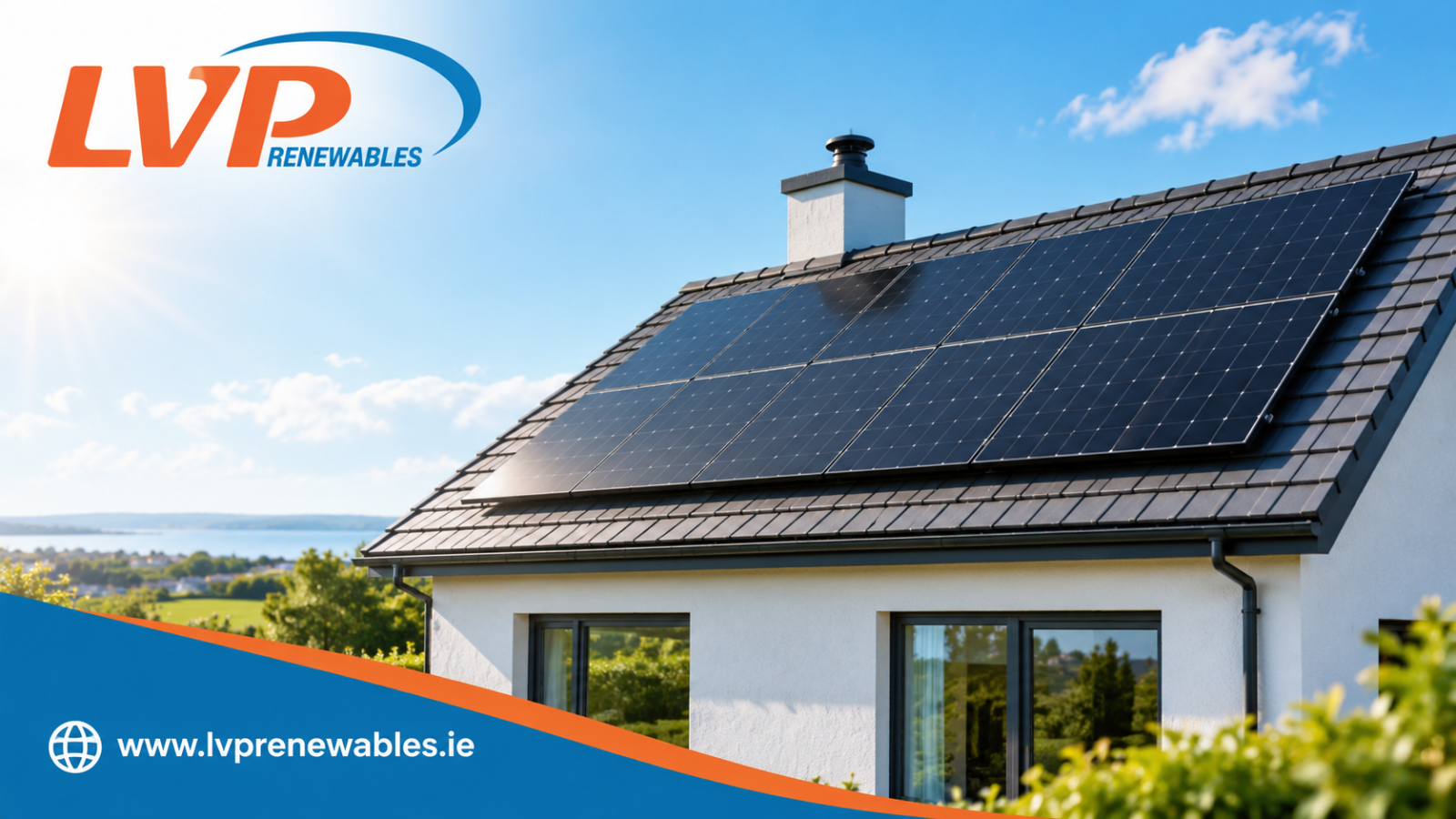
A simple layout might place the panels in two rows of seven on one roof face. Where the roof is interrupted by windows or chimneys, or has more than one suitable orientation, the installer may propose a split layout such as eight panels on one roof section and six on another. A split arrangement can fit the roof better, though different orientations may produce electricity at different times of day. The best arrangement depends on the property, not just the number of panels.

What is the 14 solar panels cost in Ireland?
People searching for “14 solar panels cost” should compare the full installed system, not only the modules. The inverter, mounting equipment, cabling, safety components, labour and commissioning all contribute. Roof type and access can affect scaffolding and installation time. A battery, hot-water diverter or EV charging equipment adds further cost and should be itemised separately.
As an indicative third-party Irish market benchmark, a guide lists a 14-panel system of about 6.2 kWp at €10,500–€11,500 before the SEAI grant. With the standard maximum solar PV grant of €1,800, that would be approximately €8,700–€9,700 after grant, if the home and installation are eligible. This is not an LVP Renewables quotation, and it may not match another installer’s equipment or scope. LVP’s pricing and consultation page provides its published package information and a way to request a property-specific price; it does not establish a fixed price for every 14-panel design.
When comparing a solar panel installation cost in Ireland, check that each quote states the panel and inverter models, system capacity, expected annual generation, electrical work, scaffolding, warranties, grant assumptions and any exclusions. Ask whether the price includes a battery or other equipment. A lower headline price may not include the same items as another quote.
Can you get an SEAI grant for 14 solar panels?
Under the current standard SEAI solar PV scheme, the grant is €700 per kWp for the first 2 kWp, followed by €200 for each additional kWp up to 4 kWp. The maximum standard solar PV grant is €1,800. Since all three 14-panel examples above exceed 4 kWp, they reach that cap only if the applicant and installation meet the scheme rules.
SEAI says the home must have an MPRN and must have been built and occupied before 2025. The grant is not available where previous solar PV funding was received at the same MPRN. The homeowner must receive grant approval before installation work starts and use an SEAI-registered solar PV company. Once approved, the scheme allows eight months to complete the works and submit the required documents.
Check the official SEAI solar PV grant page for current terms before applying. Grant amounts and conditions can change, and reaching the maximum system size does not mean every homeowner automatically qualifies. SEAI also lists a separate €600 battery grant for a qualifying 5 kWh battery; review that scheme’s terms if battery storage is part of the plan.
How much can you save with 14 solar panels?
Solar reduces the amount of electricity a household needs to buy when it uses solar generation directly. The more electricity used during daylight hours, the more of the system’s output may replace grid imports. Surplus electricity can be exported, with payment depending on the supplier and tariff. Standing charges remain payable, and export payments are not necessarily equal to the price paid for imported electricity.
Here is an illustrative calculation for a 6.16 kWp array producing 5,500 kWh per year:
•Used directly at home: 40%, or 2,200 kWh, valued at an assumed €0.35 per kWh of avoided imports = €770
•Exported to the grid: 60%, or 3,300 kWh, valued at an assumed €0.20 per kWh export payment = €660
•Illustrative annual financial benefit: €770 + €660 = €1,430
The example uses the 35c electricity price and 20c export payment shown in LVP’s published price-page assumptions, but a homeowner’s actual rates can differ. The 40% self-use share is an illustrative assumption, not a guaranteed outcome. It may be higher if people are home during the day or appliances are scheduled to run when panels are generating. It may be lower if most electricity is used after sunset. The SEAI calculator also considers location, roof direction, electricity price, system size and daytime occupancy when estimating savings.
A battery can store some surplus daytime generation for use later, but it adds upfront cost. Compare the extra cost with the value of the export payment you might otherwise receive. LVP has further information on battery storage for homeowners considering that option.
What is the payback period for 14 solar panels?
A simple payback estimate compares the net installation cost with annual financial benefits:
Net cost after grant ÷ estimated annual benefit = simple payback period
For illustration, use the midpoint of the market guide’s post-grant cost range, €9,200, and the savings example above, €1,430 a year. The calculation is €9,200 ÷ €1,430, or about 6.4 years. This is a simplified example, not a prediction for every household.
The actual solar panel savings and payback could be different. A higher installed price, low daytime use, shade or a lower export payment can lengthen the payback. A suitable roof, more self-consumption or higher avoided import costs may shorten it. Battery cost, financing charges, maintenance, future tariff changes and eventual inverter replacement also affect the return over the system’s life. Ask an installer to show the costs and energy-use assumptions behind its calculation.
Are 14 solar panels enough for your home?
Fourteen panels can be a good match for some three- or four-bedroom homes, but bedroom count is only a rough clue. Two homes of the same size can have very different electricity use. An electric vehicle, heat pump, electric cooking or a home office can increase demand; efficient appliances and a smaller household may reduce it.
Compare the system’s estimated annual generation with your own bills, while remembering that solar output and household use do not always occur at the same time. Also consider whether you expect to add an EV charger or heat pump. If so, discuss future electricity needs with the installer before choosing the system size. LVP’s pages on residential PV, battery storage and EV chargers offer further information about related equipment.
Should you install a battery with 14 solar panels?
Without a battery, the home uses solar electricity as it is generated and exports surplus. A battery stores some of that surplus so it can be used later, such as in the evening. This can increase self-consumption, especially if household demand is higher after sunset, but it does not create additional solar energy. Its value depends on the battery’s price and usable capacity, household routines, electricity tariffs and export payment.
A battery is not essential to install solar panels. Compare the price of the battery and inverter setup with the expected value of shifting electricity from export to later home use. Check its warranty and the grant terms as well. If you choose a qualifying battery, SEAI currently lists a separate €600 grant for a 5 kWh battery, subject to the applicable conditions.
FAQs
How much electricity do 14 solar panels produce in Ireland?
A suitable, relatively unshaded 14-panel array around 5.6–6.3 kWp may generate roughly 5,000–6,000 kWh per year. A 6.16 kWp example is estimated at about 5,500 kWh annually, but the actual roof and location change the result.
What is the 14 solar panels cost in Ireland?
A current third-party guide indicates €10,500–€11,500 before grant for a 14-panel system around 6.2 kWp, or €8,700–€9,700 after an assumed €1,800 grant. Treat this as an indicative market range, not an LVP Renewables quotation.
How much roof space is required for 14 solar panels?
Allow around 28–34 m² of panel surface as a preliminary guide, then have the installer check usable roof space, clearances, shade and layout. Module dimensions vary.
Are 14 solar panels enough for a family home?
They may suit a home with moderate or higher electricity use, but the right size depends on annual consumption, daytime use, roof suitability and future plans—not the number of bedrooms alone.
Can 14 solar panels reduce electricity bills during winter?
They can still generate electricity from daylight in winter, but shorter days, low sun and cloud generally mean less output than in summer. The system may reduce some grid imports, but it should not be expected to produce the same amount every day of the year.
Conclusion
A 14-panel solar PV system in Ireland may be rated around 5.6–6.3 kWp, occupy about 28–34 m² of panel surface and generate roughly 5,000–6,000 kWh per year on a suitable roof. For homeowners considering 14 solar panels in Ireland, the installed price, grant eligibility, savings and payback depend on the exact design, property and household electricity use. Use market prices and production forecasts as estimates, not guarantees.
Before choosing a system, compare the forecast with your electricity bills, check the roof’s usable space and confirm grant approval before work begins. For a tailored assessment or quotation, visit LVP Renewables or request a quote.